
The Sacramento City Unified School District is mired in a deep financial crisis, one that’s already led to layoffs, cuts to school programs and could lead to a loss of local decision-making. This story is part of a series where CapRadio journalists examined what’s at stake for students, families and district employees that we’ll roll out every Tuesday this month in the SacramenKnow newsletter.
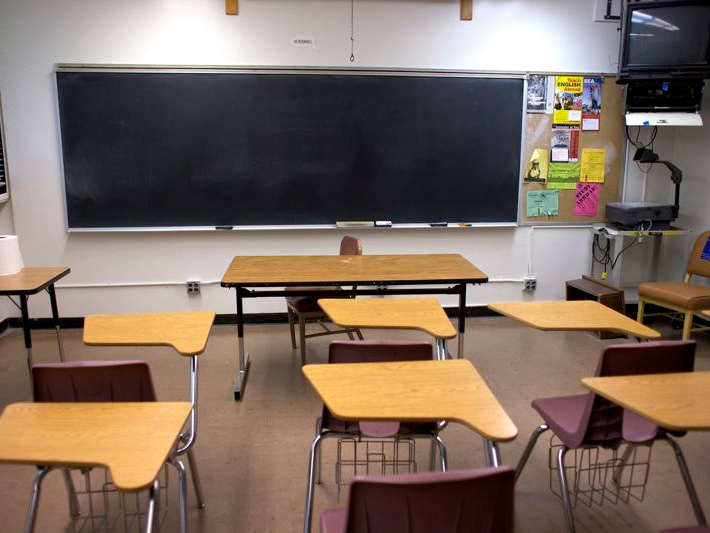
The Sacramento City Unified School District has room for about 54,000 students, but only teaches roughly 37,000.
Twenty-two of the district’s 72 schools are less than half full. Enrollment has fallen almost every year for two decades, and the district’s own forecasts show it falling further no matter which way the numbers break. “The models differ on pace,” Chris Ralston, the district’s assistant superintendent of facilities, told the board this spring, showing low, middle and high projections that all pointed down. “They do not differ on direction.”
The slow drain of students out of Sac City Unified has made the district’s already bleak budget picture worse. California pays districts largely by the student, so as Sac City’s enrollment falls, so does its share of state money. This summer, county education officials said the school district’s budget shortfall had grown to $227 million.
In response to the deficit, Sac City’s board has cut staff and school programs, though trustees said they’ve tried to keep cuts away from the classroom. The district’s financial crisis is deep enough that the district now faces the threat of state receivership, in which a county-appointed administrator would take over decisions the board and superintendent make now.
Perhaps most pressing for students and families in the district, the enrollment losses are pushing Sac City toward a decision it has spent a year trying to avoid: which schools to close.
Schools often serve as a source of neighborhood pride and a civic hub. Shutting them down, as the district did just over a decade ago, can cause community trauma and disproportionate impacts, especially when closures take place in already underserved neighborhoods. One district plan under consideration calls for closing as many as 20 campuses.
Given the scale of Sac City’s enrollment declines, it’s easy to miss one half-empty classroom at a time. “When people hear underutilization, they may imagine a few isolated sites,” Ralston told the board during a review of the district’s buildings. “What this actually shows is a systemwide pattern.” Enrollment peaked around 55,000 in 2001 and has dropped by about 20,000 since, roughly a third. Elementary schools have been hit hardest, down about 30% in a decade. Across the district, Sac City is filling a little over 68% of the seats it has.
As part of our series examining Sac City’s fiscal crisis, CapRadio sought to answer why enrollment has declined and how the steep drop has impacted the district.
Where did the students go?
“The birth trend is really what’s driving the statewide declines in enrollment,” said Alex Alvarado, a research analyst in the California Department of Finance’s demographic research unit, at a state summit on declining enrollment in October. Alvarado has produced the state’s K-12 projections since 2013, and said the trend runs well beyond California, “across the United States and in the world.”
California’s public schools have lost nearly half a million students over the past decade, down to about 5.7 million, and the department of finance expects them to lose about 700,000 more over the next 10 years. Declining births are the main reason: more than 500,000 a year a decade ago, under 400,000 now, with projections closer to 370,000. Tony Thurmond, California’s state superintendent, called it “the issue of our time.”
A common explanation for declining enrollment, that families are fleeing to private and home schooling, doesn’t hold up, said Julien Lafortune, a senior fellow at the Public Policy Institute of California. Private and home schooling jumped early in the pandemic, he told the summit, but much of that has faded. The smallest private schools, the ones that look like home schools, sit only modestly above where they were before 2020, and larger private schools have fallen back to their pre-pandemic size. Over the long run, Lafortune said, the losses are explained by births and by families moving out of California, not by students leaving the public system.
Sac City’s decline, though, is worse than the state’s, and it stands out for a specific reason. Over the past decade, Sacramento County was one of only 17 California counties where public school enrollment grew. The county added students. The district lost them.
Part of the gap is housing. “There’s not very many new homes that are being built in our area that would bring in new kids, probably with the exception of Delta Shores,” said Taylor Kayatta, a Sac City board member since 2022. The district is landlocked, and its neighborhoods were built out decades ago, filled with families whose children have grown. Ralston told the board that local births have fallen and that immigration, long a source of new families, has “come to a stop.” The district still enrolls about the same share of the school-age children who live inside its boundaries, he said. But there are fewer of those children than there used to be.
While competition from other schools is not the entire reason for the district’s predicament, it is part of it. Sac City is an open-enrollment district, meaning families can apply to send their children to almost any school in the district, not only the one they’re zoned for. Many use it to steer their kids toward the larger or higher-rated campuses, and some families leave the district entirely, for charters or the suburbs. Board member Jasjit Singh, who represents the area around Hiram Johnson High, told colleagues that families often write a school off before they ever walk in. Part of that is academic: Hiram Johnson offers only a few Advanced Placement classes, Singh said, so a family whose child wants a heavier course load looks elsewhere. Part of it is reputation. “Folks were like, ‘That’s not a school I’m going to. I’m not sending my kids there,’” he said of his door-knocking campaign to speak to parents.
Kayatta has also pointed to charter schools, which have pulled students from the district for years. That sets a trap for the district. Shutting a half-empty neighborhood school saves money, but an empty campus is an opening for a charter or private school to move in and compete for the students who remain, which is part of why past closures have sometimes deepened the district’s losses rather than easing them. Ralston’s answer, laid out in his facilities review, is blunt: tear the empty schools down. “Once it is fully vacated, the buildings would be removed. I will bulldoze them down,” he told the board. Leaving them standing, he said, just invites a competitor to set up shop and pull away the students the district has left.
Empty schools cost money
California is one of only six states that pay districts mainly for the students who show up each day rather than the ones enrolled. “When a student’s there, funding is provided for every day,” Thurmond said, making the case for switching to enrollment-based funding. “When a student’s not there, we lose funding.” A shrinking district tends to get hit twice, because enrollment decline usually comes with weaker daily attendance. The district loses money when a student leaves, and loses more when the students who stay miss school.
Costs, meanwhile, don’t fall as fast as enrollment does. “You can’t just keep the level of programs and staff if you don’t have the students to support it,” Kayatta said. A half-empty school still has a principal, an office and a building to heat, and with fewer students to carry those bills, each expense weighs more. That is what the 68% utilization figure really measures: money spent on space instead of students.
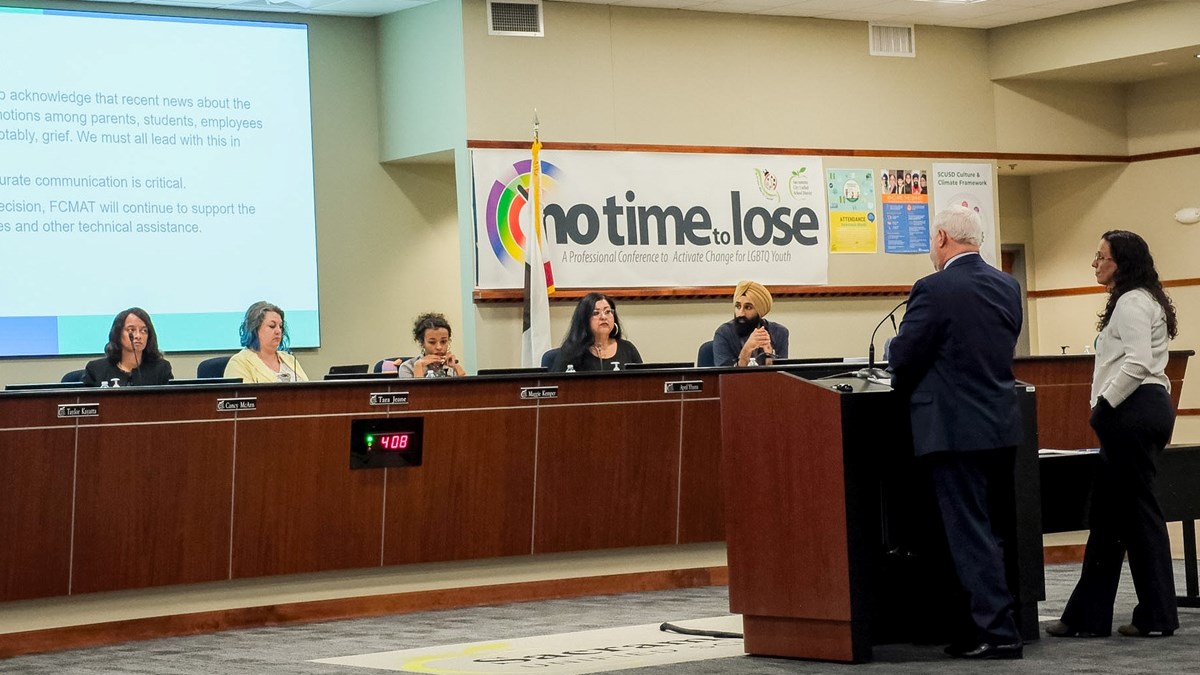 Michael Fine stands at a podium and gives a presentation to the Sacramento City Unified School District on May 7th, 2026.Ruth Finch/CapRadio
Statewide, a smaller student population isn’t necessarily a funding problem. California guarantees its public schools a set share of the state budget, an amount tied to the economy, not how many kids are enrolled. Spread that guaranteed money across fewer students, and the amount per student can even go up. The catch for Sac City is that each district is paid for the students it actually has. So the statewide gain only reaches a district that still has the students to collect it. Sac City keeps losing them, so its share keeps shrinking, while its half-empty buildings cost about the same to run.
Winning students back
Reversing the overall decline is mostly out of reach. The children aren’t being born, and even the state’s most optimistic projections never climb back to where enrollment was. “We know that we can’t just wait out declining enrollment,” Thurmond told the summit. “We need a long-term strategy.”
Districts are left fighting for a bigger share of a shrinking pool. San Diego Unified, which loses less than 1% of its enrollment a year, opened 52 neighborhood enrollment centers, ran a summer sign-up campaign that brought in about 3,000 students, and is building housing for its own employees and looking at offering free childcare. Vista Unified, in San Diego County, instead shrank on purpose, cutting from 31 schools to 27 as enrollment fell from about 28,000 to 17,300, but it turned closed campuses into community resource centers and says a larger share of local families now choose the district.
Sac City’s efforts are smaller, and aimed more at the money existing students bring in. Ralston told the board the district has found one encouraging trend. “We have been doing a better job retaining students year-over-year,” he said, meaning fewer kids leave midway through. The district also points families toward new and modernized campuses. But its most visible move this fall is about revenue, not enrollment.
At its October board meeting, Brian Heap, the district’s executive director of community engagement and communications, asked the public for a small favor: send your kids to school one more day. “Right or wrong, public schools are funded based on their average daily attendance,” Heap said. One extra day of attendance from every student, his team figured, is worth about $2.5 million. So the district is making a contest of it, called “One More Day,” with schools competing each month for a food-truck visit, a “mystery munchie” celebration, and an end-of-year drawing for a $250,000 campus-improvement grant. The targets: cut chronic absenteeism to 25% from 28.4% in the 2026-2027 school year, and lift daily attendance to just under 93% from 91.3%.
It didn’t sit well with everyone on the board. “I think we should move away from putting numbers on top of kids’ heads and saying we would get $70 to $75 if you come to school another day,” said student board member Owen Naqica, “because it kind of dehumanizes a lot of it.” The message, he worried, becomes “come to school so we can get money” instead of “come to school because we value and care about your education.”
The campaign also runs into the same budget crisis it’s meant to ease. Asked how the district actually reaches absent students, Heap’s colleague Miranda Bredeson described a “3-5-7” system: a phone call home after three absences, a call from a principal after five, a family meeting after seven. The most effective step, she said, is a home visit, a parent-teacher model Sac City helped pioneer and other districts copied. But the team that does it has been cut from nine people to three. The staff who used to knock on doors “aren’t quite as available now,” she said, so the district leans on social workers and principals instead.
The budget impact
Sac City has spent the past year under county oversight after it could no longer certify a balanced budget, and the state’s finance watchdog has warned it could run out of cash in 2027. Avoiding state receivership now colors nearly every decision the district makes.
At the October meeting, Ralston and Chief Business Officer Gerardo Castillo walked the board through the running numbers. The district has found just under $50 million in savings and would need about $17 million more every month to balance by spring. The cuts already reach into the everyday: district cell phones shut off, $3.8 million in after-school money moved to cover custodial costs, elementary sports stipends cut, and principals asked to give back 10% of their discretionary budgets. The board has been advised that if the gap isn’t closed, the district could lose control of its finances to a county-appointed administrator should the district elect to go into receivership, something board members have said is not an option.
The biggest lever is the one the district most wants to leave alone: closing schools. Ralston’s spring review mapped out consolidation scenarios, and the Sac City Teachers Association union said the plan could eventually close as many as 20 campuses. “The district remains in crisis,” union president Nikki Davis Milevsky told the board.
What makes that decision so difficult isn’t just which schools are emptiest. It’s which neighborhoods they’re in. When the district last closed schools, in 2012-13, the campuses that shut were concentrated in its lowest-income, heavily Black and brown neighborhoods, and board members have made clear they don’t want a repeat. Trustee April Ybarra lived it as a parent, watching what shutting Fruit Ridge Elementary did to the surrounding community, and she pointed to the wealthier side of her own neighborhood as a warning. “You will see a difference day and night,” she said. That history, as much as the dollars, is why the board keeps putting the closure question off.
The roughly $600 million facilities bond Ralston floated in the spring did not make the November ballot.
The only school measure in front of voters is Measure M, a $95 parcel tax for special education that needs a two-thirds supermajority on Nov. 3.
One more day
The students Heap’s campaign is counting on are the ones still enrolled, in a district with room for 17,000 more. The ones it lost didn’t leave the region. Sacramento County grew around the district as the district emptied. They moved to the suburbs, or to charters, or were never born into the city at all.
More attendance brings in money. It doesn’t bring students back, and Sac City, like most shrinking districts, is no longer counting on winning its enrollment back. What’s left to decide is which schools to keep and which to close. Ybarra, who lived through the last round, said the community already knows where things are going. “We’re not ignorant,” she said. “We understand deeply what’s happening.”
Additional reporting by Keyshawn Davis.