
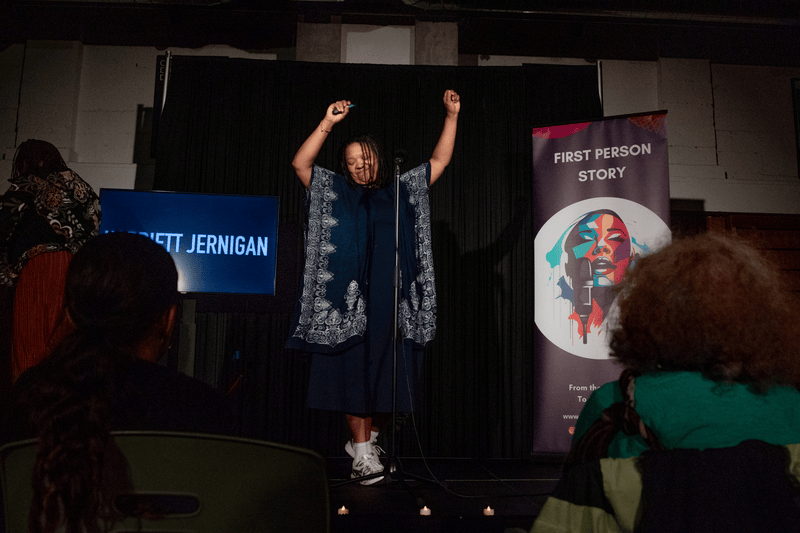
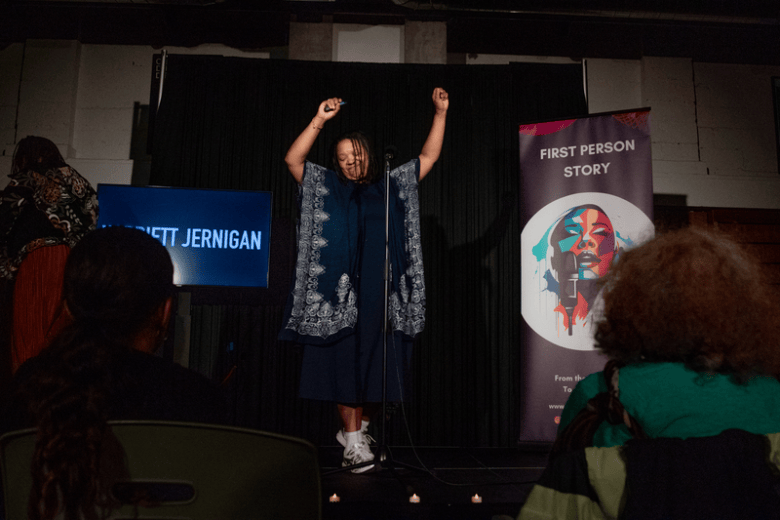
 Harriett Jernigan, founder and producer of First Person Story, performs on Oct. 9 at the West Berkeley Fencing Club, focusing her narration on her teenage years and an episode of self-discovery and desire. Credit: Ximena Natera for Berkeleyside
In the long, high-ceilinged room of the West Berkeley Fencing Club on Addison Street near San Pablo, a few helmets were the only bits of fencing gear in view as the house lights went down. The foils, épées and sabres had been safely stowed away. But that didn’t stop the participants in a popular Berkeley storytelling series from spilling their guts.
The pink-haired Kat Auterio revealed how she broke her leg in front of a hospital hours after her husband was admitted for a heart attack. As she was wheeled into his room, he asked, “Are you trying to steal my thunder?”
Katherine Rae Mondo shared how quickly she became addicted to ketamine after taking multiple doses at a San Francisco party. “Nothing is annoying,” she said, of the drug’s appeal, not even “that guy in the corner talking about the fact that he went to Burning Man 10 times.”
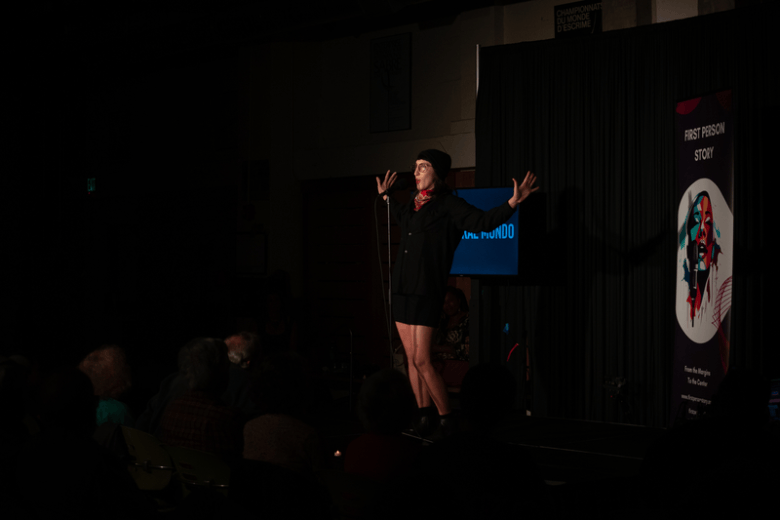 Katherine Rae Mondo sharing her story of a fateful night of partying that forced her to confront her coping mechanisms. Credit: Ximena Natera for Berkeleyside
Harriett Jernigan told the audience to “buckle up” for a story “a little bit on the racy side.” She revealed how she had planned to lose her virginity the night before she turned 20 to a notorious player in order to solve a conundrum that developed four years earlier: how to sleep with one of her best friends without ruining their friendship.
These are a sampling of the seven revelatory stories told on Oct. 9 at First Person Story’s All Star performance, showcasing the work of long-time participants in the 3-year-old workshop and storytelling series.
Of the many Bay Area live storytelling orgs, among them The Marsh and the Monkey House in Berkeley, First Person Story stands out. Founded by storytelling veteran Harriett Jernigan, it rejects the competitive story slam model and provides free workshops that promote the work of underrepresented storytellers: people of color, women, those living with disabilities and chronic illnesses, the LGBTQ+ community, low-income folks and seniors. “Our spirit is inclusive rather than competitive, and process- rather than product-oriented,” according to the website.
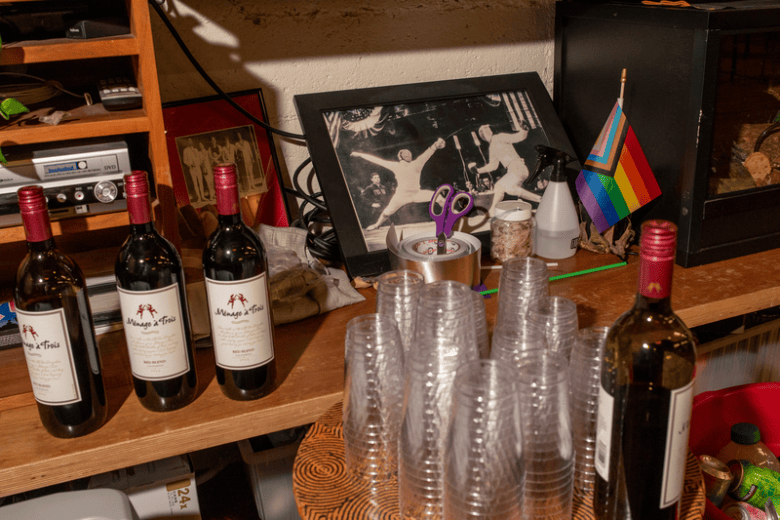 The foils, épées and sabres were safely stowed away in cabinets during the show, making room for wine. Credit: Ximena Natera for Berkeleyside
Before the show, Eva Schlesinger of Berkeley, who appeared in a First Person Story show two years ago, said, “What Harriett’s doing is unique. You get training. You have a cohort to work with. This format is helpful for people who want to tell a story but don’t know how.”
“They work on it. That helps anyone who is trying to get better,” said JP Frary, a semi-regular, before the show. He produces The Side Show twice a year in Alameda and is the resident storyteller at Redwood Nights in Fairfax. “It is obvious they do great work.”
Not like The Moth
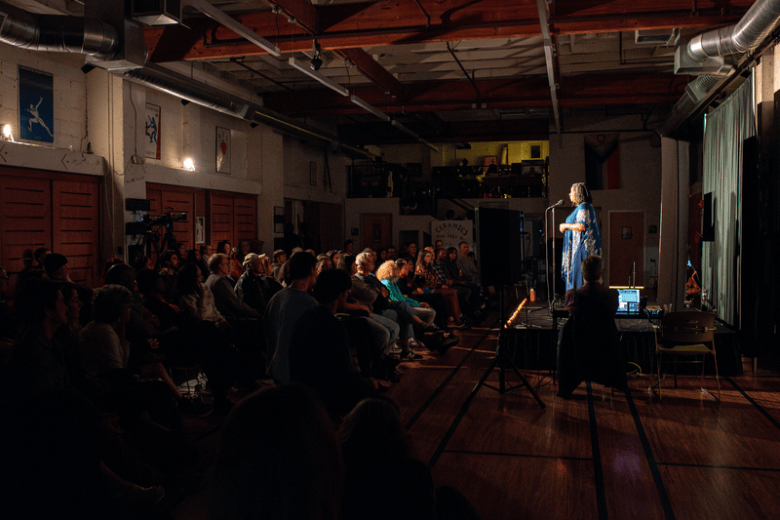 The fencing club is where Jernigan met her husband, Cole Harkness, who started out as her fencing coach in 2006. Credit: Ximena Natera for Berkeleyside
Jernigan was inspired to create the organization after having a revelation at The Moth, the competitive, 29-year-old global storytelling venue. The Moth selects regional GrandSLAM winners who then compete nationally, the reward being a chance to appear on National Public Radio’s The Moth Radio Hour.
“It’s not that I didn’t like The Moth,” Jernigan said. “But it has a very particular ecosystem.”
She explained her decision to create First Person Story by telling — what else? — a story.
About a year after she won The Moth’s Grand Slam in 2015, she began thinking about the competitive aspect of story slams and “how vexing the process can be: waiting to see if your name will be drawn out of the hat, prepping a story and rehearsing it while knowing it may never make it to the stage.”
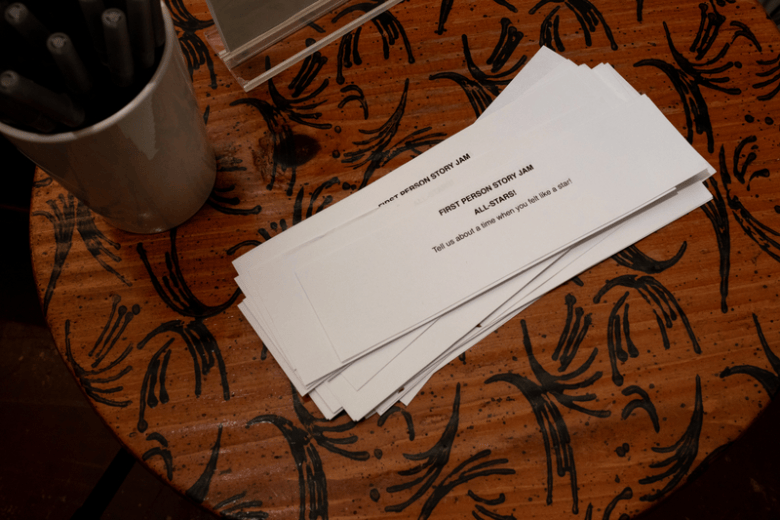 Sheets of paper with prompts invite audience members to share short personal stories. Credit: Ximena Natera for Berkeleyside
Years later, after the pandemic, she watched what appeared to be a terrified, first-time storyteller step onto the stage, ready to speak her truth, but not knowing there’d be a competition with audience judges. The woman began: “I was born and raised in The Way,’ a religious organization that’s considered a cult. Jernigan had read about the group and was eager to hear a first-person account. But the woman froze up and left the stage.
“We all lost out on a very valuable experience,” Jernigan said. “I started thinking, what if it’s not competitive? What if it’s a learning experience, that you’re not only telling this one story over time, but you’re willing to tell stories about whatever moves you and you’re giving the audience a gift.”
Another year of research and consultation took place before Jernigan started First Person Story in January 2023, with help from Nate Davis, FP’s web master, who has helped her frame the organization’s ethos and purpose. Davis and his wife, Laura Joyce Davis, who performed that night, run the website Narrative Podcasts, which offers coaching, courses and workshops in podcasting.
Eliminating the competitive nature of the slam changes the dynamic in a key way: The focus shifts from competition to the storyteller, to the craft and the community. As Jernigan described it, a competitive ecosystem also tends to reinforce the “white, cis-het” status quo that has dominated storytelling — and the culture in general.
“Instead of writing a piece that you’ve been processing in your head, you start writing a piece that will appeal to most of the audience. It also becomes very male,” she said. “Women often don’t feel as confident going up in front of people performing live on a whim in front of 200, 300, 400 strangers. We’ve been sort of conditioned not to talk about our feelings in public. We’ve been told men are funnier than women, even though that’s not true.”
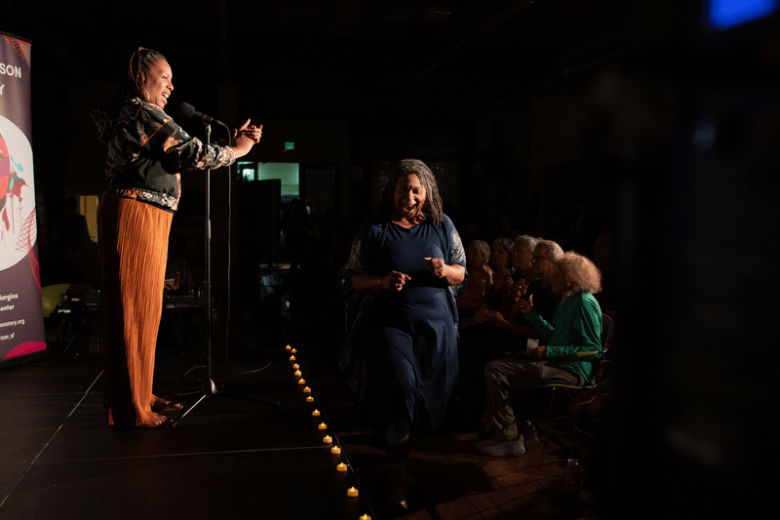 Story Jam host Dawn J. Fraser welcomes Jernigan to the stage. Credit: Ximena Natera for Berkeleyside
Especially for “minoritized people, there are so many silences, and as Audre Lorde says, ‘so many silences to be broken,’” Jernigan said. “As an under-represented person you’re either supposed to apologize for who you are or stand in the shadows or not say anything or not feel entitled.”
Everyone is entitled to speak their truth, she said. “But you need to create a space to do that.”
The physical space “to do that” turned out to be a place where Jernigan, a competitive fencer, spends a lot of time. The fencing club is where she met her husband, Cole Harkness, who started out as her fencing coach in 2006. The club already had benches lining the walls. Folding chairs formed rows in the open room. For Jernigan, the fencing club of all places was the perfect setting for a non-adversarial storytelling space.
“I find it homey, warm, comforting, full of life and diversity. It’s an intentionally inclusive club, which is a rarity,” she said. “So it seemed like a no-brainer to host it in a place that I love and that is committed to the same things I am.”
First Person Story’s $20 admission gets you a seat and also snacks like cheese-and-crackers and cookies, along with red wine and flavored seltzers. Jernigan, who loves hosting house parties, sees food as another vehicle for bringing people together. “I see this as a great opportunity to have a great party with a great community,” she said.
Creating a storytelling community
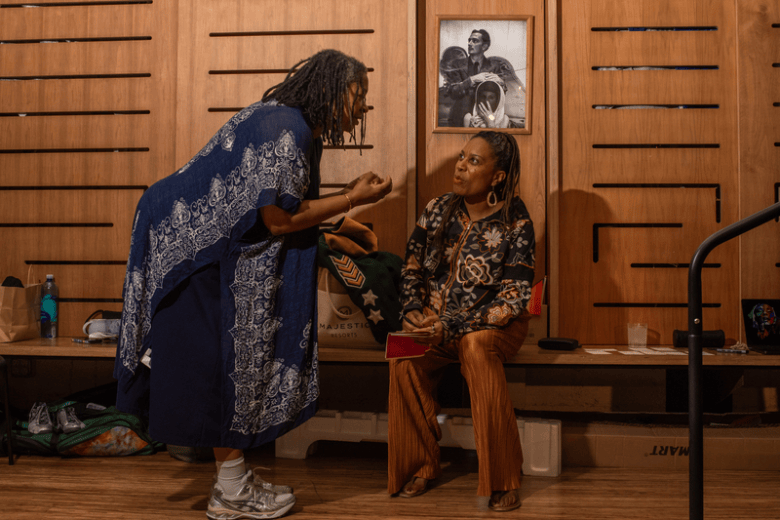 Jernigan, left, and Fraser chat before the show. Credit: Ximena Natera for Berkeleyside
Oral storytelling is an ancient tradition that predates the written word and crosses cultures. Story slams are a relatively new invention, the offshoot of poetry slams, which Mark Smith, a Chicago construction worker, started in 1986 as a response to the dry, academic-style readings that prevailed at the time.
In contrast, slams have a more raucous reputation with hosts like Dawn J. Fraser, First Person Story’s emcee that night, who goad and interact with the audience, making them part of the act.
“We want you all to be part of the fun,” Fraser said, after revving up the crowd to cheer louder — and louder.
Instead of introducing the storytellers by delivering pat bios from a script, Fraser worked spontaneously, asking both the storytellers and the audience to write down on slips of paper when in their lives they felt like an all-star.
She then used the performers’ responses to create her improvised intros, and read the audience responses aloud, tucking a few of the weirder ones into her blouse. When one audience member wrote down “farts,” Fraser quipped, “Clearly, someone who’s 12 years old.”
Scouting for talent
Jernigan brings a plethora of worldly experiences to her role, many of which have been mined as subject matter for her performances. She started writing poetry when she was 12 and began participating in poetry slams in college.
For the past seven years she has taught writing and rhetoric at Stanford University and German at the Bauhaus in Germany, where she has lived four times. She is a multiple Moth StorySLAM winner and a GrandSLAM finalist and collaborates with the Stanford Storytelling Project. She has also been a professional baker and a spontaneous backup singer.
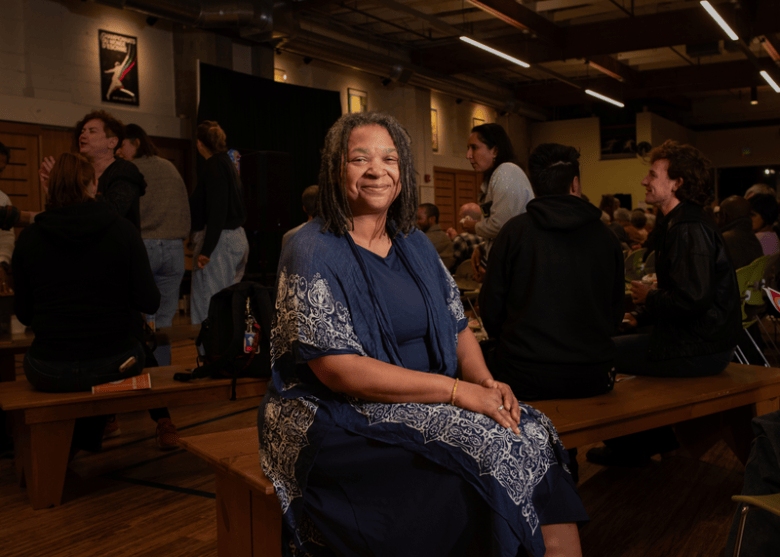 Jernigan sits for a photo before the show. Credit: Ximena Natera for Berkeleyside
She recently appeared in the storytelling show “Crushing” at San Francisco’s Strand Theater. She has performed on The Moth Radio Hour and, more locally, at venues like Naked Truth in Mill Valley, Redwood Nights in Bolinas and The Side Show at Radium Arts in Alameda.
Jernigan scouts for talent at the various Bay Area venues where she’s performed. She has found storytellers like Schlesinger and Serena Chang at The Moth.
First Person Story has four shows each season, in January, April, June and October. Cohorts are typically made up of five storytellers who hone their stories in workshops that last six to eight weeks. Such pieces are referred to as “true stories told live” rather than monologues because the latter, according to Jernigan, doesn’t have to have the traditional Western story arc, with a beginning, middle, end, rising action, falling action or transformation. Live stories, especially true stories, following that traditional arc, she said.
Participants attend the workshops for free and receive a $100 stipend for their efforts, using money raised from ticket sales. Jernigan would like to raise that figure once she begins more aggressive funding in season four.
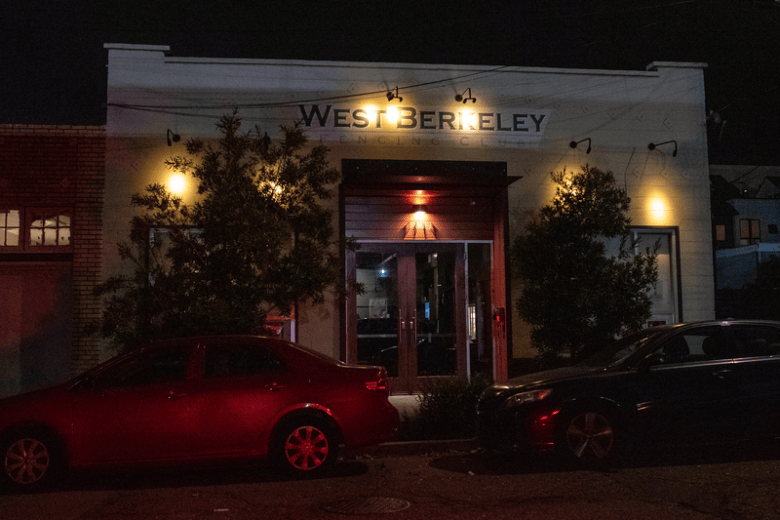 The West Berkeley Fencing Club on Addison Street. Credit: Ximena Natera for Berkeleyside
At the first in-person meeting, storytellers break bread to get to know each other and set up a WhatsApp for group communications. An audio draft is created, which is revised and shortened after rounds of feedback from the cohort to create “the best story possible,” Jernigan said.
Participants also have three consultations with the story coach, a seasoned storyteller from a previous group. Jernigan compared the process to a “sourdough starter” in baking.
“It’s one thing for me to say, ‘Don’t worry about it! We’ve got you.’ It’s another thing for a storyteller from another cohort to say it,” Jernigan said. “You want somebody who’s been through the process to reassure people and help lead the workshops.”
What Schlesinger appreciated about the workshopping was how suggestions were posed: as questions rather than prescriptive critiques. “They’ll say, ‘Would you be willing to …? How would you feel about …?’”
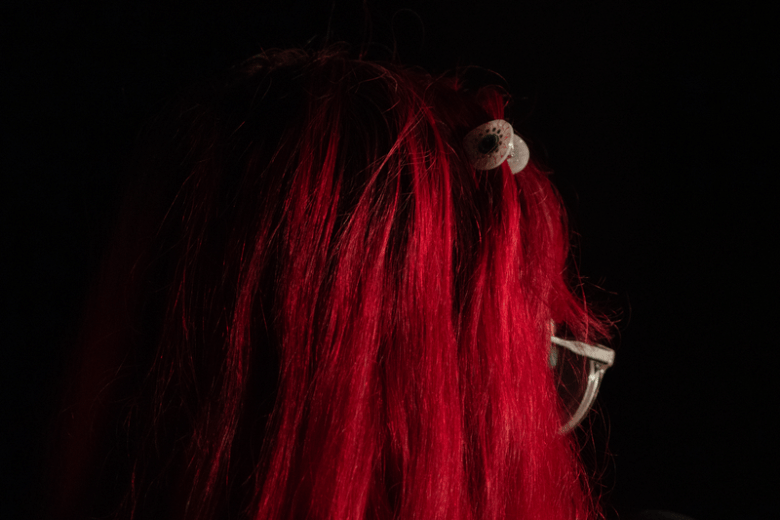 Kat Auterio performs on stage. Credit: Ximena Natera for Berkeleyside
Chang, whose background is in engineering, had never performed on a stage, nor received any structured feedback about her writing or known any writing principles before working with Jernigan. Chang learned that some sentences move the plot forward and that’s interrupted by reflection.
Jernigan “was the first person to name that for me,” said Chang, who also learned she was good at it. “She made me more aware of how I could hone that skill in future stories.”
After the dress rehearsal, participants are given an audio recording so they can continue to make improvements before the live show.
“Throughout this process, we are all talking on WhatsApp, sharing memes, finding common ground, asking questions, just enjoying ourselves and getting to know each other,” Jernigan said. “You might call it bonding.”
Mining one’s life for material
Many of the participants in the show are heavy-hitters in the Bay Area and national storytelling and stand-up community, with big-time creds.
Fraser, the evening’s host, is a storyteller, public speaker and a nationally acclaimed communications coach who created and hosted “Barbershop Stories,” featuring storytellers performing true tales in barbershops and salons around NYC. She’s a Lead Instructor with The Moth and was featured among some of the nation’s top change makers at TED@NYC.
Dhaya Lakshminarayanan, who also does standup, had her first comedy album debut at No. 2 on iTunes. She has appeared on NPR’s Snap Judgement and was crowned the grand prize winner of Comedy Central Asia’s Ultimate Comedy challenge.
In addition to her work at Narrative Podcasts, Laura Joyce Davis is the executive producer of Shelter in Place and a PodcastMagazine top influencer. Auterio is a Moth GrandSLAM Finalist and has told stories at Porchlight, RISK!, Bawdy Stories and Story Slam Oakland and Fireside.
Rotstein has been featured on RISK! and is a workshop facilitator for Capital Storytelling. Mondo is an audio engineer for NPR’s “This American Life.”
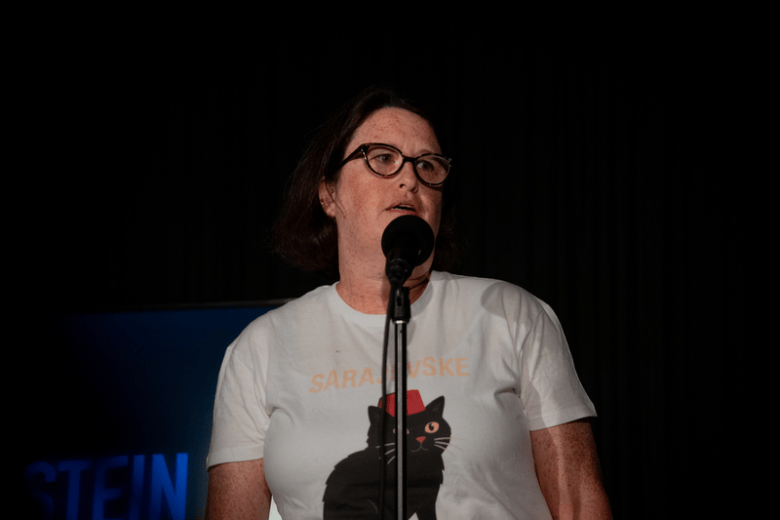 Abby Rotstein set her story in a hospital room, where a rotation of competent and caring nurses sparked a series of crushes. Credit: Ximena Natera for Berkeleyside
Not all come from the storytelling communities. Serena Chang’s day job is at Recidiviz in Oakland, where she partners with the government to reduce incarceration.
On the surface, what storytellers share is an unabashed ability to reveal the private details of their lives in the service of entertainment. But there’s more to it. As they work through the iterations of their stories, they search for deeper meaning — and sometimes learn more about themselves in the process.
“One of the things fundamental about good storytelling is digging and thinking, ‘What is the story about?’” Jernigan said. “We often think it’s about one thing, which is relatively superficial, but if you dig deeper you realize it’s about something else entirely.”
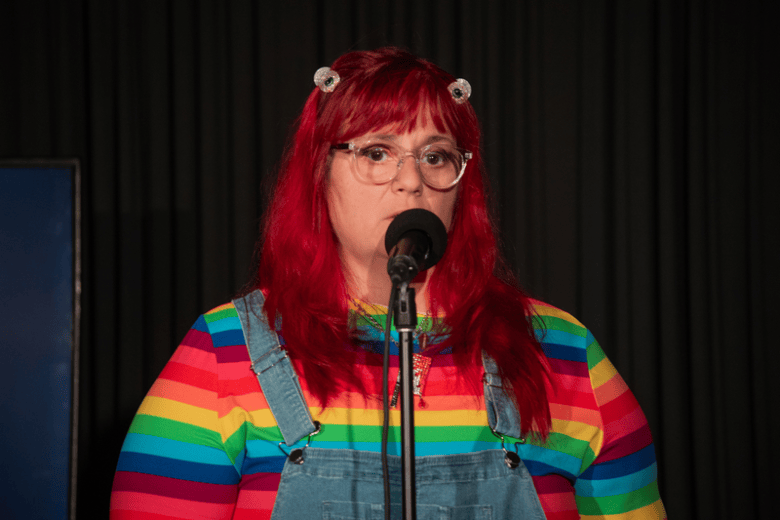 Auterio performed a piece about her experience in the emergency room, vampires and her emotional support dog, Lil D. Credit: Ximena Natera for Berkeleyside
At the All-Star event, Lakshminarayanan told of a recent trip to Madagascar with Matt, her longtime travel companion and unlikely friend, a white Southern Baptist man. “It’s not that my friends in San Francisco are judgmental,” she said, to audience laughter, “but their questions are.” After their bus got stuck in the mud, she feared that the locals would rob them, revealing how she, too, had to see beyond easy categorizations.
Davis described how she struggled to evict an Airbnb tenant who trashed her Oakland house during the pandemic — that after her husband lost his job and she and her family headed east after her mother-in-law promised to help homeschool Davis’ three children. The piece ultimately revealed the unwavering support of her neighbors through the nightmarish incident.
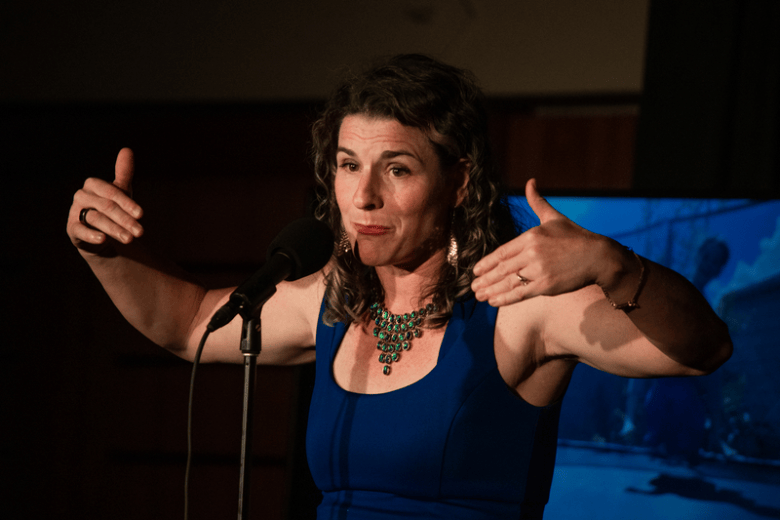 Laura Joyce Davis told the story of Airbnb guests from hell and the tragic loss of her inflatable playground donkey. Credit: Ximena Natera for Berkeleyside
Abby Rotstein described falling for several nurses — even the anesthesiologist — who cared for her when she got a colonoscopy. “It was really really nice to be seen and attended to and orbited around,” she said, in contrast to how her father, “a raging ball of chaos and anger” made her feel after he refused to drive her to a breast biopsy. When she told the audience she had gone “no contact with him — cause he’s dead” — they applauded.
Chang’s tale was about acceptance. She described the many bad haircuts she has received, first at the hands of her mother, then at Super Cuts, where she received a choppy style reminiscent of early Justin Bieber. During the pandemic, Chang had no choice but to have her mother become her stylist again, this time with the help of a YouTube video and electric shears. When it was over, her mother observed: “It’s right for you.”
For Chang, her growth as a storyteller parallels her identity as a lesbian. In the first story she ever told, she described how she and her brother came out to their grandmother at the same time — which won her the The Moth’s San Francisco Story Slam in 2023.
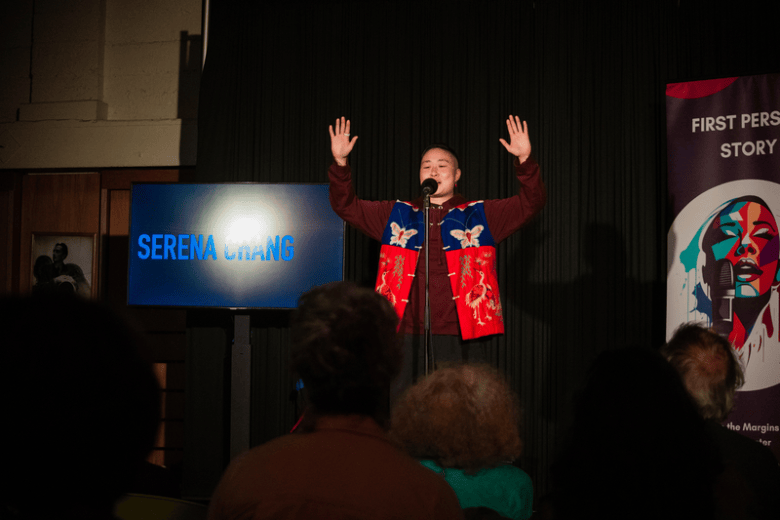 Serena Chang highlighted her decades-long search for an adequate haircut and the allies and enemies she made along the way. Credit: Ximena Natera for Berkeleyside
“Storytelling has helped me connect with different parts of my identity and upbringing,” Chang said. “The process of writing a story causes me to really reflect on the things that have happened in the past. In searching for what the moral of a story should be, it forces me to think about how I changed through certain events in my life. That’s taught me things like the importance of my mom’s affirmation or how grateful I am for being so connected to my brother.”
The process can be transformative.
“People find joy where they thought there’d been none. They learn to see life as bittersweet rather than bitter. They learn that no one is happy all the time, and that’s OK. They learn to turn their perfectionism down a notch or two. They finally have that conversation with that family member that they’ve always wanted to have but have been too afraid to initiate,” she said. “They come to new understandings about how they feel about their friends, family, jobs, values, their lives in general.”
The depth of the storytelling — and the vulnerabilities they exposed — was not lost on the audience.
“Getting up and sharing something so personal and incredible is so cool,” said Jana Flores of Oakland. “The stories are so good.”
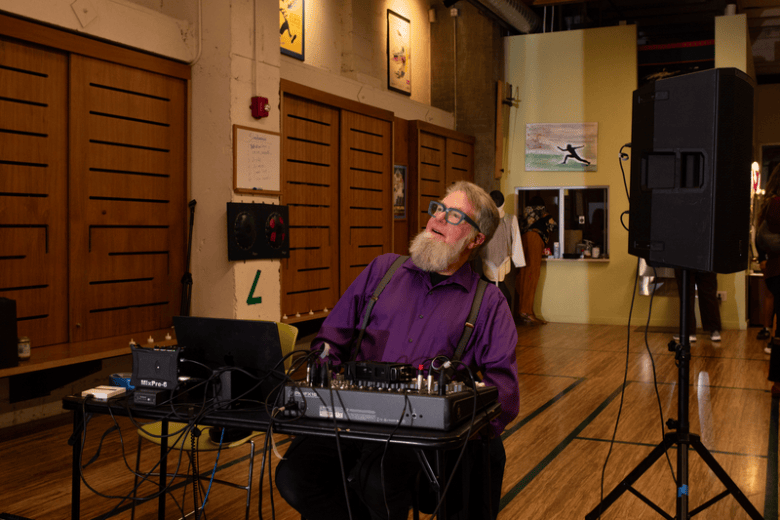 Jim Lively runs sound for the show. Credit: Ximena Natera for Berkeleyside
This was the second time Flores attended First Person Story with her 12-year-old daughter. During the last slam, they heard about someone who had a rat infestation in their apartment. Through such stories, her daughter can see how people solve problems.
“How do we make meaning from both the hard moments and the beautiful moments?” Flores said. “This is good for her to hear.”
Next up: a podcast and a production company?
In addition to increasing fundraising efforts in season four, First Person will be offering public workshops at around $200, Jernigan said, while continuing to provide scholarships for those who end up in the curated shows. She’s also begun to collect audio recordings for a potential podcast and in the future envisions a production company that “platforms” underrepresented people.
“We’ve been very slowly incrementally building so we maintain our sense of what’s important to us and build a quality product at all times,” Jernigan said.
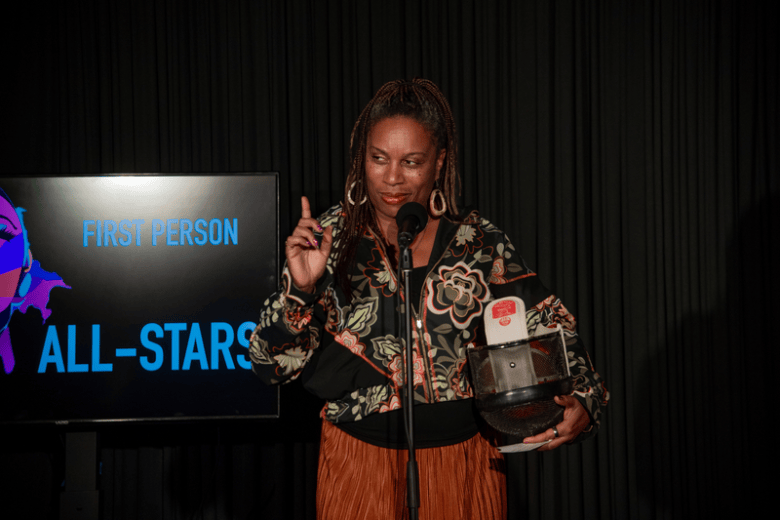 Fraser hosts the story jam. Credit: Ximena Natera for Berkeleyside
This month, Jernigan learned that First Person will be conducting a workshop on its inclusive storytelling method at SXSW EDU, the educational conference that precedes the South by Southwest festival. SXSW brings together technology, film & TV, music, education, culture and gaming. First Person was among 160 selected from 1,500 submissions.
As the evening wrapped up, Jernigan put out a call to the audience for those willing to remove the armor of daily life and expose their tender parts to the world.
“Who knows?” Jernigan said. “You might be next on the stage.”
Related stories
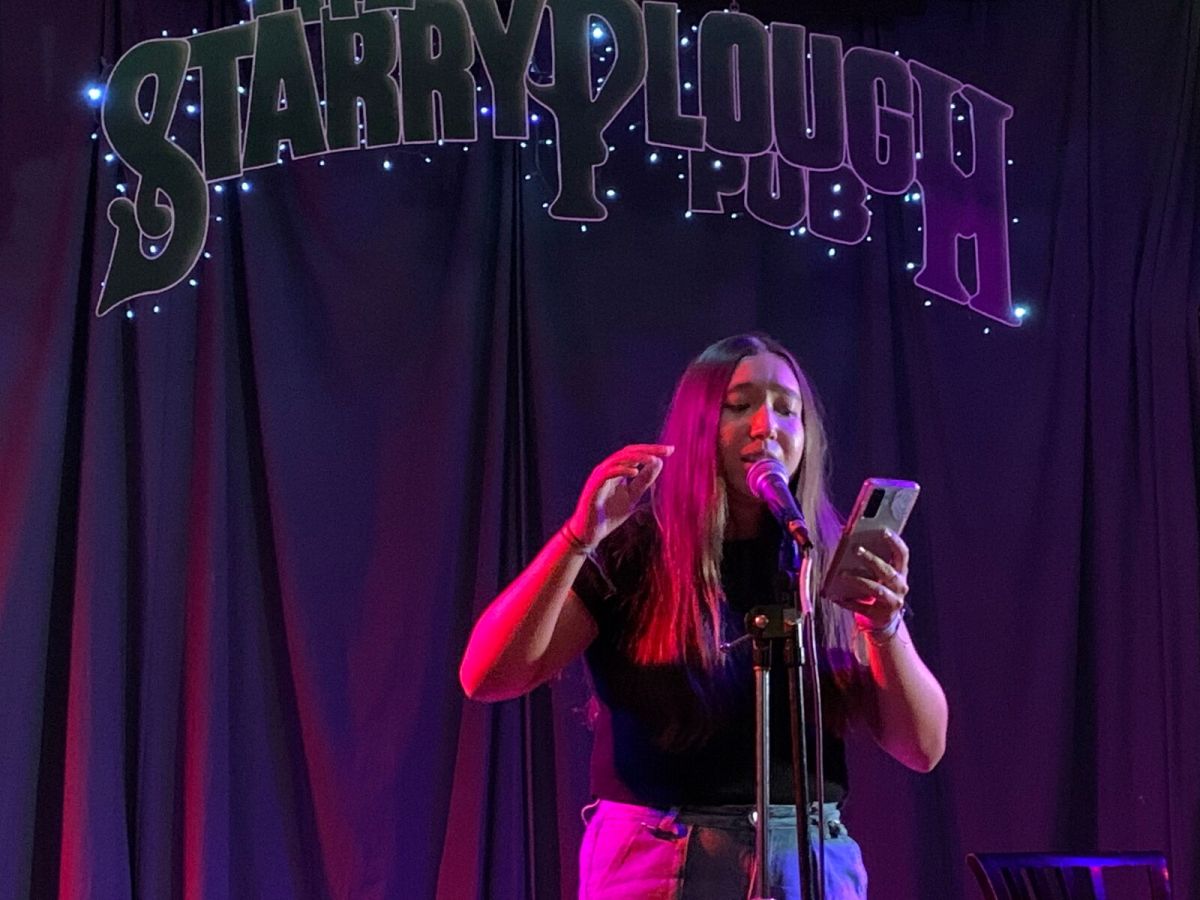
For 25 years, slam poets have bared their souls — and sometimes teeth — at Berkeley’s Starry Plough
October 30, 2023Oct. 30, 2023, 5:03 p.m.
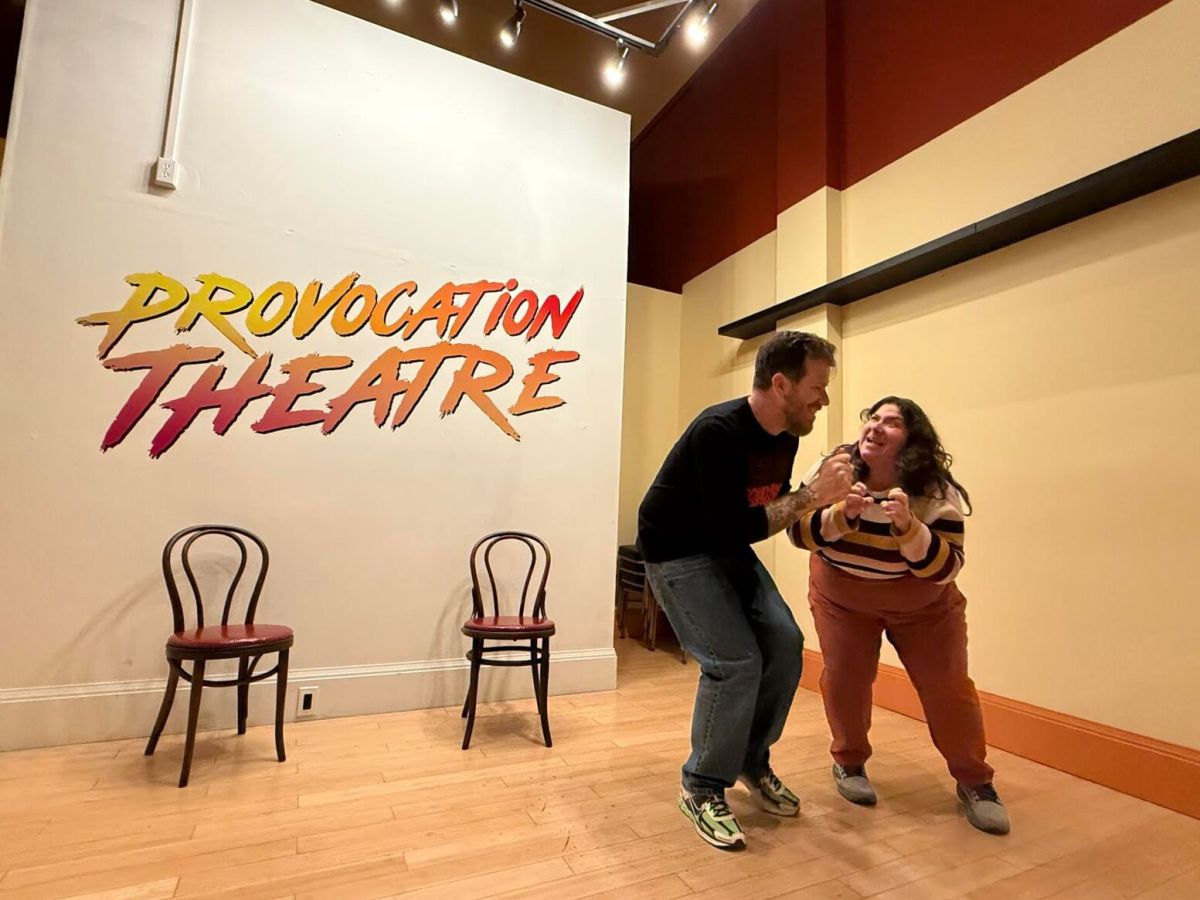
New improv comedy theater in downtown Berkeley aims to ‘cultivate queer joy’
July 20, 2026July 20, 2026, 2:26 p.m.
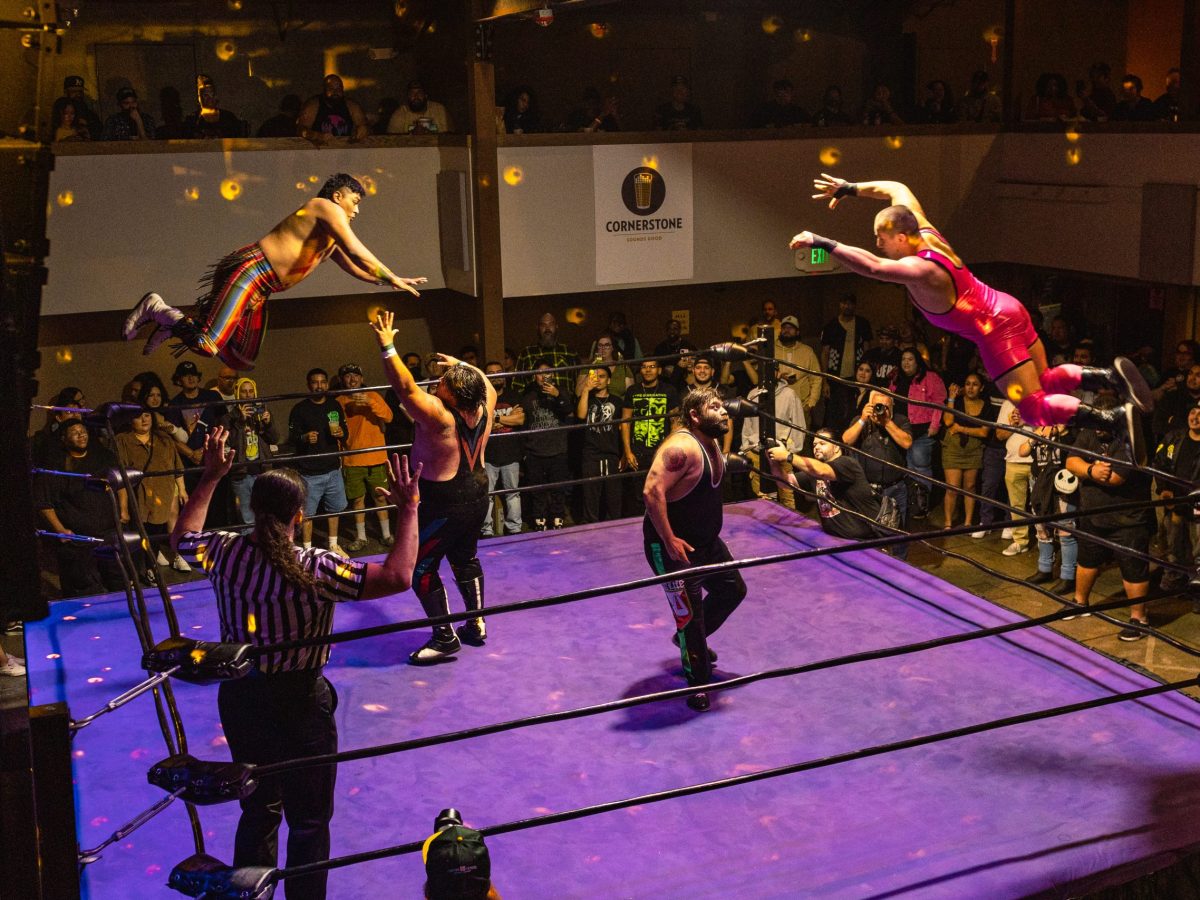
At Berkeley pro wrestling gym, all who love body slams are welcome
October 23, 2024Nov. 5, 2024, 1:46 p.m.
…We rely on your support
We know that most readers don’t get to the end of the article. But you did! To support our in-depth, rock-solid reporting, please consider making a donation to our nonprofit newsroom today. We rely on our readers — particularly the ones who read the whole story!
“*” indicates required fields