
Forty-six years.
That is how long Greg Meyer’s Detroit Marathon record stood. Forty-six years of races, thousands of runners and a record that no one could quite manage to break.
Then came Andrew Bowman.
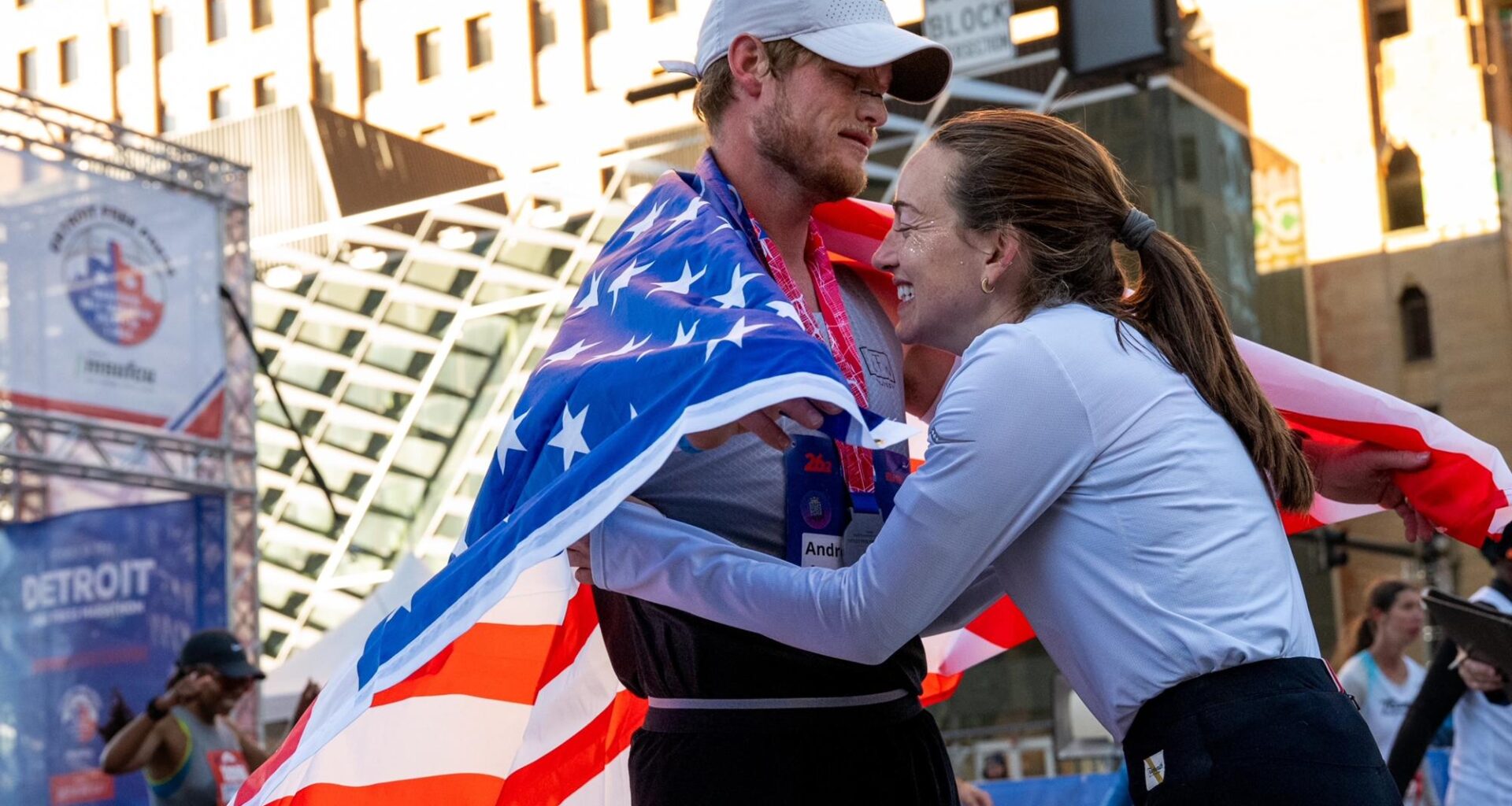
On Oct. 18, the former Oakland University runner crossed the finish line of the Detroit Free Press Marathon, presented by MSU Federal Credit Union (MSUFCU), in 2 hours, 12 minutes and 11 seconds, breaking the longstanding record by 56 seconds.
For Bowman, it was his third consecutive victory in the Detroit Free Press Marathon. But his journey to the finish line began long before he ever imagined running a marathon. In fact, there was a time when he wanted nothing to do with one.
Growing up, Bowman enjoyed soccer and wrestling more than running. Running was simply something he happened to be good at. It wasn’t until he and his twin brother, Jacob, had the opportunity to attend Oakland together that he began taking the sport more seriously.
Within his first year and a half at the university, however, something changed. He fell in love with running.
The brothers, who competed alongside each other throughout childhood and college, shared a relationship built on equal parts competition and camaraderie.
“It’s like you have a shadow with you everywhere you go,” Bowman said.
Though Bowman considered Jacob the more naturally talented runner, their competitiveness kept them both on their toes. By the time they attended Oakland, they had come to appreciate having each other as teammates.
“I had enough of that when I was in high school and college,” Bowman said jokingly about his competitive years. Yet he credits much of who he is today to having Jacob beside him.
But the road to success was anything but uninterrupted. Heading into his fourth year at Oakland, Bowman was coming off one of his strongest collegiate performances, narrowly missing qualification for a national competition. Then came an injury.
Compartment syndrome sidelined him for nearly a year, leaving his athletic ambitions uncertain. Surrounded by teammates continuing to compete, Bowman found himself unable to do the very thing he had grown to love.
“At that point I was left with my thoughts and trying to do some soul searching,” Bowman explained. “You gotta find out who you are, you know, outside of the sport and then why exactly it was important to you in the first place.”
What followed was a realization that would reshape his relationship with running. He realized that what mattered most wasn’t necessarily winning, but having the chance to see what he was capable of.
“The lows are really just lessons and times to grow,” he reflected. “And the highs are the celebration for all the months of unseen work that you do.”
That perspective followed him beyond his collegiate career, first as a graduate assistant with Oakland’s track and cross-country programs and later as a coach at Rochester Christian University.
Working with athletes facing their own challenges allowed him to revisit the lessons he learned during his time at Oakland. Despite everything he had accomplished as a runner, there was still one distance Bowman hadn’t given much thought to: 26.2 miles.
An All-American in the 3,000-meter steeplechase, Bowman had preferred shorter distances. Running 26.2 miles was never part of the plan. That changed with encouragement from his wife, Sydney, herself an accomplished distance runner.
“She started to get into my ear and was like, ‘You can be really good at this, let’s try this,’” Bowman recalled.
Years later, that encouragement helped bring him to a record that had stood since 1980. Unlike previous years, Bowman entered the 2026 Detroit Free Press Marathon with a specific goal he was willing to share: breaking Meyer’s record. He knew what it would mean to place his name alongside that of an Olympian. But accomplishing it would require more than physical preparation.
“You have to believe that that’s coming down and that’s a given,” Bowman explained. “You’re gonna go do it.”
His training had not changed dramatically. His confidence had. “More like the psychology changed rather than the physical side of it,” he noted.
Still, even confidence has its limits. In the final three miles, Bowman admitted he began to doubt whether the record was within reach. After months of preparation and miles spent chasing history, the outcome remained uncertain.
But he pressed forward. And when he crossed the finish line, nearly half a century of marathon history changed hands. Still, for Bowman, the most meaningful part of crossing a finish line isn’t always the time on the clock. Sometimes, it’s who is waiting on the other side.
Becoming a father has given Bowman a different perspective on competition. Whether a race ends in triumph or disappointment, his young son greets him just the same.
“My son kind of looks at me and he just doesn’t look at me any different,” Bowman shared. It’s a reminder that one race, however important, is only a moment in a much larger life.
Bowman also credits much of his success to Sydney, whose own competitive running has faced challenges following pregnancy and injury.
As he pursued his ambitions, she helped care for their son and made sacrifices to support his training. Bowman acknowledged that watching someone else pursue a shared passion from the sidelines is far from easy.
“My wife’s a rock,” he said.
He hopes to see her return to competing alongside him, just as they once shared the experience of racing in Detroit. For now, another challenge awaits.
Bowman’s record-breaking performance earned him a qualifying time for the 2028 U.S. Olympic Marathon Trials, where he hopes to finish among the top 15 to 20 runners. He knows the competition will be formidable. Some of the country’s fastest marathoners will be there, and Bowman has no illusions about the difficulty of keeping up with them. But then again, he never expected to be a marathoner in the first place.
“I didn’t think I was gonna be a national champion either, but that’s not why I do these things,” Bowman said. “I wanna see how well I can stack myself up against these people.”
He also hopes to bring a little recognition back to Michigan.
“Make sure that people know that there’s a corner in Michigan and it’s Detroit, where there are some good runners that can compete with the best of them,” Bowman said.
For 46 years, Detroit’s marathon record belonged to an Olympian.
Now it belongs to a former Golden Grizzly, who never planned on becoming a marathoner at all.