
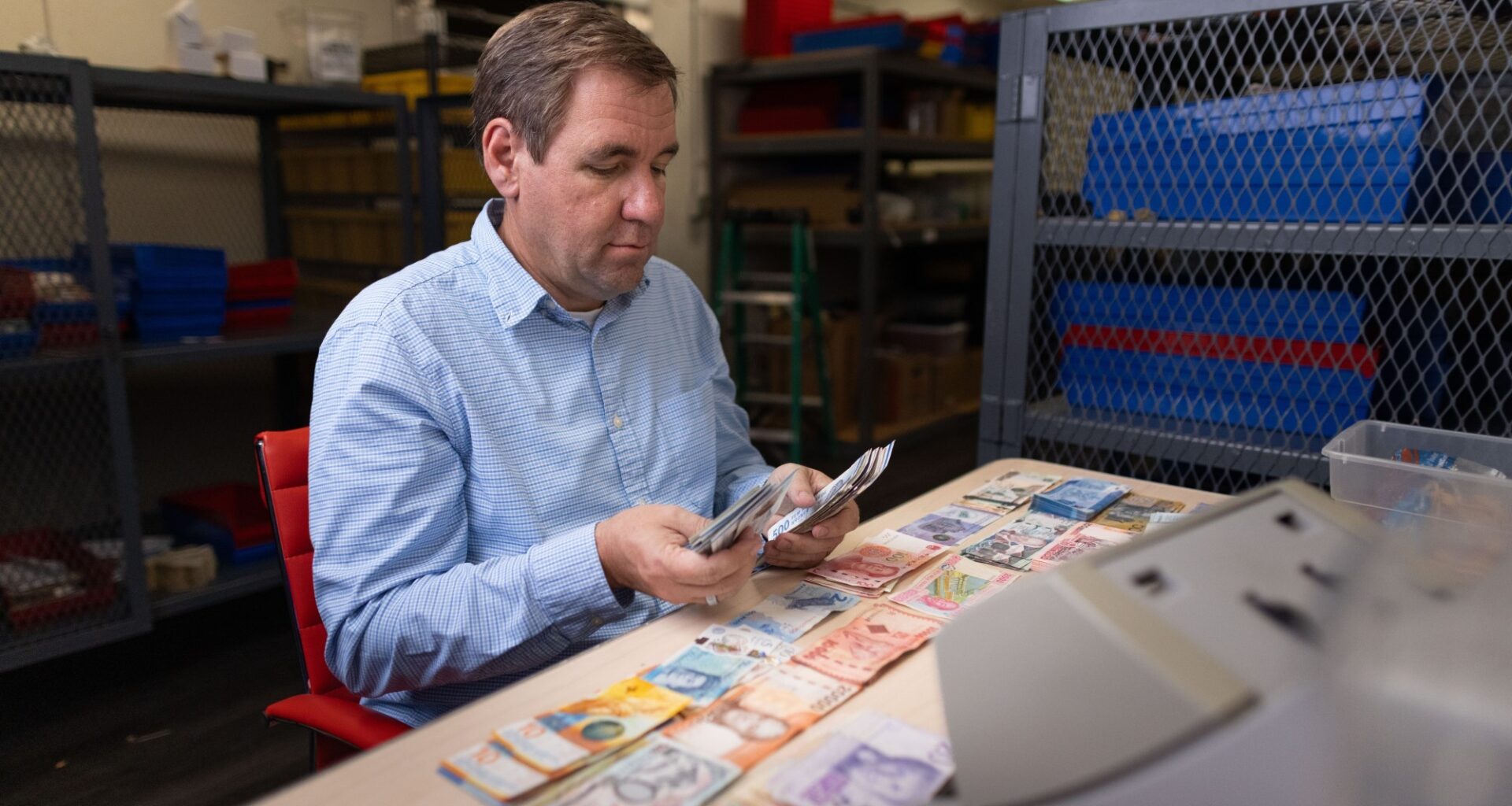
A private airplane was taxiing for takeoff last Halloween at Miami International Airport when at least four vehicles suddenly sped onto the runway and blocked its exit. U.S. Customs and Border Protection agents allegedly jumped out, boarded the aircraft, detained the pilot and seized more than $1 million in U.S. and Mexican currency.
The plane and the money belonged to a company called Global Coin Logistics, which specializes in buying bulk U.S. currency at a discount from Mexico and other foreign countries and bringing it back to the U.S. to sell at a profit to ATM operators and other companies in need of cash. Less than two months before the CBP seizure in Miami, agents from the U.S. Drug Enforcement Administration had seized $320,000 at the San Diego International Airport from a Global Coin Logistics courier.
The federal agents involved in both cases did not make any arrests, and neither seizure has yet resulted in criminal charges. But weeks after both seizures, Global Coin Logistics received administrative forfeiture notices from the DEA and CBP announcing that the agencies intended to keep the seized cash for themselves.
Administrative forfeiture is a process by which federal agencies can seize money and property from U.S. citizens and companies without ever filing a court case and without a judge or other neutral arbiter ever reviewing the probable cause.
On Monday, Global Coin Logistics and its owner, Steven Bailey, filed a pair of federal lawsuits in San Diego and Miami challenging the seizures as unconstitutional. The lawsuits argued that in the year since, the DEA and CBP have never given Bailey and his company any “specific legal or factual reasons” as to why they seized the money. And they alleged the forfeiture notices that the agencies did send only vaguely cited federal statutes that encompass hundreds of possible crimes.
Because the notices were vague and provided no specific facts or probable cause, they violated the due process clause of the Fifth Amendment, the lawsuits alleged.
A spokesperson for the DEA’s San Diego field office said the agency does not comment on pending litigation. CBP did not immediately respond Monday to a request for comment.
Bailey and his attorneys from Institute for Justice, a nonprofit law firm that advocates for stronger constitutional rights, argued that the DEA and CBP make hundreds, if not thousands, of similar seizures each year, each time allegedly citing the same dubiously vague statutes. To that end, they hope the twin lawsuits filed Monday in San Diego and Miami not only help Global Coin Logistics reclaim its seized money, but that rulings in the cases will set a precedent against such seizures and the vague notices that accompany them.
“What we want here is for a court to very clearly state that what CBP and DEA did to Steven and GCL is wrong, that it violates their constitutional rights, and that they can’t do that ever again going forward,” Robert Frommer, a senior attorney with Institute for Justice, told the Union-Tribune in a recent interview. “We are hopeful that a clear statement like that will cause the government to think twice before it tries to pull these shenanigans on anyone else.”
In the meantime, Bailey said the seizures have “destroyed about 75% of my business … (and) cost me an absolute fortune over the last year in lost revenues.”
Global Coin Logistics, founded in 2016, is registered with the Financial Crimes Enforcement Network, or FinCEN, and complies with all anti-money-laundering rules, according to the lawsuits. Bailey said his company moved between $6 million and $12 million of cash every week before the seizures. Now, he said his company typically moves between $500,000 and $1.5 million weekly.
“Obviously, given the circumstances, nobody in Mexico is comfortable shipping money to me, because everybody’s scared it’s going to get seized,” Bailey told the Union-Tribune. “The thing nobody can get past is that it can be seized without any true information about what we did wrong so we can fight it, and with no clear timeline for when it’ll be fixed.”
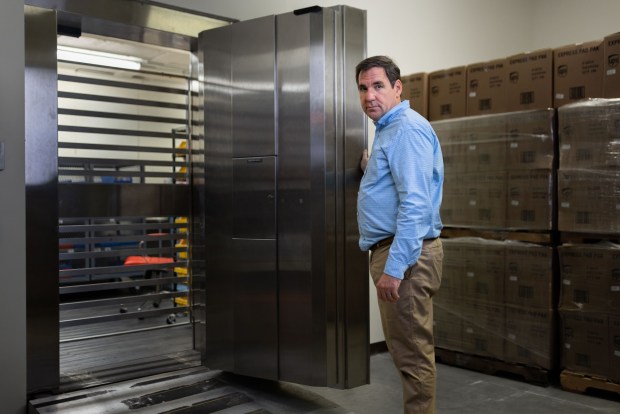 Steven Bailey, owner of Global Coin Logistics, stands at the entrance of one of his company’s vaults. (Courtesy of Institute for Justice)
Keith Neely, another of Bailey’s attorneys from Institute for Justice, told the Union-Tribune that both lawsuits boil down to one simple assertion: “That if the government wants to take and keep your property, it needs to tell you what you did wrong. And the problem here is that the government didn’t do that.”
According to the San Diego lawsuit, in early September 2025, a Global Coin Logistics courier imported a shipment of $1.2 million in U.S. cash from Tijuana to one of the company’s vaults in Southern California. The lawsuit alleged the courier declared the cash on three separate occasions — to Mexican customs officials in Tijuana, to CBP officers at the Calexico border and to U.S. customs officers at an inland checkpoint — and was cleared all three times with no issues.
A few days later, an East Coast ATM operator placed an order for $320,000 in $20 bills, and the same courier planned to transport the cash on a commercial flight from San Diego to Philadelphia in his carry-on luggage, a typical practice for the company’s couriers.
“GCL’s couriers provided security primarily through obscurity,” the lawsuit alleged. “They typically flew on ordinary commercial flights, sat among ordinary passengers, and passed through the same Transportation Security Administration checkpoints as everyone else. A courier who looks like any other business traveler draws none of the attention that an armored truck or a uniformed guard would.”
But on this occasion, a TSA agent in San Diego flagged the cash-filled luggage, and eventually DEA agents arrived and questioned the courier at length, according to the lawsuit. The courier allegedly showed the agents the documentation explaining the business and where the money had come from and was going to. Bailey also ended up on the phone with the agents, explaining his business and offering additional documentation for the cash.
“DEA agents showed no interest in GCL’s documentation for the currency,” the lawsuit alleged. “Instead, they took the currency to a separate room, out of (the courier’s) sight, where they claimed a drug-sniffing dog inspected and alerted to the currency.”
Bailey and his attorneys said any bulk amount of cash is likely to contain trace drug residue. “We know historically, you put enough cash in front of a dog, it’s going to smell something no matter what,” Bailey said. “So that’s not really a true indication that it’s tied to something (criminal).”
Just days after Bailey and his company received the notice alerting him that the DEA intended to seize the $320,000, CBP carried out the second seizure in Miami of more than $1 million.
Frommer and Neely suspect the two seizures were likely linked, given how closely they occurred to each other after nearly a decade of Global Coin Logistics operating without issue. But they said because the forfeiture notices contained no specific facts or allegations, it’s impossible at this point to know for sure.