
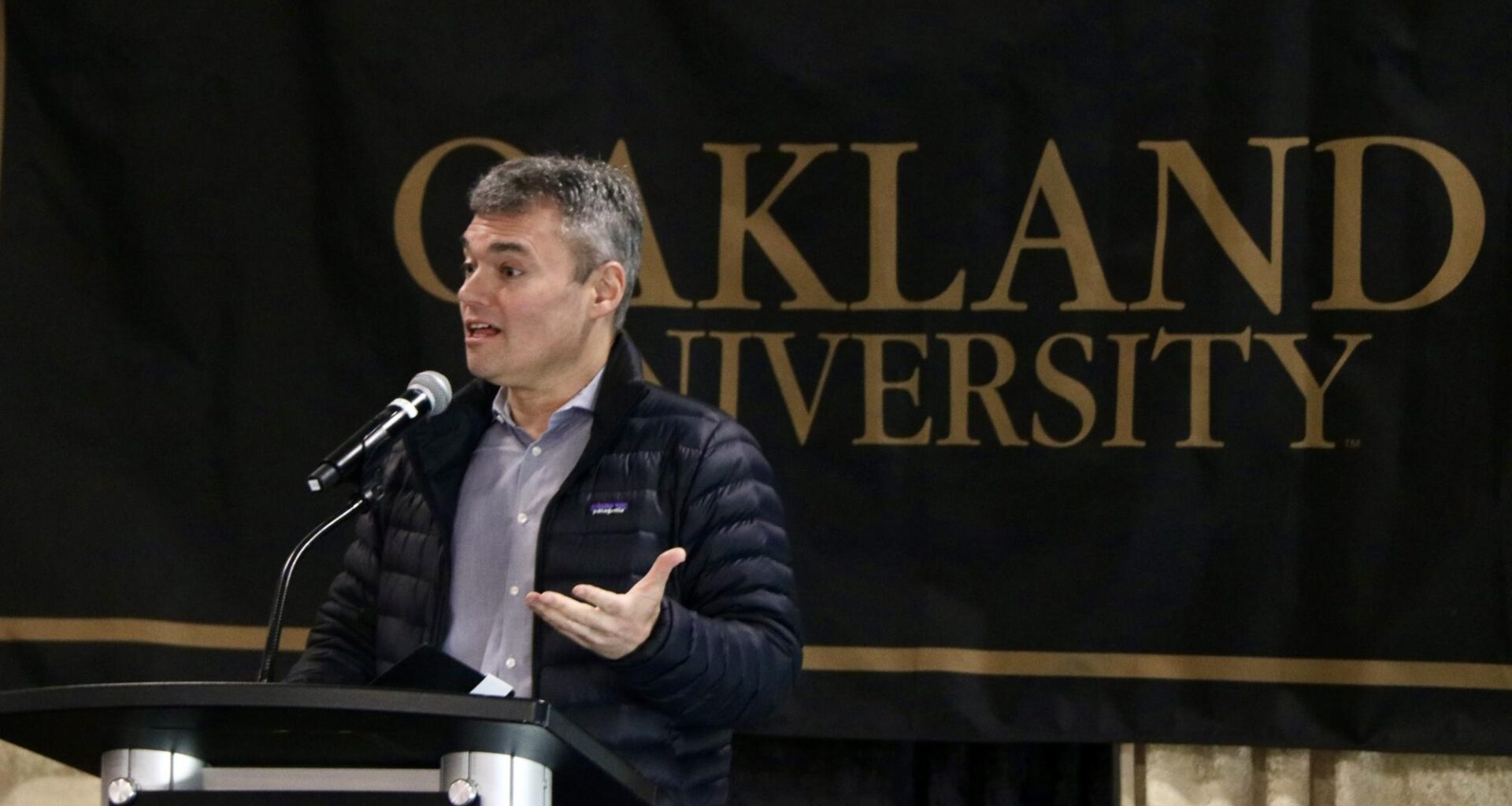
Peter Beinart, a Jewish American journalist, author, former editor of The New Republic and professor at the City University of New York, spoke about antisemitism, Islamophobia and American democracy at Oakland University (OU) on Tuesday, Oct. 20. The event took place from noon to 1:30 p.m. in Gold Rooms B and C of the Oakland Center.
Beinart addressed religious discrimination, voting rights and political equality ahead of the November midterm elections. Following the speech, audience members raised questions about democratic institutions, religious prejudice and the Israeli-Palestinian conflict.
An attendee asked about the role of universities and college students in protecting democratic institutions. Beinart described universities as places for challenging established ideas and questioning political systems.
“That’s what makes universities so precious,” Beinart said. “Because people are challenged to think about how the world could be different.”
Beinart expressed concern about government pressure on universities and restrictions on student activism, particularly surrounding criticism of Israeli government policies. Another audience member asked whether shared Judeo-Christian values could protect Jewish Americans from increasing antisemitism.
Beinart explained that the term can create divisions between religious communities by grouping Jews and Christians while excluding Muslims.
“I don’t like the phrase Judeo-Christian,” Beinart said.
Beinart referenced the 2018 Tree of Life synagogue shooting in Pittsburgh as an example of how hostility toward immigrants can intersect with antisemitism. A question about Israeli elections shifted the discussion toward Palestinian voting rights and disagreements within Israeli politics.
Beinart compared political inequality in Israel with racial segregation in American history, emphasizing differences in political representation and access to voting. The speech reflected themes from Beinart’s 2025 book “Being Jewish After the Destruction of Gaza: A Reckoning”, which examines Jewish identity, Israel and Palestinian rights.
Alan Epstein, a retired OU political science faculty member, concluded the session by asking whether democracy and Zionism are compatible. Epstein referenced a statement from University of Michigan Regent Mark Bernstein about choosing between commitments to democracy and Zionism in Michigan’s U.S. Senate race.
“Right now I think Jews face a grim choice in Michigan,” Bernstein told The New York Times. “We either compromise our commitment to democracy, or we compromise our commitment to Zionism.”
Epstein asked whether democracy and Zionism are fundamentally incompatible or can be resolved. Beinart explained that liberal democracy requires equal treatment under the law, regardless of religion or ethnicity.
“So I think there is a contradiction between the idea of a Jewish state and a liberal democracy,” Beinart said.
Beinart distinguished cultural Zionism from political systems granting different legal rights based on religious or ethnic identity. OU students shared perspectives on the discussion and the upcoming election.
Cullen Black, president of OU student congress, shared personal views on Beinart’s speech about the importance of independent thought on college campuses.
“If we as a society normalized the perception of one religious group as an innately anti-American threat, that doesn’t simply polarize and divide us; it opens the door for other minorities to be demonized in exactly the same way,” Black said.
Black connected the discussion to the importance of maintaining an inclusive campus environment.
“OU students of all religious backgrounds have a right not to feel threatened, and they have an obligation to respect the backgrounds and beliefs of their peers,” Black said.
Samara Nkwantabisah, an OU sophomore majoring in political science, attended for extra credit and reflected on voting for the first time.
“It’s my first time voting,” Nkwantabisah said. “And I think it just gives people more insight and information about who they’re planning to vote for.”
Heather McGarity, an OU junior majoring in political science with a minor in deaf studies, attended to hear different perspectives on the election.
“It’s obviously a hot election. It’s very important. It’s a critical time in history,” McGarity said. “I think this is going to be in my children’s history books someday.”
McGarity expressed optimism about the upcoming election. “I am very optimistic,” McGarity said.
Isaiah Howell, a senior OU student majoring in criminal justice and minoring in sociology, emphasized the importance of learning about social issues.
“In today’s time, I personally believe that it is important for students like me to stay educated on important social topics,” Howell said. “The part of Beinart’s speech that still echoes in my mind is Beinart’s use of historical comparison between Israel and the United States.”
Howell connected the comparison to Oakland University’s land acknowledgement, highlighting the importance of understanding historical injustices. Beinart expanded on the comparison by describing the displacement of Native Americans during the 19th century.
“Think about what happened in this country in the 19th century,” Beinart said. “Native Americans were forced off of their lands, violently forced off of their lands, pushed into smaller and smaller enclaves.”
The comparison reflected central themes of Beinart’s speech: the importance of religious discrimination, historical injustices and the importance of equal rights in a democracy.
Additional reporting for this article was contributed by Aaron Griggs.