
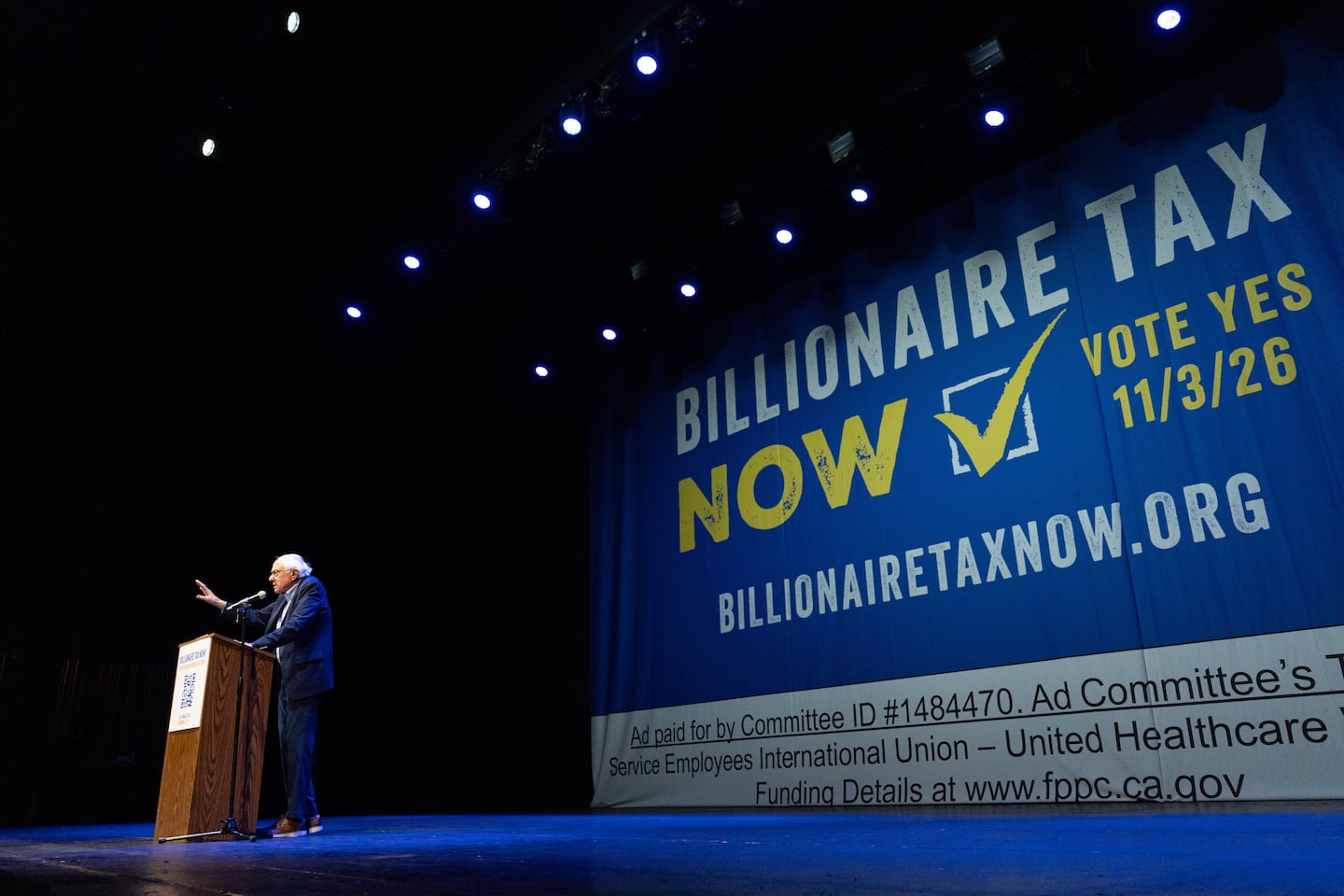
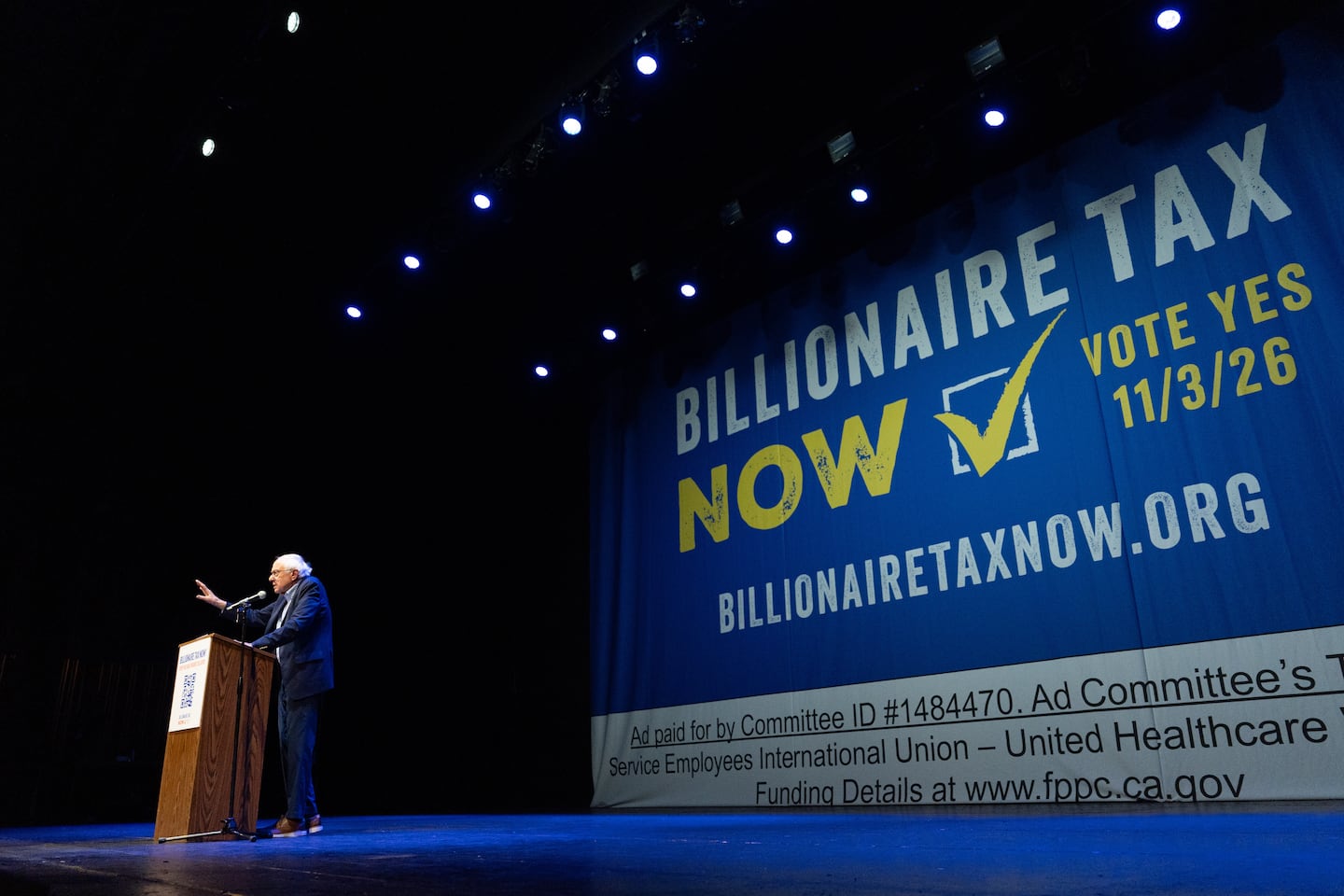
 Senator Bernie Sanders addressed a crowd at a campaign event for a proposed billionaires tax, in Los Angeles.Jae C. Hong/Associated Press
To tax or not to tax the billionaires, that’s the ballot question before Californian voters on Nov. 3. And it’s got the whole country watching, including union and business leaders here in Massachusetts.
Taxing the accumulated wealth of billionaires, not just their annual income, has become a seismic political fight that makes our millionaires’ tax battle feel like chump change.
If passed, Proposition 40 would impose a one-time tax of up to 5 percent on taxpayers with assets valued over $1 billion, including stock, art, and intellectual property but not real estate or retirement funds. That would hit about 250 people, many of whom top the Forbes richest list, including tech tycoons Meta founder Mark Zuckerberg ($216.6 billion) and Nvidia cofounder Jensen Huang ($187.2 billion).
A wealth tax has been bandied about for years — Senator Elizabeth Warren pushed a federal one during her 2020 presidential run — because many believe the richest Americans don’t pay their fair share with a tax structure focused on income.
But with President Trump’s “One Big Beautiful Bill” making historic cuts to safety-net programs, the time seemed right to bring a billionaire tax to the ballot. Led by health care justice union SEIU-UHW, the measure could raise enough to offset the $100 billion in federal Medicaid funding California is expected to lose over the next five years.
Still a tax on the rich, even amid growing wealth disparities, hasn’t been a political slam dunk.
Unions are split on the issue, and Democrats are also divided: Vermont Senator Bernie Sanders is crisscrossing the Golden State for Prop. 40, while Governor Gavin Newsom is against it. He supports a national wealth tax. Sanders and California Representative Ro Khanna filed a bill in March calling for a 5 percent annual wealth tax on America’s estimated 938 billionaires.
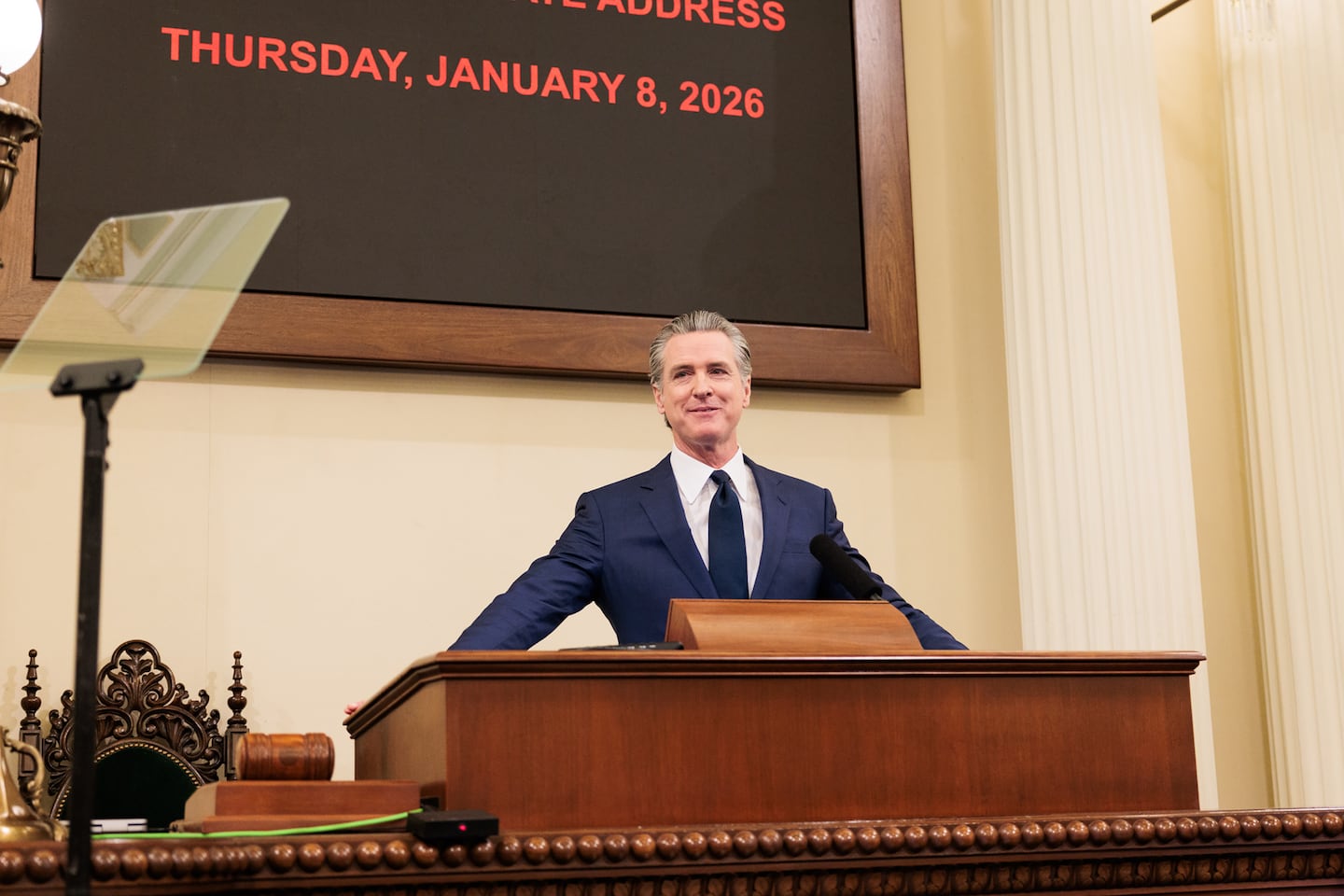 California Governor Gavin Newsom has opposed the state’s proposed billionaire tax.MAX WHITTAKER/NYT
Many polls give a slight edge to the billionaires tax passing, but it feels too close to call. One reason: The ultrawealthy have spent more than $350 million to defeat Prop. 40, while supporters have raised more than $34 million.
Win or lose, the proposal has caught the attention of Massachusetts union leaders and advisers behind the successful 2022 ballot campaign that created the millionaires tax, a 4 percent surtax on incomes over $1 million.
“It’s great that California is trying this new ballot question to make sure that billionaires are paying their fair share,” said Jessica Tang, president of AFT Massachusetts, a statewide union that represents educators, librarians, and other workers. “We should look into it.”
The millionaires tax has been a boon to the state’s coffers, generating more than $10 billion that can be spent only on education and transportation. But like other states, Massachusetts is scrambling to figure out how to make up for federal health care funding losses from Trump’s big bill, which will ultimately total about $4 billion a year, or 20 percent of the state’s annual MassHealth budget, according to the Massachusetts Taxpayers Foundation.
But the thought of another tax on the super rich doesn’t sit well with business groups, including the taxpayers foundation, which tried to defeat the millionaires tax. They claim high earners are already uprooting in droves to no-income-tax states like New Hampshire and Florida. And just the prospect of a billionaires tax has apparently sent California’s two wealthiest residents packing: Google cofounders Larry Page ($262.2 billion) to Florida and Sergey Brin ($240.5 billion) to Nevada, according to Forbes.
Business groups fear other knock-on effects: Founders won’t want to start their blockbuster companies here, to avoid hefty taxes. Cue the “Taxachusetts” chants.
“It would send another troubling sign to business owners, to investors that Massachusetts is becoming an even more expensive and unpredictable place to do business and to accumulate wealth,” said Jay Ash, chief executive of the Massachusetts Competitive Partnership. “It’s just not about losing wealthy residents. It’s about losing the economic activity that they generate.”
My prediction: This is the opening salvo in a new war on the wealthy. It’s hard to see a billionaire tax being proposed in Massachusetts, largely because the state lacks California’s critical mass of jet-setting, private island buyers. But that won’t stop progressives from going after anyone who has accumulated more money than they could spend in a lifetime and would barely feel the pinch of paying millions of dollars more.
Phineas Baxandall, research director of the Massachusetts Budget and Policy Center, which provided analysis for the millionaires tax campaign, puts it this way: “There’s nothing magical about the number 1 billion … maybe the cutoff is 100 million.”
Should Massachusetts explore another tax on the wealthy? Take our poll.
AN ENTHUSIASTIC TECH LEADER
After stepping down from the CEO role at marketing tech firm BlueConic in early 2025, Cory Munchbach says she has waited for 18 months or so before taking on a new full-time job because she wanted to find the perfect fit. Well, now she’s found it — or maybe it found her? Today, the Massachusetts Technology Leadership Council, one of the state’s main high-tech trade groups, announced it picked Munchbach to be its next chief executive. Munchbach is taking over for Sara Fraim, who is stepping down after four years in the position, and will lead a six-person staff. MTLC board co-chair Sam King says she ran into Munchbach at a Civic Action Project event in May and sent her the job description. Co-chair Mark Lorion says the board considered many candidates, but Munchbach stood out. Her enthusiasm is infectious, Lorion says, and, “We all feel like we learned something every time we spent with Cory.”
 The Somerville Theatre.Barry Chin/Globe Staff
That Hollywood happy ending for the Somerville Theatre might not have happened if seller Richard Fraiman opted to go with the highest bidder for the property. Last week, theater operator CSB Theatres, led by theater manager Ian Judge, announced it had acquired the nearly 50,000-square-foot building in Somerville’s Davis Square for $12 million. But the lead broker, Hunneman executive vice president Carl Christie, says Fraiman received numerous offers, including three serious contenders. One was higher than CSB’s. (Christie declined to disclose the details.) Hunneman made a concerted push to find buyers, in part to help figure out the unusual property’s fair market value. “Ian Judge has worked with the ownership for decades, and my client Richard Fraiman really believes that the Somerville Theatre should remain a key asset in Davis Square,” Christie says. “The only way to really assure that was to make a deal with the current tenant.”
 NBC10 Boston anchor Glenn Jones, along with 826 Boston students Liliana and Jae, participated in a panel discussion with podcast host and tech journalist Kara Swisher at a fund-raiser at City Winery.Mike Mejia
How is it that 826 Boston snagged podcaster Kara Swisher for its biggest annual fund-raiser? It all started in the spring when alert staffers Jenna Leschuk and Charlie McEnerney noticed a donation from the Washington tech journalist. They both thought: “How many Kara Swishers can there be?” Turns out Swisher’s mother-in-law, Ann Katz, has been volunteering at the Boston nonprofit, which provides free tutoring to students. 826 Boston went in for the bigger ask to have Swisher headline the nonprofit’s “Night of 1,000 Stories” event at City Winery. Last year, 826 Boston generated headlines for walking away from a $250,000 federal grant rather than renouncing its commitment to diversity, equity, and inclusion. 826 Boston, which held its fund-raiser last Thursday, is still $20,000 shy of meeting its $275,000 fund-raising goal. A $500 donation gets you a signed copy of Swisher’s memoir, “Burn Book: A Tech Love Story.” Donate here: 826boston.org/gala. (Full disclosure, Shirley got a book.)
 Liberty Mutual is building a “vertical addition” to the “eastern wing” of its existing 22-story headquarters tower at 157 Berkeley St. David L. Ryan/Globe Staff
Liberty Mutual has something for mascots LiMu the Emu, Doug, and now Liberty Biberty to get excited about: two proposed additions to its Back Bay headquarters totaling around 85,000 square feet, alongside the company’s 590,000-square-foot tower.
We’re happy to see Liberty investing here, especially during these lean times for construction.
But is this really an expansion? Not if you go back to the insurer’s prepandemic footprint. When Liberty’s 22-story tower opened in 2013 at 157 Berkeley, it was billed as an expansion for the insurer’s earlier headquarters, at 175 Berkeley/30 St. James. The older complex totals 430,000 square feet and features the insurer’s name atop its façade, but all employees who were there relocated to the newer tower in 2023 and 2024. Liberty plans to lease the older space to other office tenants.
The insurer’s 3,200-person Boston workforce hasn’t changed in size all that much. But now, post-pandemic, most employees come in two or three days a week, so Liberty doesn’t need as much space.
No decisions have been made yet about signage. So the old Liberty sign remains, without any employees working there. It made for a nice backdrop for the quirky protest over the weekend about Liberty’s newest quirky mascot, even though the protesters were standing in front of the wrong building.
Somebody hand that man a vorpal sword! Eagle-eyed reader Dr. Jeff Lowenstein correctly guessed the answer to our trivia question from last week: What game did Hasbro chief executive Chris Cocks credit for turning him around in school as a kid and inspiring a lifelong passion for reading and learning? The answer: Dungeons & Dragons (naturally, a Hasbro property). Cocks shared this with WBUR host Tiziana Dearing last week. She then asked him about his favorite character class. The chief executive said it’s the bard, the adventuring party’s quintessential entertainer. “They tend to be more of a fast talker,” Cocks told Dearing. “I can let my inner extrovert out.”
THANKS FOR READING POWER PLAY.
This newsletter was written by Shirley Leung and Jon Chesto, edited by Aaron Pressman, and produced by Asia Alexander.
Have a question for the team? Email us at powerplay@globe.com.
Delivered Tuesday and Friday.
Shirley Leung is a Business columnist. She can be reached at shirley.leung@globe.com. Jon Chesto can be reached at jon.chesto@globe.com. Follow him @jonchesto.