

Voter guides are a Rorschach test for political partisans: No matter how objective the authors or how scientific their methods, you still might detect signs of bias. That’s why when The Standard began assembling our 2026 Voter Guide, we designed a module that makes bias impossible — well, almost impossible.
The “endorsement roundups” found on every page of The Standard’s 2026 guide are perhaps the most data-intensive aspects. (They’re also the most vibrant, each a color-coded “beeswarm” chart with a teeming hive of polka dots.) Each dot represents the endorsement of a single group, political party, or PAC, and each roundup tracks the picks of dozens of organizations. All told, we included endorsements from 95 groups:
20 advocacy groups18 labor unions17 political action committees9 political parties9 party-affiliated groups8 newspapers6 business groups4 civic groups4 independent guides
As of Thursday, those groups had made a combined 2,009 endorsements: 1,229 on props, 689 on candidates, and 91 on judicial retention. We track every endorsing organization in a massive spreadsheet and database and update it every couple of days as endorsements are added or change.
Design choice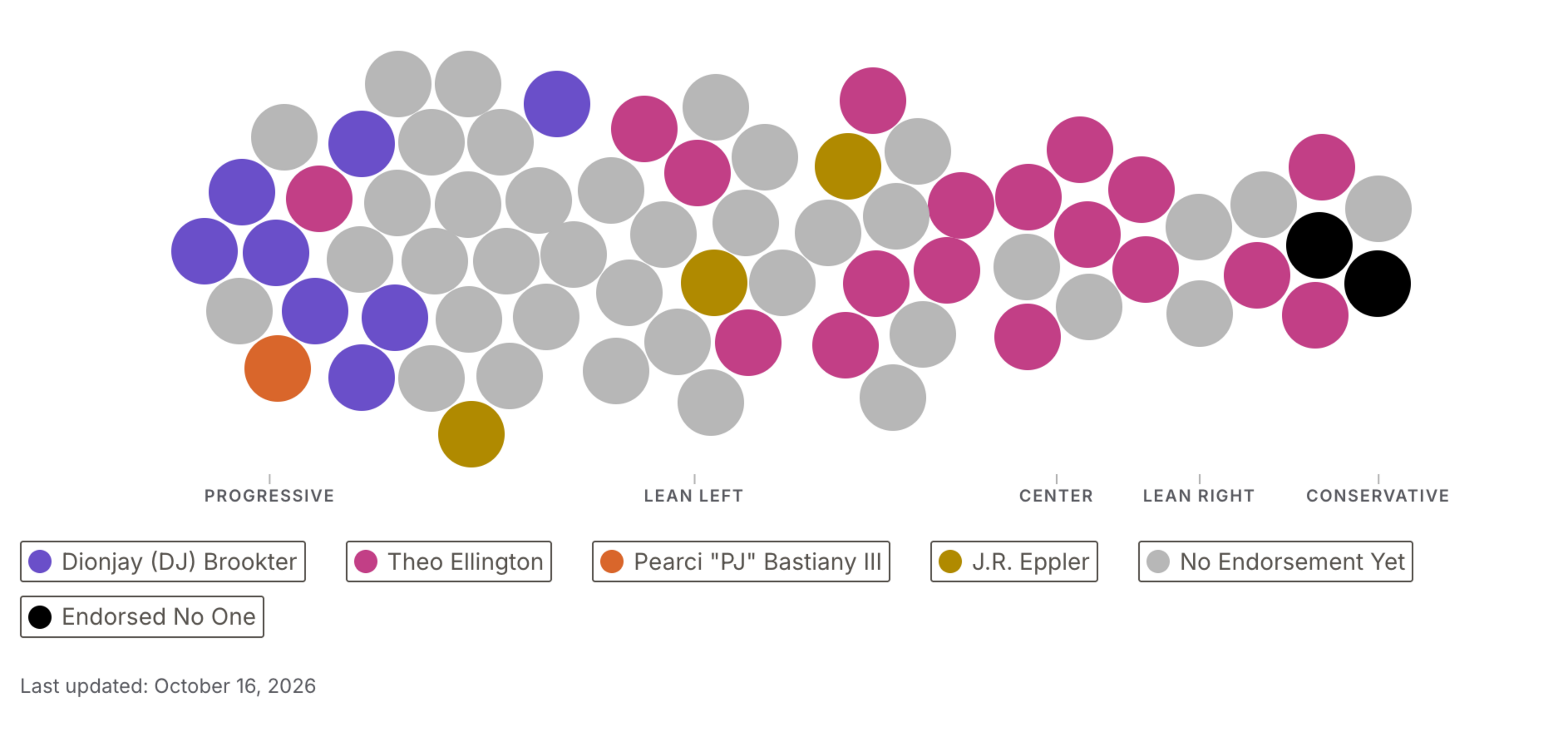 A beeswarm chart containing endorsements for the District 10 race. | Source: SF Standard Staff
Once we had collected all this great data, we wanted to do more than put it in a table at the end of each article. Tables are useful for storing data but not very helpful in making sense of it. Not to mention, it would have been unwieldy and, frankly, ugly.
Thus began the work of finding the right data visualization. At first, we thought about just counting up the endorsements for each candidate or yes/no position and making a bar chart. But we quickly realized that presentation would hide a key signal from endorsements: partisanship. Knowing how many endorsements a candidate or measure has is helpful, but knowing the political leaning of that endorsement opens up a new axis of analysis.
Plotting the endorsements on a left-right axis would allow readers to quickly identify which side of the aisle is backing the measure. We soon landed on a beeswarm chart, which had two characteristics we liked: It was easy to understand and showed individual endorsements, so outliers were easy to spot.
Partisanship scores
The beeswarm had a third benefit: It isn’t overly precise. Partisanship in California politics — especially San Francisco politics — is not a strict left/right binary. It’s more often an ultraleft/moderate left binary, with a few moderate right outliers. To construct the chart, we gave every endorser a partisanship score ranging from -2 (far left) to +2 (far right). This was more art than science, but we made attempts at normalization using historical voting data and official party platforms. (So far, no group has told us we put them in the wrong spot. But if we did, don’t hesitate to reach out!) The beeswarm, unlike a scatterplot or grid, allows some movement, showing clusterings as organic blobs rather than falsely precise points on the axis.
Telling examples
Let’s compare two of the statewide tax initiatives: Prop. 3, which extends a high-income tax for education, and Prop. 40, the billionaire tax. As you can see, Prop. 3 has support from the far left to the center of the political spectrum, while Prop. 40’s support is concentrated at the progressive end, and many in the center left decided to not endorse at all.
 Prop. 3 endorsements. | Source: SF Standard Staff
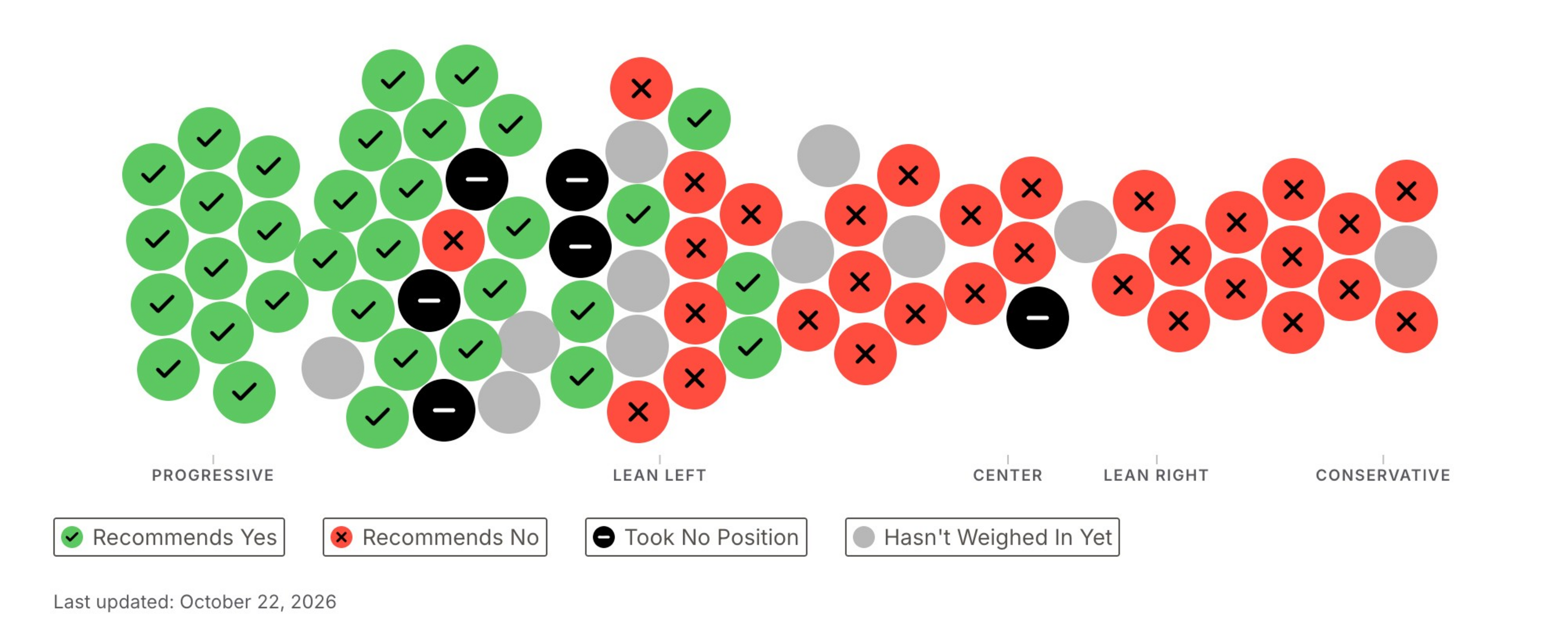 Prop. 40 endorsements. | Source: SF Standard Staff
Another interesting roundup is the race for insurance commissioner. As a Democrat-versus-Democrat contest, it is one of the most “intermixed.” Still, we can see that Kim’s support leans progressive and Allen’s center-left. Make sure to check the dots that buck the trend!
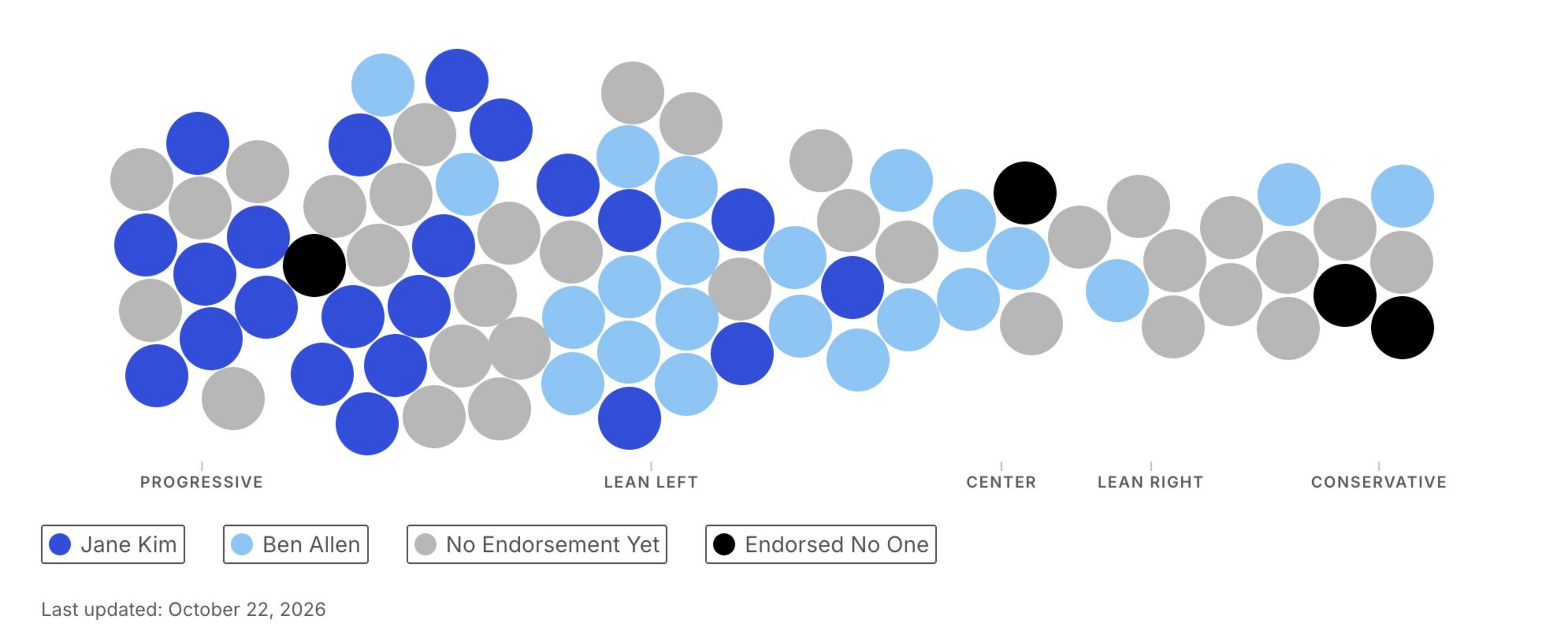 Insurance commissioner endorsements. | Source: SF Standard Staff
For the endorsement roundup power users, you can even inspect the minute differences between otherwise similar measures, like Mayor Daniel Lurie’s three charter reforms, Props. D, E, and F. For example, the SF Republican Party backs the mayor’s power measures, E and F, but opposes making it harder to put measures on the ballot, D.
Gallery of 3 photosExpand photoClick arrows to view
the slideshow
Prop. D endorsements. The SF Republic Party’s no recommendation is the second red dot from the right. | Source: SF Standard Staff
Prop. E endorsements. | Source: SF Standard Staff
Prop. F endorsements. | Source: SF Standard Staff
More insightsCredit where it’s due
We’re not the only ones to aggregate endorsements this way. There are a few other groups that make cross-checking endorsements easy. We’re fans of SF Endorsements (opens in new tab), run by Peter Xu, which has been collecting endorsements since 2019. There’s also a new project, Bay Ballot (opens in new tab), which tracks more than 120 organizations and creates roundups for downballot races in all nine Bay Area counties.
Endorsements are just one signal among many. There’s also polling, campaign finance, and of course, our very own (best attempt at) nonpartisan guides. Happy voting!