
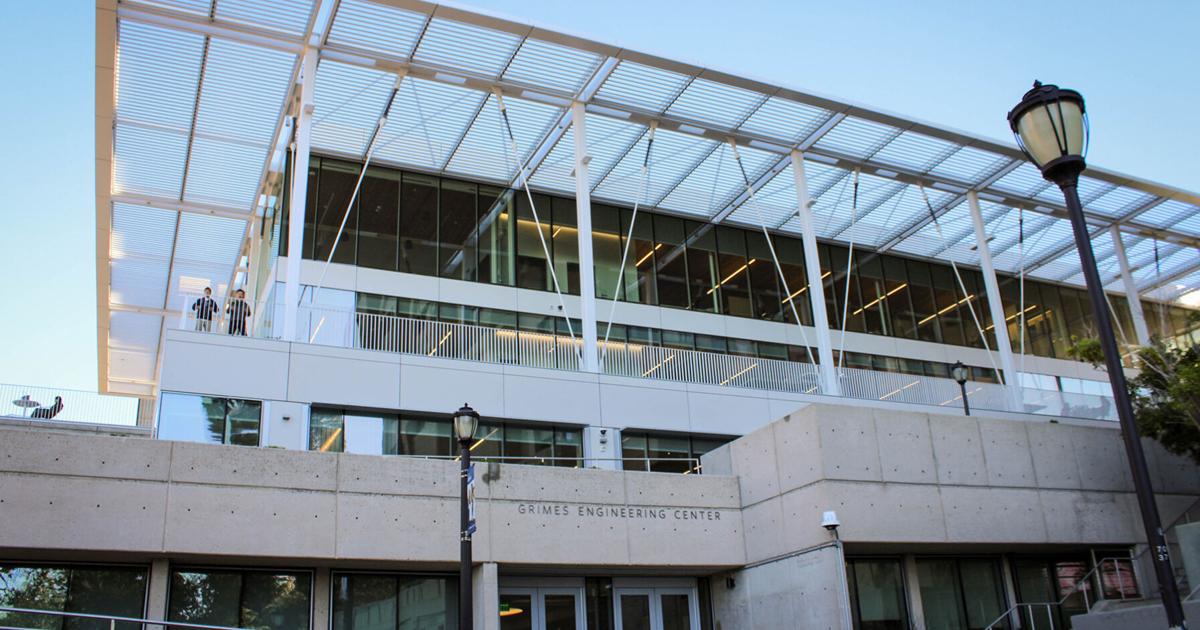
Grimes Engineering Center is the product of a sustainable redesign initiative that sustainably transformed the former Bechtel Engineering Center into a 36,000-square-foot contemporary program space.
The building’s transformation is part of the larger 2022 Campus Master Plan, a “renewed long-term vision” for the physical development of UC Berkeley’s campus.
“We had a big responsibility building right on the central glade where we’re surrounded by very beautiful, classic projects … and our goal was to create something that complemented the classical order,” said Michael Leung, senior associate principal at architecture firm Skidmore, Owings & Merrill, which led the project’s design efforts. “But we wanted to do it in a very contemporary and open way.”
Leung and his team began working on the engineering center in April 2021 and concluded in October 2025. His firm found that the existing foundation of the Bechtel Engineering Center could support a heavier load than the existing infrastructure. In order to add square footage, the team found they could replace weighty construction features with lightweight steel infrastructure.
Grimes Engineering Center’s sleek, modern design features concrete paneling with large glass windows and a wraparound terrace that faces Memorial Glade.
However, parts of the original construction can still be seen inside the building, such as in the Kresge Engineering & Mathematical Sciences Library, which was almost entirely preserved, according to Leung. The lower two floors, which were part of the Bechtel Engineering Center, were also preserved in the Grimes Engineering Center.
When the building is lit up at night, Leung said he can “see the project coming to life.”
“The space has a highly visible and kind of welcoming presence on the central glade, and it allows not only the entire UC Berkeley population, but the general public to see that inspiring space and be welcomed to explore it,” Leung said.
SOM, Leung’s architecture firm, used an adaptive reuse strategy, a sustainable redesign strategy that partially preserves an existing building and retrofits it to sustainably adapt the space. The firm said the foundations of Bechtel Engineering Center were robust enough to make retrofitting the space the most efficient redesign strategy.
“That was our vision from day one; we frankly never considered completely demolishing everything,” Leung said.
SOM conducted a life-cycle carbon assessment to determine the sustainability of the project. The assessment found that implementing the adaptive reuse strategy reduced carbon use for constructing the building’s structural system by about 45%.
Using an adaptive reuse strategy is also a cost-effective construction method, according to Leung, because generally less construction work is needed. He said adaptive reuse construction strategies have the potential to become widespread.
“We see tremendous opportunity, both at UC Berkeley and across the Bay Area,” Leung said.