
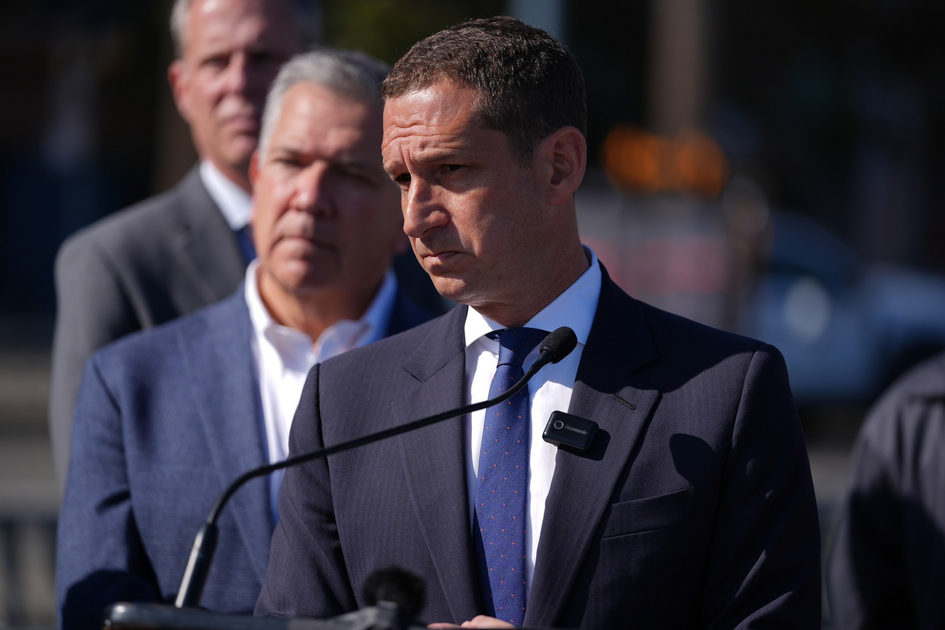
Daniel Lurie has a well-rehearsed patter about making it easier to do business in a city festooned with red tape. Just last week, San Francisco’s can-do mayor regaled an audience at a gala for SPUR, the good-government think tank largely aligned with his reform efforts, with a story about how he rallies his troops.
“I tell my team all the time: Get close to the problem,” he said. “Talk to the person trying to open the restaurant. Talk to the builder waiting on a permit. Talk to the business owner worried about what is happening outside their front door. Listen to what is getting in their way. Then fix it.”
It would seem a no-brainer, then, that Lurie’s fix-it crew would be all over the shortcomings of a program that infuriates small businesses, particularly restaurants: the 20-year-old SF City Option, which requires employers to pay into a fund for workers’ medical expenses — and which far too few employees bother using. As The Standard has extensively reported, these health reimbursements are so underused that the city recently transferred $201 million from dormant health savings accounts into its own coffers.
That’s money the city forced employers to cough up that employees largely did not use — either because they didn’t know it was there or because it was too onerous to access — and that the mayor can now spend any way he pleases.
Many business owners hate this program not because they’re stingy and don’t want to be on the hook for employee health benefits. They hate it because it costs a fortune to administer, it’s convoluted for workers to access, and it appears to gild the city’s budget at the expense of already stretched small businesses. This is why you’ve seen so many “Healthy SF” surcharges on restaurant bills over the years: They are restaurateurs’ passive-aggressive way of reminding customers that everyone suffers from heavy-handed city policies.
Yet after months of on-again-off-again efforts to address this pernicious problem, Lurie’s team is no closer to fixing it than when he took office. In fact, I’m told, talks broke down altogether in the spring among representatives for restaurant owners, business advocates, organized labor, and the mayor’s office. The parties have not convened a meeting since, leaving participants unsure what, if anything, Lurie’s negotiators intend to do next.
“It is true that we have not yet arrived at a final reform plan,” Laurie Thomas, executive director of the Golden Gate Restaurant Association, said when I asked her where things stood on efforts that began in February 2025. I wondered what the hangup was. “I honestly am not sure,” she replied.
I have a pretty good idea.
Lurie’s inability to fix this problem is consistent with his unwillingness to take on labor unions. Despite ongoing budget deficits and a bloated city government, Lurie let labor talk him out of big layoffs over the past two budget cycles and promised not to downsize in the near future, while guaranteeing pay raises. The SF City Option, part of a law known as the Health Care Security Ordinance, is a brainchild of organized labor. Conceived in 2006, in an era before the Affordable Care Act, it sought to require employers who didn’t provide employee health insurance to pay into a fund that would set up city-administered accounts to support workers.
Despite health insurance now being widely available under Covered California, San Francisco’s dominant labor unions want to tweak, not eliminate, the program they have championed for so long. “We are very open to modifications,” said Mike Casey, president of the San Francisco Labor Council. “We think the way it’s currently structured needs amendment.”
Casey insists that unlike other negotiations with the city he has been involved with, this one is not acrimonious. “We want to look at real reform here and see if we can create a system that everyone can use and that the money is not placed into this surplus fund.”
***
No one disputes that the nearly 20-year-old program (it took effect in 2008) has not worked as originally planned. Three years ago, the city announced it was beginning a process known as escheatment, a bureaucratically sinister word for the government’s appropriation of unclaimed property. Unless steps were taken to distribute funds to the employees entitled to them, more than $500 million then in inactive worker accounts would become the city’s by 2026. Embarrassed by the sheer amount of money flowing to unintended uses, the Department of Public Health, which oversees the accounts, mounted a lengthy publicity campaign to locate workers and inform them of the cash at their disposal.
The outreach campaign whittled down the stash by $300 million, with workers racing to use their unspent funds (opens in new tab)on everything from long-delayed medical treatments and smart watches (with a letter of medical necessity) to contact lenses and — in the case of my colleague Sara Deseran, a former restaurant employee — physical therapy sessions. But the system’s critics see that process as flawed. Workers must pay upfront for medical or medical-adjacent expenses, then seek reimbursement from the city. The program seems to benefit those who are most adept at gaming the system, said Sharky Laguana, a former president of the Small Business Commission and a participant in the now-dormant talks with the mayor’s office.
Laguana has a proposal: He wants the city to create a “claim-activated” funding mechanism. Instead of paying into funds that may never be used, employers would pay medical expenses after employees have filed claims to the city. “This way an employer would be invoiced only on something that already has happened,” he says.
Laguana is unmoved by the fact that, after a significant marketing and mobilization effort, the city was able to boost utilization rates on the reimbursement accounts from 34% before 2023 to around 80% more recently. “That still leaves another 20% to be escheated at a future date,” he said. “I want it scrapped in favor of something that works better.”
A hopeful sign is that Casey, the labor leader, praised Laguana’s problem-solving efforts and agreed that a solution needs to focus on providing healthcare and health insurance to workers. He recognizes the flaws in the city’s reimbursement accounts. “Until we get a single-payer healthcare system in the country, we’re doing a patchwork approach that is the next best thing,” he said.
(Casey sounded as if he fell out of his chair when I told him over the phone that I agreed with him about the need for a government-funded single-payer plan; where we disagree is the likelihood of us having one any time soon.)
The Department of Public Health did not provide the amount of money that remains in the fund, inactive or otherwise, and the city has not begun another three-year process to claw back unclaimed money. The $201 million the city grabbed in May went into a reserve fund meant to make up lost federal and state funding. Reserves like these are how San Francisco mayors have long balanced the city’s budget.
And while some in leadership undoubtedly like the idea of backfilling the budget with manna-from-heaven-like cash, they are actually playing with fire by claiming workers’ funds as the city’s own. The payments from employers are considered fees. Yet money that gets used for a purpose other than that for which it was expressly intended — in this case, paying for workers’ healthcare expenses — can be considered an illegal tax because it wasn’t approved by voters. A smart class-action attorney could sue on behalf of aggrieved businesses, leaving the city open to legal liability.
What the mayor’s office thinks about this is unclear. Aly Bonde was spearheading the dialogue before May, when Lurie promoted her to succeed Staci Slaughter as chief of staff. The mayor’s office declined to make Bonde available for an interview and issued a statement:
“Mayor Lurie has been a champion for small businesses, and we are constantly looking for more ways to support them. And as the cost of living rises, we’re working to make sure San Franciscans can access health care and critical services. We’ve been working with businesses and labor for months to try to find consensus on how best to achieve those goals, and we’re going to keep at it.”
My prediction: After the midterms, and after a sufficient majority of the city’s public-sector labor unions accept the contract deal Lurie offered them in September, the mayor’s team will find a solution that mollifies small businesses. Maybe that will entail exempting some of them from the health-expenses mandate. Hopefully, they come up with a mechanism that more efficiently funnels money into workers’ pockets.
Either way, it’s a problem Lurie himself needs to get close to and fix.