
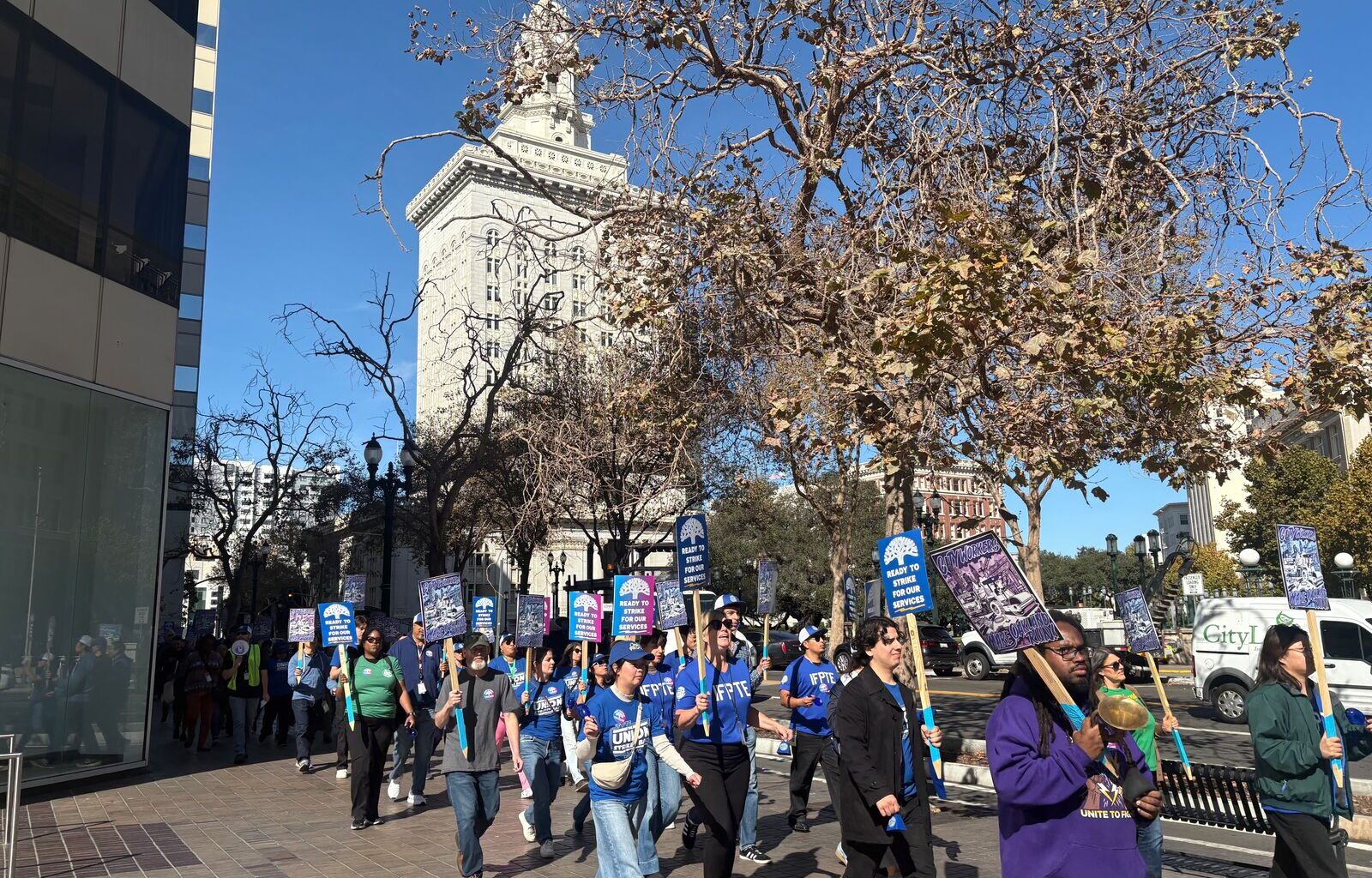
One of Oakland’s biggest unions says the city has a little over a week to finalize a new bargaining agreement or their members will walk off the job — marking the first strike by a city union in nearly a decade.
About 150 of those workers, with the International Federation of Professional and Technical Engineers Local 21, marched raucously through downtown during their lunch break on Tuesday.
“We don’t take this lightly,” said Julian Ware, the union’s Oakland vice president, speaking to the crowd in front of the Main Library.
Ware told The Oaklandside that there are a few remaining points of tension in negotiations with city leadership, which have been stretching on for more than six months. The union wants language preventing the outsourcing of some city work to private contractors.
“How many times have we seen work done by a contractor that we then need to redo?” Ware said into a megaphone at Tuesday’s rally.
The union also wants stronger guardrails against the use of artificial intelligence in city work, he said, and better protections for city staff if ICE officers show up at City Hall or when they’re in the field.
Asked about the strike and sticking points in negotiations, a spokesperson for the city administration pointed us to a press release from Tuesday morning, sent before IFPTE’s announcement.
“The city is continuing to bargain in good faith, with multi-year wage increases on the table, and with the expectation of reaching agreements with all four groups,” the statement said.
The last time city workers went on strike was in 2017. More than 2,000 SEIU 1021 members refused to work for seven days, and they were joined by members from IFPTE Local 21 and IBEW Local 1245.
IFPTE’s contract ended in June, along with the city’s other union contracts. OPOA, which represents police officers, was the first major union to reach an agreement with the city, announcing a new deal at the end of August, and Oakland’s fire union reached a tentative agreement with the city today.
It’s unclear where things stand with Oakland’s other major union, SEIU Local 1021, whose members last week voted overwhelmingly to authorize a strike if needed. An SEIU representative did not immediately respond to an interview request. Oakland is also still negotiating a deal with the Confidential Management Employees Association, which represents supervisors, and the International Brotherhood of Electrical Workers 1245.
Ware told The Oaklandside that the city’s staff unions support one another but that IFPTE members saw an urgency in moving ahead with a strike plan. Some representatives from SEIU and the Oakland teachers union showed up to the rally Tuesday.
Barbara Lee, who was elected with support from the city’s unions, has not weighed in on the topic of the strike. At her state of the city earlier this month, Lee promised that the city is working “very, very hard” to get a fair contract for city workers. On Tuesday, the mayor’s office announced that Lee would be attending the West Oakland ribbon-cutting for Nelumbo, a materials technology company, around the same time as the union’s press conference.
The city is making some progress in addressing the staffing crisis
City union members have repeatedly said that a major sticking point with the city is the failure to hire enough workers to do critical jobs. Ware called the situation “unacceptable.”
Earlier this year, the city reported that roughly 20% of city jobs — one in five — were unfilled. This has negatively affected the city’s ability to do important work, including road paving and illegal dumping cleanup, the unions argue. Nearly 20% of jobs at the Oakland Public Library, where the unions gathered on Tuesday, are also currently unfilled, according to city data.
But the city’s vacancy rate has improved slightly over the course of 2026, according to a new report that the City Council’s finance committee discussed on Tuesday. As of September, Oakland’s vacancy rate was down to about 18%. Of the 4,293 full-time city jobs on the books, roughly 768 are budgeted and vacant.
This is the lowest vacancy rate the city has reported since 2021. During the pandemic, the rate spiked, jumping from a little over 12% in May 2021 to over 18% in October of that year.
The office with the worst vacancy rate is Human Resources Management, which is at over 34% – still an improvement over last year, when nearly 45% of HR jobs were vacant. IFPTE representatives previously told us that filling HR jobs is a priority for the union, to speed up hiring elsewhere.
Other hard-hit big departments include the City Administrator’s Office, where over 25% of jobs are vacant; OakDOT, with nearly 23% vacancies; the Department of Workplace and Employment Standards at around 28%; the Economic and Workforce Development at nearly 28%; and Human Services at just over 28%.
Around 13% of OPD jobs are unfilled, as are more than 15% of firefighter jobs. These are relatively low compared to other departments, but there has been significant public concern about lack of staffing around public safety services. Unions representing both departments recently secured their own new labor agreements with Oakland.
The only department that boasted a 0% vacancy rate in September was the Mayor’s Office.
Of the city’s labor organizations, IBEW, which represents electrical workers, has the highest vacancy rate, with a third of its jobs unfilled. But the union only represents 21 full-time employees in Oakland. In terms of bigger unions, IFPTE Local 21, the union planning to strike, has the highest rate, with more than one in five represented jobs sitting unfilled. IFPTE represents administrative, IT, legal, and engineering workers.
About 19% of SEIU Local 1021 member positions are unfilled. SEIU represents emergency dispatchers, librarians, maintenance workers, park staff, and building inspectors, among other jobs.
Why are these positions unfilled? According to HR, 185 jobs across various city departments are empty because departments haven’t submitted the paperwork to fill the vacant positions. For another 182 jobs, HR has a list of eligible candidates, but departments haven’t filed requisitions to start hiring. Forty-five jobs are unfilled because departments have requested a pause in the recruiting process for funding or organizational reasons.
Other jobs are at various stages of being filled. For 41 positions, departments have filed the right paperwork, but they still need approval from higher-ups in the city administration or HR. Forty more jobs have been approved by all the right people, but recruitment hasn’t started because an analyst hasn’t been assigned to that task. HR is actively recruiting for 94 jobs, as of September. And departments are actively interviewing candidates for 140 jobs.
At Tuesday’s committee meeting, councilmembers thanked HR for improving recruitment. But they also urged the department to use more tools to bring in more job candidates. Councilmember Janani Ramachandran noted that City Hall recently hosted a job recruitment fair, and she suggested HR should host more of them in the future.
The failure to hire for frontline jobs in Oakland can have significant impacts on residents. Last month, the city investigated a situation in which dangerous chemicals were dumped into the Temescal Pool while people were swimming. Several were taken to the hospital, and one has filed a claim against the city for injuries and emotional distress. According to city records, Oakland has the money and authority to hire two pool technicians but has failed to do so for months, relying instead on other staff who have other job duties.
The city posted the pool tech jobs shortly after The Oaklandside reported on the incident.
“*” indicates required fields