
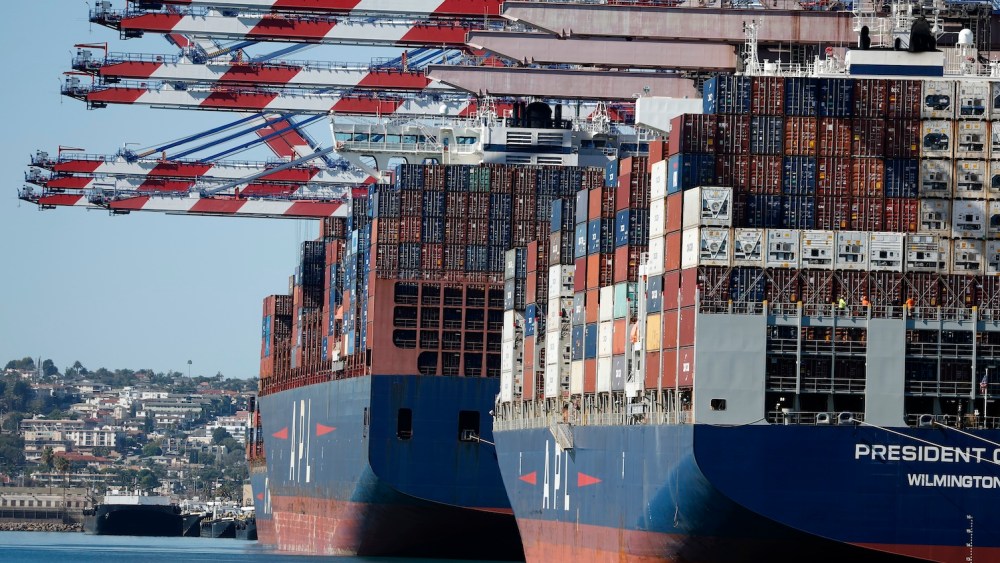
About 250 watchmen represented by a local branch of the International Longshore and Warehouse Union (ILWU) have voted to authorize a strike at the ports of Los Angeles and Long Beach, the Pacific Maritime Association (PMA) said Tuesday.
If the two sides do not reach a new agreement before the contract extension expires, a walkout could begin at 5 p.m. Pacific time.
Although ILWU Local 26 accounts for only 2 percent of the union’s total workforce at the two ports, the association said the terminals where its members work handle more than half of the cargo moving through the San Pedro Bay complex. The potentially impacted terminals handle roughly 85 percent of Long Beach’s cargo and 33 percent of freight at the Port of Los Angeles, the PMA said.
A watchmen strike could halt vessel, yard and gate operations at the affected terminals at both ports.
“None of the employers’ proposals have been resolved, and significant differences remain,” according to a statement from the PMA, which is represented by 72 shipping lines, stevedore companies and marine terminal operators at ports in California, Oregon and Washington. “A timely agreement matters not only to the parties at the table, but to the entire Southern California supply chain and to the local, state and national economies that depend on it.”
Local 26 represents maritime security personnel who handle gate security and cargo watch duties, work that puts a small group at the entry and exit points for containers moving through some of the largest terminals in the country.
Eight terminals would be impacted—six container terminals and two non-container terminals—by the labor action. The container terminals are APM Terminals (Pier 400), Long Beach Container Terminal, Total Terminals International, SSA Marine’s Berth C60 and Berth A90 and Pacific Container Terminal. The non-container terminals are SSA Marine-operated: LB 206 and Outer Harbor Berth 55.
The watchmen work under a separate agreement from the coastwide six-year longshore contract that was brokered between the ILWU and the PMA in summer 2023. The local union’s contract expired in July 2025, after which the members have worked under an extension while the two sides have met regularly for more than a year with help from federal mediators, the association says.
In an Oct. 23 letter to other maritime unions, Local 26 president Luisa Gratz said negotiations had stalled since last year despite the federal mediation request, noting that “nothing of value has resulted from the union’s commitment to bargaining in good faith with our employers and PMA.”
The association said every tentative agreement so far has been based on a union proposal, and it described a “strong” economic offer including “meaningful” wage increases and pension improvements. It said full-time watchmen earn an average of more than $170,000 a year, plus fully employer-paid health care and pension benefits, without providing a breakdown.
The strike threat arrives while the complex is struggling to move rail-bound cargo inland, a pressure that predates any walkout and would compound if terminal gates and yards stop.
According to a compilation of both ports’ daily rail reports from The Dwell, 34,592 import containers were awaiting on-dock rail service on Tuesday. The L.A. port accounted for 18,709 containers, 46.9 percent of which had waited nine days or longer. The Port of Long Beach accounted for 15,883 containers, with 21.7 percent having waited nine or more days.
During a media briefing earlier this month, Port of Los Angeles executive director Gene Seroka said the rail dwell times are “something that we’re watching really closely.”
The congestion has been brewing since the spring, with rail dwell time escalating every month since March, according to Pacific Merchant Shipping Association data. Average rail container dwell across the complex rose to 7.19 days in September from 6.75 days in August, while average dwell for containers leaving by local truck rose to 3.18 days from 2.95 days.
In its October market update, C.H. Robinson identified Southern California intermodal railcar shortages as a constraint that was extending import dwell and slowing inland movement.
Both ports handled record monthly volumes in September, with Los Angeles processing about 1.04 million 20-foot equivalent units (TEUs) and Long Beach handling 997,177 TEUs. The combined total of roughly 2.04 million TEUs has left the complex handling holiday cargo at a pace with little slack for a terminal stoppage at facilities handling more than half of its cargo.
The terminal backlog has not been matched by a comparable offshore queue, since The Dwell’s congestion tracker reported one ship awaiting a berth during the week of Oct. 26, based on data from the U.S. Maritime Administration and the Marine Exchange of Southern California, a reminder the constraint is inland movement rather than vessels waiting to unload.