
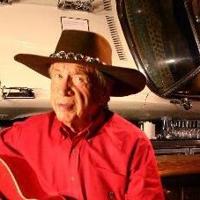
Country music legend Buck Owens was never much of a city guy. Born in what was then the town of Sherman, Texas, he moved with his family to the even smaller town of Mesa, Ariz. during the Depression and didn’t come to Bakersfield, population 35,000, until 1951.
It was no surprise, then, that after divorcing his wife of 15 years in 1971, Owens wanted some time and space to himself. So, he moved to the country.
For the next several decades he lived in a small adobe almost 20 miles outside of Bakersfield, just off Zerker Road. The house was a little quirky, and uncomfortably cold in winter, but it came with more than 120 acres of land. That’s where he died in 2006, succumbing to a heart attack just hours after playing a show at his Crystal Palace.
That same country estate is now for sale — without the adobe, it should be noted, but with a 6,741-square-foot mansion in its place.
The property is impressive and, considering Owens lived there and left behind a private fishing pond that’s still there, arguably historic.
Although he had other homes around town, most notably a place at 309 Panorama Drive in northeast Bakersfield, his old country estate reflects a side of Owens the public rarely glimpsed.
A friend of his, former Buckaroo Jim Shaw, said Owens deliberately chose a property outside of town. The modest size of the house was a reflection of who he was.
“Buck wasn’t a big, fancy-house guy. He really wasn’t somebody who wanted a bunch of square footage,” he said, adding that Owens marched to “the beat of a different drum.”
The adobe was very much that. Even in the 1970s it was an outdated house, with a master bedroom but no other bedrooms except one for the live-in maid.
The kitchen was “teeny,” in Shaw’s words, but the fireplace was big enough to put a car in. Owens added a garage to the property, along with a fishing pond that remains much the way it was.
Not interested in farming so much land, Owens leased out the bulk of the property. But he spent much of his life there in peace.
“He loved the house,” Shaw said.
These days the estate looks very different. It boasts some 80 acres of nut-bearing pistachio trees, along with a pool, spa, tennis court and guest residence.
The two-story house itself, built in 2013 after the adobe’s demolition, is what you might expect from a property listed for sale at $5.9 million. It has three bedrooms, a gourmet kitchen, an office and game room, not to mention more than 400 fully paid-for solar panels.
Executive Director Mike McCoy at the Kern County Museum said it was just like Owens to settle down in the country.
“Buck was never an (urban) guy,” he said. “I don’t think he always liked living in town.”
“He didn’t like neighbors. He was always very private. He wanted elbow room.”
Owens certainly had that living off Zerker Road. The place is surrounded by citrus orchards, such that visitors can’t so much as catch a glimpse of the home without trespassing.
Neither was McCoy surprised that Owens would choose to live in a small home instead of a large one.
“Buck was very much — he grew up the hard way and he didn’t forget that,” he said.
“I think he was most comfortable in everyday spaces. He wasn’t a fancy-schmancy guy.”
The small kitchen seemed to fit Owens’ profile, too, given his propensity for eating out. Many meals he ate at Zingo’s, other times at his Crystal Palace, McCoy recalled.
Owens preferred simple food, too, which was perfect for the kitchen in the adobe.
“It would’ve been a sandwich and a cup of coffee,” McCoy said. “Maybe some scrambled eggs.”