

Community members, healthcare workers, and elected officials are demanding answers after Oakland’s Highland Hospital discharged a man into the custody of federal immigration agents without confirming the agents had a warrant authorizing his detention.
At a tense Board of Supervisors meeting Tuesday evening, officials with Alameda Health System, which operates Highland Hospital, acknowledged that hospital staff never received a copy of a warrant from U.S. Immigration and Customs Enforcement agents who brought the man to the hospital earlier this month.
The revelation has raised questions about whether the public hospital system followed its own protocols and Alameda County’s sanctuary policies restricting local cooperation with federal civil immigration enforcement. It also prompted an angry response from Supervisor Nikki Fortunato Bas, who said Tuesday that hospital officials had previously assured her ICE had presented the necessary documentation.
“I am just very upset right now because I had conversations with representatives who should have known the answer to my question, which was whether or not ICE legally had that person in custody… and I was told affirmatively that they did see a warrant,” Fortunato Bas said.
The man, identified by ICE as Eduardo Antonio Ruiz-Garcia, was arrested Oct. 16 in Emeryville during what federal officials described as a targeted immigration enforcement operation. According to immigration advocates, ICE agents used excessive force during the arrest, fracturing six of his ribs.
Ruiz-Garcia was hospitalized at Highland for six days, during which ICE agents remained at the hospital, according to Nikolas De Bremaeker, managing attorney at Centro Legal de la Raza, an Oakland-based nonprofit that provides legal aid to immigrants. After he was discharged, he was returned to federal immigration custody.
Jason Sweeney, a spokesperson for the U.S. Department of Homeland Security, which oversees ICE, denied allegations of excessive force. In a statement to The Oaklandside, Sweeney alleged that Ruiz-Garcia “attempted to assault officers” and refused their commands.
“Officers relied on their training to control the situation,” Sweeney wrote.
ICE also claimed Ruiz-Garcia had disclosed a preexisting injury from falling off a ladder two days before his arrest. The Oaklandside could not independently verify the cause of his injuries.
As of Friday morning, Ruiz-Garcia remains at an immigration detention facility in the Central Valley, according to De Bremaeker.
Centro Legal worked with a pro bono attorney to file a habeas corpus petition in federal court challenging the legality of his detention. The petition is currently pending, De Bremaeker said.
What happened at Highland Hospital?
At Tuesday’s joint meeting of the Alameda County Board of Supervisors and the Alameda Health System Board of Trustees, hospital administrators outlined their procedures for responding to immigration enforcement activities.
Under California Senate Bill 81, enacted last year, healthcare facilities must establish procedures for handling requests from federal immigration authorities to access patients, confidential information, and nonpublic areas of hospitals. The law also prohibits medical staff from sharing a patient’s immigration status or birthplace with immigration authorities, unless the patient consents, or there is a valid court order or search warrant requiring it.
Kayla Bowen, associate general counsel for Alameda Health System, explained that the hospital’s protocols direct employees to refer requests from immigration authorities to an administrator on call, who can consult legal counsel to review documentation and determine the appropriate response. The intent, she said, is to allow medical workers to focus on patient care, rather than navigate complicated legal questions involving immigration enforcement.
But the discussion took a contentious turn when Fortunato Bas pressed hospital administrators on whether ICE agents had presented an arrest warrant when they brought Ruiz-Garcia to Highland Hospital.
Bowen said hospital personnel had requested documentation but never received it.
Bowen emphasized that hospital officials are not responsible for determining whether federal immigration agents have lawfully arrested someone.
“As a hospital, it’s not our determination of that legality of custody,” she said. “We are going to provide care. We’re not going to hold up the provision of care to assess for that.”
Alameda Health System officials said providing care to a person already in ICE custody does not constitute cooperation or collusion with civil immigration enforcement.
Still, Fortunato Bas questioned why hospital staff had not taken more steps to verify ICE’s authority or involve legal advocates before allowing ICE to take the patient when he was discharged.
James Jackson, CEO of Alameda Health System, acknowledged that he had previously given Fortunato Bas incorrect information about the documentation.
“It was my understanding that we did have the proper documentation,” Jackson told Fortunato Bas.
He apologized for the misunderstanding but denied allegations that hospital administrators intentionally assisted ICE agents.
“There was never any intent to collude,” Jackson said. “If we did not have the documentation that we should have had, that’s a part of our process, and we will learn, and we will be better.”
Advocates say ICE interfered with medical treatment
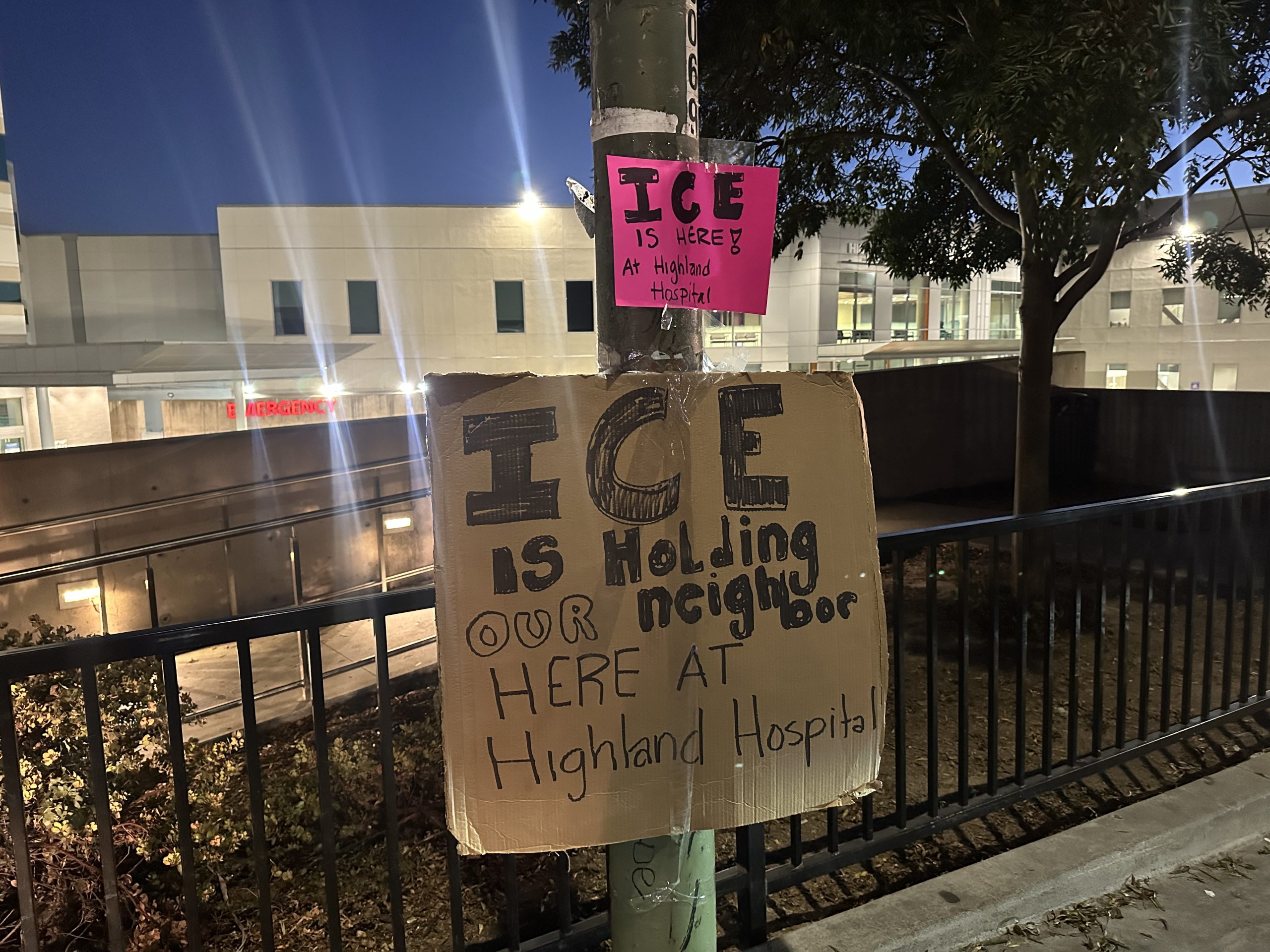 Signs left behind by protesters outside Highland Hospital on Oct. 18, after ICE arrested a man in Emeryville on Friday, Oct. 16. Credit: Azucena Rasilla/The Oaklandside
Immigration advocates and medical workers also raised concerns about how ICE agents behaved during the man’s hospitalization.
De Bremaeker, who helped coordinate Ruiz-Garcia’s emergency legal response, said several ICE agents were present throughout his hospital stay, including an agent whom he said injured Ruiz-Garcia during the arrest.
“He even sat on the foot of his bed, grinning at him,” De Bremaeker told The Oaklandside.
According to De Bremaeker, agents also attempted to influence medical decisions, asked hospital employees for private patient information, and refused to loosen Ruiz-Garcia’s handcuffs while medical workers treated him. The restraints, De Bremaeker said, caused additional pain and interfered with his treatment.
“As far as I know, he was able to receive the necessary treatment, but the treatment, as it was given, was definitely suboptimal,” he said.
At Tuesday’s meeting, De Bremaeker urged hospital administrators to establish clearer procedures for situations in which federal agents interfere with medical care or patient privacy. Alameda Health System officials said their existing protocols allow staff to ask immigration agents to leave treatment areas and require employees to escalate disputes to an on-call administrator.
But De Bremaeker said those policies had not adequately protected Ruiz-Garcia.
He called for stronger communication between the hospital and Centro Legal so immigration attorneys can intervene quickly when ICE shows up with an in-custody patient. Hospital officials acknowledged that Centro Legal had been contacted later than it should have been.
De Bremaeker told The Oaklandside that his organization has been in contact with Rep. Lateefah Simon, Rep. Aisha Wahab, and Sen. Alex Padilla about seeking a federal inquiry into ICE’s conduct inside hospitals.
DHS did not specifically address the allegations of interference with medical treatment in its statement to The Oaklandside. Sweeney said agents routinely accompany people in federal custody to hospitals for monitoring.
“If we have a detainee we need to take to the hospital for medical care, we have officers accompany them for their monitoring, safety of the staff, and the public. This is standard procedure for all law enforcement agencies,” he said.
ICE violated Alameda County’s sanctuary policies, advocates say
Another point of contention at Tuesday’s meeting was the presence of ICE vehicles and agents on hospital property during Ruiz-Garcia’s six-day hospitalization.
Earlier this year, Alameda County adopted an “ICE-free zones” policy prohibiting the use of county property as staging areas, processing locations, or operational spaces for civil immigration enforcement officials.
During Tuesday’s meeting, multiple medical workers and community observers said they witnessed ICE agents use a loading dock near Highland’s morgue to park vehicles and change shifts while guarding Ruiz-Garcia. They also criticized the Alameda County Sheriff’s Office, which provides security at Highland, for reportedly helping ICE agents move throughout the facility.
Alameda Health System administrators disputed advocates’ characterization of the loading dock as a staging area.
Bowen said ICE vehicles had initially parked in a garage accessible to patients, visitors, and employees. Hospital staff later moved them to a less visible area after demonstrators gathered outside the facility, raising concerns about access to the garage and hospital operations.
The decision, Bowen said, was intended to minimize interactions between immigration agents and other people at the hospital, not facilitate enforcement activities.
“With the presence of protesters outside and within the parking garage, there was a disruption to hospital operations, and we wanted to limit any disruption for the ability for patients to access care,” she added.
Bowen said sheriff’s deputies helped ensure agents traveled only between Ruiz-Garcia’s hospital room and their vehicles.
But some medical staff and immigration advocates argued that allowing agents to park, change shifts, and escort Ruiz-Garcia out of the hospital effectively amounted to collusion.
“We can’t be a sanctuary on paper and then hand over our community members to ICE agents to take away,” said Claire Chalmers, a registered nurse who has worked in Highland’s intensive care unit for nearly a decade.
Chalmers said she witnessed sheriff’s deputies escorting ICE agents around the facility. She also criticized what she described as inadequate training for nurses caring for people in immigration custody.
In an interview with The Oaklandside, Alameda County Sheriff’s Office spokesperson Sgt. Robero Morales defended the deputies’ actions. He said the sheriff’s office maintains a 24-hour presence at Highland under a contract with the hospital and was focused on ensuring the safety of patients, staff, and visitors.
He also said deputies would not question another law enforcement agency’s authority to hold someone already in its custody.
“We would never ask another law enforcement agency if they have the authority to do what they’re doing,” he said. “We would expect, we would hope, that a law enforcement agency has their reasonings for holding this person.”
Asked whether deputies had discussed ICE’s authority to detain Ruiz-Garcia, Morales said, “That conversation did not occur and will not occur.”
Deputies, he said, have no authority to interfere with ICE’s detention of Ruiz-Garcia.
Healthcare workers are demanding stronger protections and better training
During nearly an hour of public comment, dozens of hospital workers, immigrant rights advocates, and community members denounced Alameda Health System’s handling of the situation.
Nora Goodfriend-Koven said her daughter, a clinician at Highland, reported that roughly half of her pregnant patients missed routine prenatal appointments during the period when ICE agents were at the hospital. She attributed the absences to patients’ fear of immigration enforcement.
Other healthcare employees described similar experiences at clinics outside Highland. Carrie Schiff, a nurse practitioner at La Clínica’s San Antonio Neighborhood Health Center in Oakland, said approximately half of her patients missed appointments during the same week.
Some healthcare workers also challenged administrators’ assertions that existing training and written guidance were sufficient.
Gabby Wimer, a second-year emergency medicine resident at Highland, said staff had repeatedly requested hands-on training and simulations to prepare for encounters with ICE agents.
“It’s laughable to say that it’s not the hospital’s responsibility, or they’re not capable of determining if someone’s in lawful detention because a bunch of healthcare workers without legal training have been able to do that, as have a bunch of community activists,” she said.
“We need to have a strong response in place so that people can trust that Highland and all of AHS will be there for them,” Wimer added.
Councilmember Charlene Wang, whose district includes Highland Hospital, also called for an investigation into the incident and a review of the hospital’s immigration enforcement protocols. In a statement Wednesday, Wang urged Alameda Health System to publicly release the findings of a critical incident investigation within 30 days.
“Highland is a place of healing and recovery. ICE’s presence there is the opposite of that,” Wang said. “Patients and families should be able to walk into a public hospital without fear.”
Alameda County Supervisor Nate Miley also called for a written report establishing what happened, whether hospital personnel followed existing procedures, and what changes might prevent similar incidents.
Miley also cautioned against confrontations with federal immigration agents, warning that an escalation could provoke a federal response.
“The Trump administration is just looking for an excuse to invoke the Insurrection Act,” he said. “If our sheriff’s department gets into an altercation with ICE, trust me, Trump will come in and… have federal troops here in Oakland and Alameda County. I don’t want that.”
Fortunato Bas called on hospital administrators to work directly with medical workers, immigration attorneys, and community advocates to strengthen training and establish clearer procedures for future encounters with ICE. She also raised the possibility of seeking emergency court intervention when questions arise about the legality of a patient’s detention.
Fortunato Bas said she also plans to have Alameda Health System provide a report about its handling of the incident to the board’s Alameda County Together for All ad hoc committee at a public meeting in the coming weeks.
“*” indicates required fields