
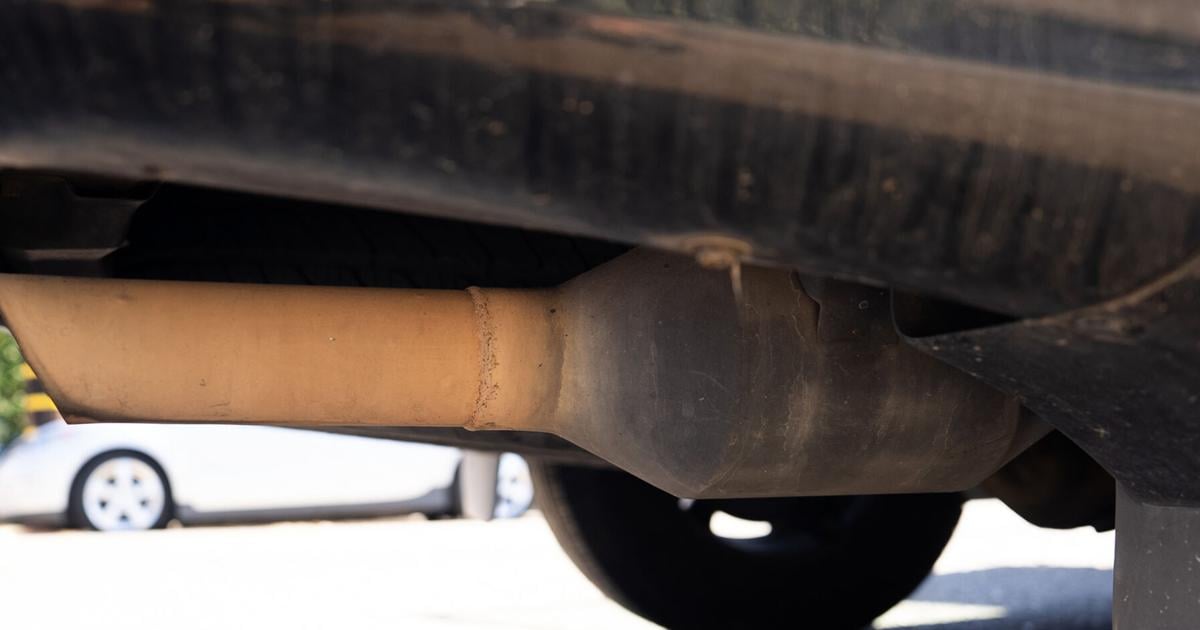
Berkeley Police Department has reported more than 300 catalytic converter thefts so far in 2026, a 21% increase from 248 reported thefts in 2025.
Catalytic converters are exhaust emission control devices that convert toxic pollutants into less harmful gases. They contain rare and expensive metals — such as platinum, rhodium and palladium — making catalytic converters commonly stolen items.
As the prices of these precious metals rise, catalytic converter thefts have as well. For car owners, replacing these stolen parts can range from $300 to $2,500 depending on the model of car.
UC Berkeley student Joy Herzberger was living in Los Angeles a few weeks before her move-in date for the semester when her converter was stolen. She shared the car with her boyfriend and lived in an apartment with a gated driveway, which made her unafraid of theft. It was only when she left her car parked overnight at her friend’s house that her converter was stolen.
“It being stolen was really stressful and frustrating, but more so, the issues with, ‘What do you do now that it’s stolen?’ ” Herzberger said. “We’re two adults trying to exist in Los Angeles, so I didn’t have very good insurance on the car.”
Following the theft, Herzberger contacted her insurance and discovered that coverage for the theft would have been priced at about $280 per month, a cost that for her would have been unaffordable.
According to data from BPD, catalytic converter thefts rose in 2020 and 2021, with more than 500 reported cases of theft each year. In 2022, BPD reported 847 reported thefts — the highest in the last decade.
Herzberger said the lowest quote she got for the catalytic converter replacement was $4,000. She decided that for her 2005 Toyota Prius with more than 200,000 miles, the replacement would be too expensive. Herzberger said this was a difficult decision, given that she and her boyfriend had already invested in a new battery and purchased a new set of tires.
“The car sat on the street for two to three weeks while we debated and figured out what to do, and then we ended up having to sell it — scrap it for parts,” Herzberger said. “I think we got $350. It’s frustrating … the tires alone are worth more than that.”
Herzberger said she didn’t file a police report because she didn’t think the police could provide any support for the theft.
“It’s overwhelming because the system perpetuates poverty … we were too poor to spend another $100 a month,” Herzberger said. “Now we’re out of a car.”