
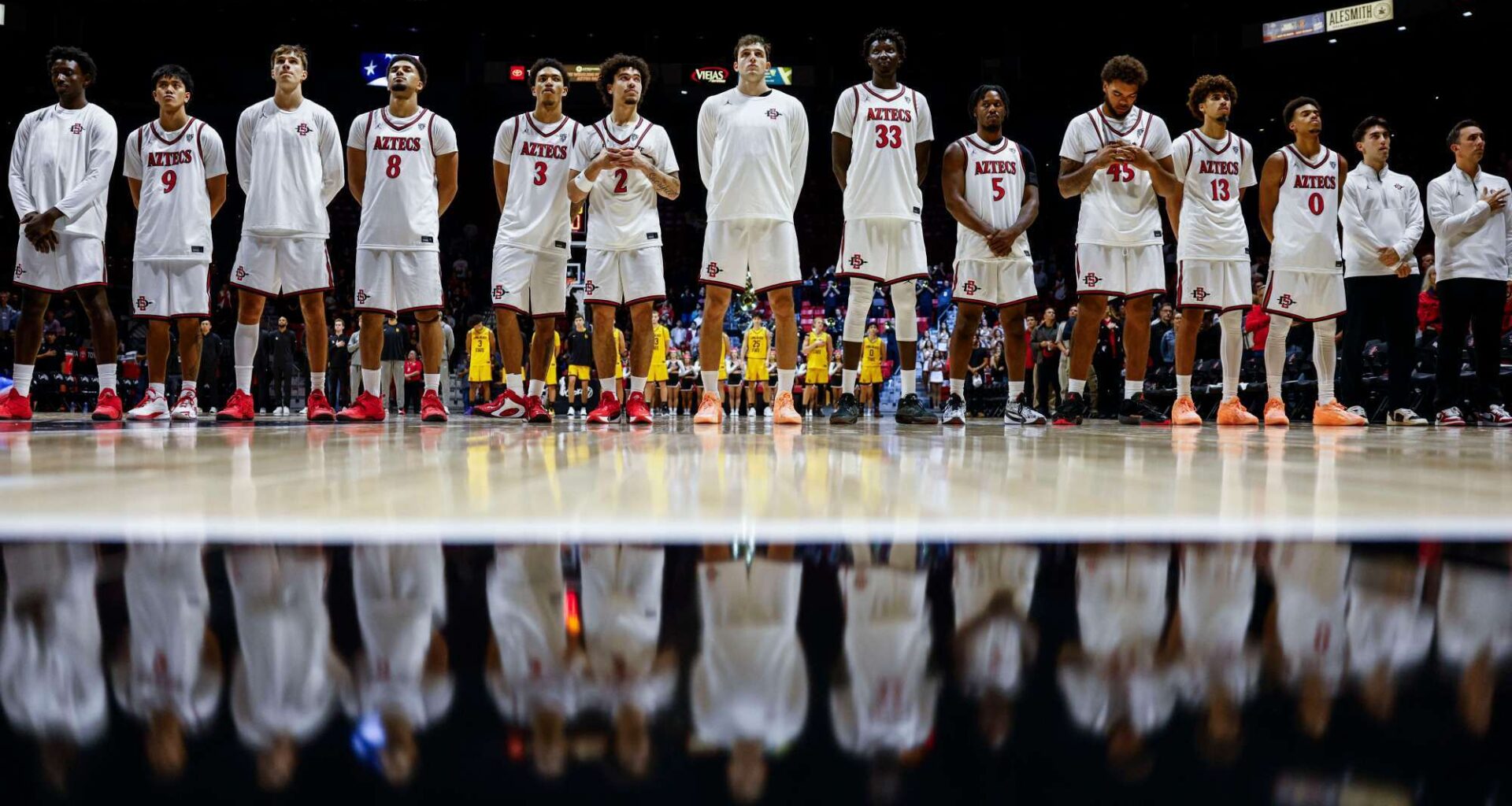
Basketball seasons are viewed through the prism of history and expectation. They’re all relative.
San Diego State won 22 and 21 games in the last two seasons, which were considered mild disappointments after reaching the national championship game and the Sweet 16 in the two before that.
Eight miles west on Interstate 8, it’s been 18 years since USD had a 22-win season and went to the tournament. The Aztecs have been 12 times in that span and reached four Sweet 16s.
The players and coaches haven’t changed their expectations. They’re competitors; they shouldn’t.
But maybe it’s time for fans to change theirs as they trod across the sport’s shifting sands. College basketball in 2026-27 is not what it was in 2022-23, and few programs of national relevance have been as impacted as SDSU, which opens its 10th season under Brian Dutcher on Tuesday night against Cal State Fullerton.
Their magical run to the Final Four came at the dawn of the pay-for-play era. The Aztecs have exponentially increased their NIL and revenue-sharing budget in each year since … and keep falling further behind.
Their payroll this season is $5 million, a five-fold increase over just two years ago and 14 times what they had in 2022-23. And that ranks about 85th nationally in 2026-27.
Another way to look at it:
The Kenpom computer metric estimates how each of Division I’s 365 teams would fare against an average roster. The No. 40 team this year is plus-18.52 points. Five years ago, No. 40 was nearly four points lower.
It tells you that the rich are getting richer, that the gap between the haves and have-nots is growing, that mid-major programs with middling payrolls are getting smaller and smaller in the rear-view mirror of the big boys.
Kenpom’s preseason rankings have the Aztecs at No. 77. The spread between No. 77 and No. 25 is just under 11 points. That’s nearly double what it was a mere four years ago.
Kenpom projects the Aztecs to go 16-12, and that doesn’t include the second and third games of the Players Era 16 in Las Vegas, both against power conference teams with double or triple (or even quadruple) the budget. That would be their fewest wins since they went 11-18 in 2004-05.
“The only expectations that matter are ours,” Dutcher said recently. “We have high expectations, I have high expectations. … I believe I can speak things into existence. I think we’re going to be good. I’m going to demand it, they’re going to buy in, and we’re going to be a good team.”
The success or failure of this season may depend on how you define that.
Here are keys to the next five months:
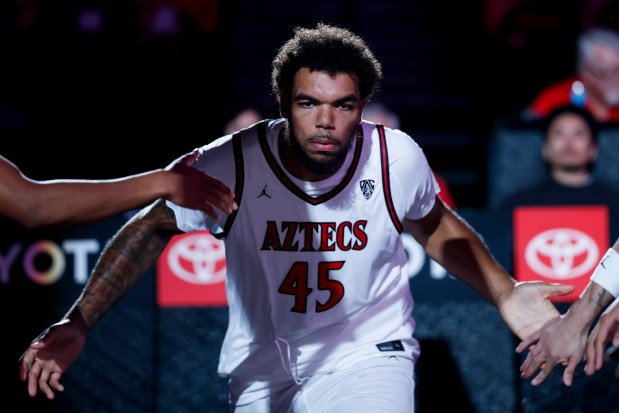 SDSU center Jeremiah “Bear” Cherry walks onto the court during pregame introductions before the exhibition against Long Beach State on Wednesday. (Meg McLaughlin / The San Diego Union-Tribune)
Not your aveage Bear
The rotation will go 10 deep on most nights, with capable replacements at most positions.
But the guy they absolutely, positively can’t afford to lose, either through injury or foul trouble, is 6-foot-10, 270-something-pound senior center Jeremiah “Bear” Cherry.
Dutcher admits it: “He can be the key to the season.”
Cherry grew up in San Diego, then took a circuitous route to return – high school in the Phoenix area, a JC in New Mexico, UNLV, then Sacramento State. He was remarkably injury-free until last season, which lasted six games before a knee injury abruptly ended it.
Cherry ultimately didn’t need surgery and rehabbed diligently through the winter and spring. He’s had a couple of small knocks that kept him out of practice over the summer but has otherwise been durable. He’s also steered clear of foul trouble in the three preseason exhibitions, with five in a combined 69 minutes.
He’s been SDSU’s most consistent performer, hitting double figures in all three games (12, 16 and 11 points) as well as the team leader in rebounds (18) and blocks (10).
“He plays with great passion, he scores that ball, he buries (defenders) in the post,” Dutcher said. “But he’s got room to grow, and we’re on him hard to get better every day. If he becomes the player we all think he can be, then we have a guy down low who’s going to be a problem for everybody.”
USC coach Eric Musselman called him “a legitimate Big Ten-type center.”
It’s an upgrade from last season. The problem is, there’s no comparable replacement. Italy’s Luca Vincini, still adjusting to the American game, doesn’t bring the same athleticism and aggression. Thokbor Majak is 7-1 but still gets pushed around. Tae Simmons played some emergency 5 last season, but he’s 6-6.
“It’s really, really impressive, somebody his size with his athleticism,” sophomore guard Chance Gladden said. “Just the attention he attracts defensively and offensively is really fun to watch.
“I really love playing with him.”
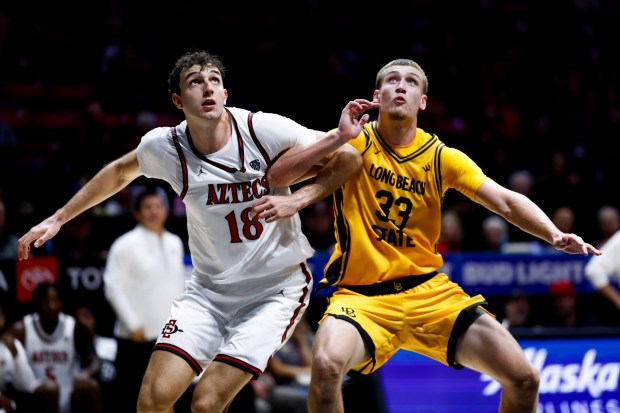 SDSU forward Luca Vincini (18) battles with Long Beach State’s Max Vanlaningham for a rebound in their exhibition last week at Viejas Arena. (Meg McLaughlin / The San Diego Union-Tribune)
The glass
Dutcher was asked about rebounding and pointed to his head.
“All this gray hair is because of rebounding,” he said, only half-joking.
It was the thing, perhaps more than anything else, that held back his last two teams. In both seasons, the Aztecs ranked in the 200s nationally in both collecting and preventing offensive boards after routinely being under 100 in previous years.
Kawhi Leonard’s two teams, in 2009-10 and 2010-11, ranked seventh and 15th nationally in offensive rebound rate.
“I’m always worried about rebounding,” said Dutcher, who turned 67 on Friday. “We have to step up and get the ball. It’s something you work at every day, but great rebounders are instinctual, too. We have to find guys who are instinctual, who will go out there and pursue the ball and get it.
“Sometimes it’s guards; it’s not always the bigs. I’m encouraged by Bear. He’s big and strong, he’s got good hands. Tae is improving but still has room to grow. We will continue to work on rebounding. We will get initial (defensive) stops, but it’s that second-chance opportunity.”
He was speaking a few days before their first exhibition at Arizona, where his team would surrender 20 offensive boards and 19 second-chance points in an 82-67 loss.
It became an even bigger focus at practice, and they showed improvement, outrebounding a taller USC team 36-34. They crushed Long Beach State on the boards in Wednesday’s 92-65 rout, but the Beach was missing its two starting bigs and a 6-10 reserve.
Dutcher is realistic.
“We have a chance to maybe not dominate on the glass,” Dutcher said, “but not lose a game on the glass.”
He’s gray enough.
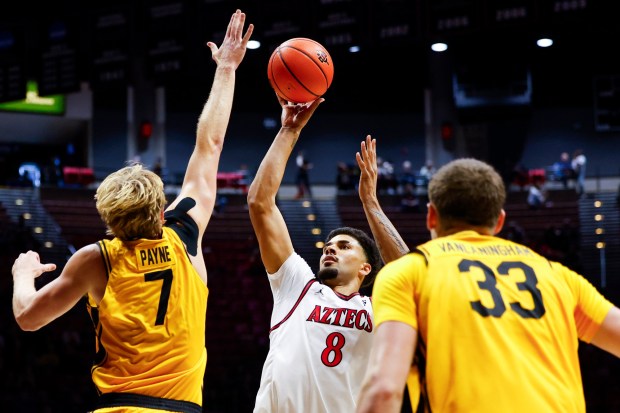 SDSU sophomore forward Tae Simmons shoots a contested shot against Long Beach State’s Jack Payne (7) during last week’s exhibition at Viejas Arena. (Meg McLaughlin / The San Diego Union-Tribune)
Taking their best shot
Dutcher has an unwritten pact with his players: If you play defense with the unrelenting, selfless intensity required, he won’t micromanage your shot selection.
The formula took the Aztecs to the national championship game with Division I’s 75th-most efficient offense, the only team to do that outside the top 50 in the last 20 tournaments.
But offenses have changed as metric-driven NBA concepts creep into the college game, with notable increases in the most efficient shots — 3-pointers, layups and free throws. Some coaches have practically banned the midrange jumper.
Not at SDSU, where 17.6% of shot attempts last season were 2s outside the paint, according to CBB Analytics. The national average was 10.6%, and metric-based programs like UC San Diego were under 5%.
The Aztecs’ 10.2 attempts per game were surpassed by only 19 teams among the 365 in Division I. Their average distance of 2-point attempts (7.1 feet) ranked 333rd. Their ratio of shots behind the arc (33.8%) ranked 301st.
Open midrange jumpers aren’t inherently awful shots, particularly if your opponent has a rim protector and actively deters 3s, but you have to make them at a high clip for them to be productive. The average college team generates 1.1 points per possession, which translates to 36.7% shooting on 3s and 55% on 2-pointers.
The problem was the Aztecs made just 38.5% of their 2-point attempts outside the paint, or .86 points per possession. All other areas were 1.00 or better.
That could change this season with a more perimeter-oriented roster. Elzie Harrington, Chance Gladden, Latrell Davis, Isaiah Sy, Luka Skoric, David Torresani and Zach White are all capable 3-point shooters.
The Aztecs’ ratio of midrange shots is dropping, too. They attempted 13 against Arizona, then 13 combined against USC and Long Beach State. That equated to 11.9% of their total shots.
It might not seem like much, but the margins in college basketball are shrinking as computer readouts calibrate efficiency. Every point counts, and the numbers tell us not all shots are created equal.
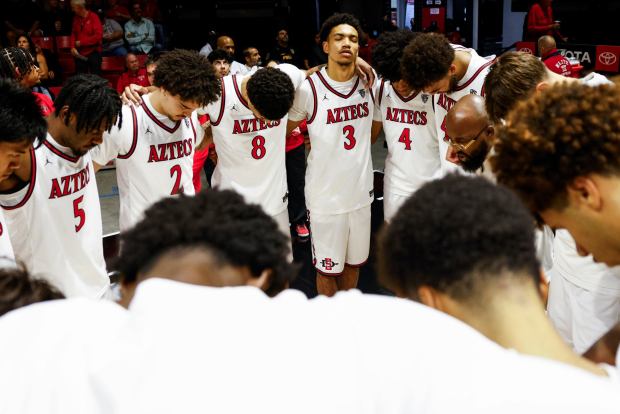 SDSU players pray before their exhibition against Long Beach State at Viejas Arena on Wednesday. (Meg McLaughlin / The San Diego Union-Tribune)
Culture wars
The Aztecs have won with talent, no doubt about it. But they’ve also won with culture — grit, toughness, heart, focus and determination.
The 2022-23 rotation was full of veterans who had been in the program for three, four, five, even six years. They understood the history. They understood the level of commitment.
This team doesn’t — yet. There are nine new players, and the top two returnees were freshmen last season. No one on the roster has played in the NCAA Tournament. Many of them came from losing programs. Three of them were in Europe four months ago.
The coaches remind them daily, explaining what it means to wear an Aztecs basketball uniform, the standards, the expectations, the pride, the pedigree.
Gladden noticed it during the Long Beach State game, thinking they were playing pretty well, up 31 in the second half, the crowd roaring, six players in double figures, the visitors struggling to score.
“It is definitely weird,” said Gladden, who played for a 17-17 Boston University team in the Patriot League last season. “It is pretty intense, even today. The coaches were on us about it not being good enough. It shows how serious it really is.
“It just shows how much attention to detail we have to have.”
How quickly they embody that will determine how quickly they become the team Dutcher envisions.
“That’s a message we have to deliver without beating them down with it,” said Dutcher, in his 28th season on Montezuma Mesa as an assistant or head coach. “They’ll get there. It’s more urgent for us always as coaches than it is for the players.
“We have a sense of urgency, having done it for so long and know what it looks like. And then you get nine new guys who don’t know what it looks like, and you’re trying to show them and explain to them, knowing they’re willing participants and they want to do things the right way, but you’re dealing with a learning curve.
“We have to try to speed the learning curve up as much as we can without beating them down where they give in. … So it’s a process.”
San Diego State
Last season: 22-11 (14-6, second in the Mountain West)
Kenpom ranking: No. 77 nationally
Preseason poll: Picked to finish third in the Pac-12
Coach: Brian Dutcher (10th year)
Key losses: Miles Byrd (Providence), BJ Davis (Creighton), Magoon Gwath (DePaul), Miles Heide (Virginia Tech), Taj DeGourville (Nebraska), Pharaoh Compton (Oregon), Reese Dixon-Waters (senior)
Key returnees: Elzie Harrington (8.0 points per game last season), Tae Simmons (5.8 ppg)
Key additions: Latrell Davis (San Jose State), Jeremiah “Bear” Cherry (Sacramento State), Chance Gladden (Boston), Isaiah Sy (Oregon State), Luka Skoric (Croatia), David Torresani (Italy), Luca Vincini (Italy), Zach White (freshman).
Key games: Nov. 24 vs. No. 18 Iowa State, Dec. 19 vs. No. 25 BYU, Dec. 29 at No. 22 UCLA, Feb. 6 vs. No. 15 Gonzaga
Outlook: This is the lowest the Aztecs have been rated in the preseason Kenpom rankings. The last time they were sub-75 and had a roster of newcomers was 2019-20; they finished 30-2 before the pandemic wiped out the NCAA Tournament. But with only two returning rotation pieces after losing six veterans to the transfer portal, Dutcher has his work cut out for him. The schedule is beyond challenging, with six power conference foes and at least five games against preseason top-25 teams. This edition of the Aztecs does not have the length and athleticism of past year, but may have more skill in the backcourt with players like Harrington, Davis, Gladden and the sharpshooting Sy. The 6-10 Cherry has uncanny agility for his size is a nightly double-double threat, but there’s little interior depth behind him.
He said it: “I told them, ‘There are all sorts of things I can give you, but I can’t give you everything every day. I’ll give you one or two things, and if you do these two things before the next game, you’ll be a better player. And then I’ll give you two more.’ That’s the process we’re in. We have about 30 things we need to do better, but we can’t do all 30 things in one week. So we’ll pick out one or two things and continue to grow this team every week until it is what I think it can be, which is a very competitive team.” – Dutcher
Ceiling: Get some marquee nonconference wins, challenge Gonzaga for the Pac-12 title, return to the NCAA Tournament and maybe win a game or two.
Floor: Overwhelmed by power conference foes, finish middle of the Pac, hover around .500 and miss the tournament for a second straight season.
– MARK ZEIGLER