
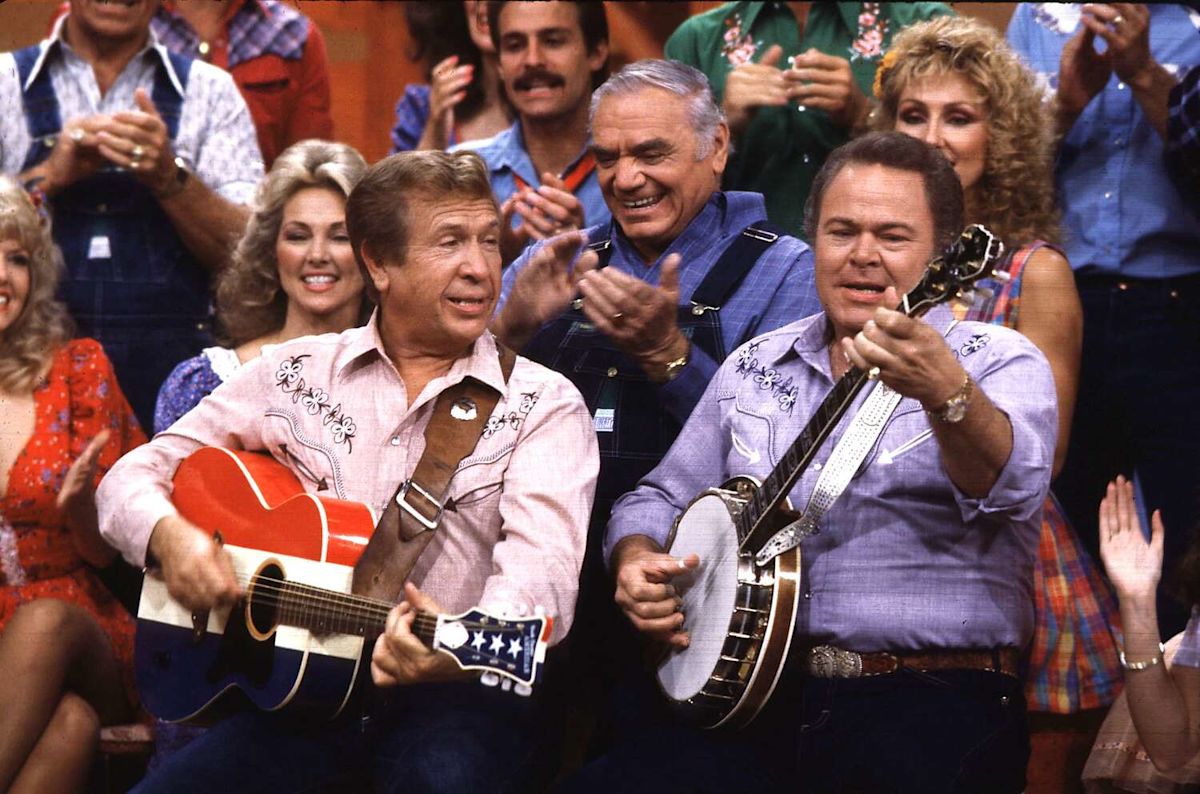
By 1970, Buck Owens was sitting on top of the world.
The future Country Music Hall of Famer had just had a prolific decade. He had No. 1 hit records, with one hit covered by the Beatles. An album of his Carnegie Hall performance was a smash hit. He lived in a star’s house on the bluffs of Bakersfield’s scenic Panorama Drive, overlooking the San Joaquin Valley out to the southern tip of the Sierra Nevada.
But in 1971, a divorce from his second wife, Phyllis Buford, would bring a 15-year phase of his life to an end.
It was then Owens left the family home on Panorama and bought 120 acres about 18 miles north of town. The spread came with plenty of land and a humble little two-bedroom adobe home, which featured a grand fireplace and not much else.
The original adobe house on Owens’ Kern County ranch is long gone, but the property Owens purchased, along with a massive home (built years after he died in 2006) hit the market last week, with a price tag of $5.9 million.

The Bakersfield sign on Sillect Avenue near the Buck Owens Crystal Palace in Bakersfield, Calif. on March 28, 2025. (Douglas Zimmerman/SFGATE)
While the home’s listing agent, Jonathan Busby, told SFGATE earlier this week that the current owners asked him not to comment to the press about the property, the listing itself speaks volumes about what the next owner can expect to get. “A Rare Opportunity to Own a Piece of Bakersfield History!” the listing states. “Property once owned by the legendary Buck Owens, this extraordinary estate spans over 124 acres, including approx. 84 acres of producing pistachio orchards.”
The main property on the parcel is a 6,741-square-foot home with three en suite bedrooms, an office, a game room and three additional bathrooms.
Outside is where the property really shines. The “resort-style amenities” include a pool house, pool and spillover spa (hot tub), outdoor kitchen, a tennis court and a lake for fishing. The property also features a 6,000-foot shop, a four-stall barn, a six-car garage, solar panels and two private wells.
Jim Shaw, director of the Buck Owens Private Foundation, told SFGATE on Tuesday he remembers when Owens first purchased and moved onto the property in late 1970. He recalls Owens downsizing when it came to his actual dwelling, while expanding his time outdoors on the property.
“It was a charming little house,” Shaw said. “I remember when he moved out there, he was up in Panorama. Just kind of a non-insulated adobe with hand-made wooden window sills and rough-sawn wood throughout.”

Pictures of Bakersfield country singer Buck Owens and his guitars hang on the walls at Rooster’s Honkeytonk in Bakersfield, Calif., on March 27, 2025. (Douglas Zimmerman/SFGATE)
The place perhaps wasn’t custom-tailored for a musician of Owens’s stature, but Shaw recalled that Owens felt most at home in this modest house, which may have been why he didn’t do a lot to it during his decades living there.
Shaw recalled the adobe structure as both “a great house” and “terribly impractical.”
“A little kitchen, really small, and one big room,” he said, chuckling. “A huge 10-foot long fireplace. I don’t know what they did in that fireplace. A decent-sized bedroom, and a small maid’s room on the other side. He added one nice big bedroom on one end and put a nice big five-car garage and tennis courts and the pool.”
Shaw said Owens also built a home on the property for his sister, Dorothy Owens, who lived there until she died in 1995 of cancer. That house has also been torn down.
Owens’ family history of cancer had sparked him to donate a lot of his spare time and money to fighting the disease both before and after his sister’s death: “I’m doing my part. If everyone would do their part, and if the government would help, we could lick cancer,” the country star told the Sapulpa Daily Herald in 1977. “The money our government allowed for cancer last year was almost negligible. They wanted to go to the moon – they did it. They wanted to find a polio vaccine – they did it. The government spends billions and billions on projects, then junks ’em.”
Shaw believes the current footprint of the home on the property for sale may be closer to the house where Dorothy lived, but acknowledged that “neither of the original houses” remains standing on the property today.

Buck Owens in his signature red jacket performs with his back-up band, the Buckaroos. Owens, a long-time Bakersfield resident, is credited as being a pioneer of the Bakersfield sound. (Getty Images)
Shaw, a former keyboardist with Owens’ band the Buckaroos, recalls that particular time with such clarity because he came on with Owens in March 1970, just before the singer’s divorce and move out to the country.
Today, the estate becomes the second major remnant of Owens’ physical property to be available.
The Crystal Palace, a national country music landmark in Bakersfield that Owens built as the West Coast’s answer to the Grand Ole Opry, has hosted every who’s who in country music from Taylor Swift to Garth Brooks (who even got engaged there). It shut down a little more than a year ago, and was initially listed for $7.5 million.
Prominently located on Buck Owens Boulevard, the 21,354-square-foot building includes a music hall and restaurant components. The price has since been dropped to $5.75 million.
More Central California
– $725M mega-hotel breaks ground on I-5 between LA and SF
– California plans to create 700 jobs at its first steel mill in over 50 years
– Central Calif. county considers building massive $1.1B town for seniors
– California I-5 commuter city can’t stop megadevelopment
This article originally published at Buck Owens’ massive Kern County ranch asks $5.9M.