
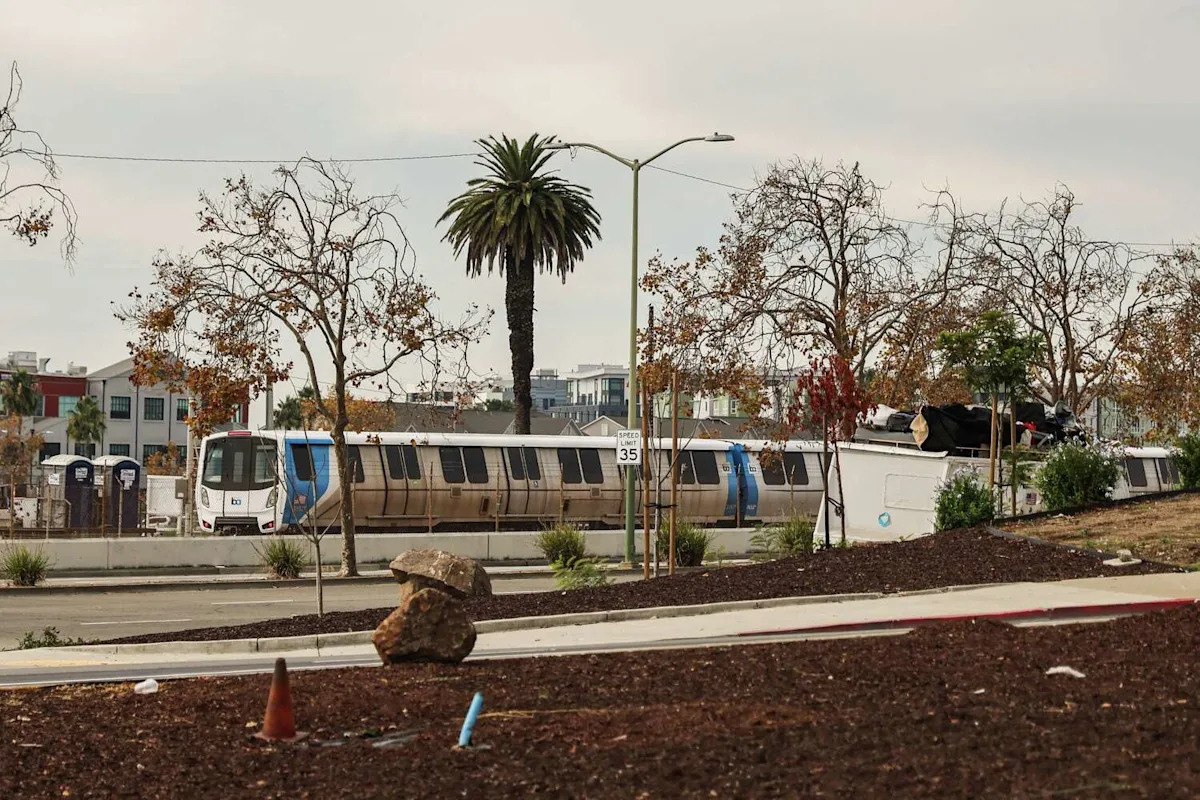
BART is facing a budget crisis of unfathomable magnitude. But that hasn’t stopped political leaders from pressing for a new train station.
This one would sit at the edge of a vibrant neighborhood in East Oakland, on property tantalizingly close to the waterfront but hemmed in by the Nimitz freeway. Train tracks already criss-cross the area, making it ripe for new infrastructure. All that’s missing is the money.
“I’m realistic; this is not something that would be viable for construction next year,” said Oakland City Councilmember Charlene Wang, a proponent of the project. She and others are aware of all the headwinds, ranging from BART’s projected deficit of $400 million annually if voters do not pass a transit sales tax measure in 2026, to the unlikelihood of securing grants from the Trump administration, to the region’s track record of slow-rolling construction.
On top of all that, there is the monumental price tag. A similar in-fill station in Fremont will cost just shy of $300 million, much of it secured and managed by the city. Oakland, like BART, has no funding to spare.
Yet Wang is ready to play the long game. Last week the City Council passed a resolution urging BART to conduct a feasibility study on the proposed San Antonio neighborhood station, which would likely sit at East 12th Street and 14th Avenue. BART’s fortunes and federal politics could easily change with the next election cycle, Wang said, and it doesn’t cost much to consider an idea.
“Honestly, I can’t think of a single thing that would be a better boost for our neighborhood,” said Wendy Jung, who was walking through San Antonio Park, about three blocks up from the proposed station site, on a recent morning. “It would just be so convenient for people who want to pop over to downtown Oakland, or get to San Francisco.”
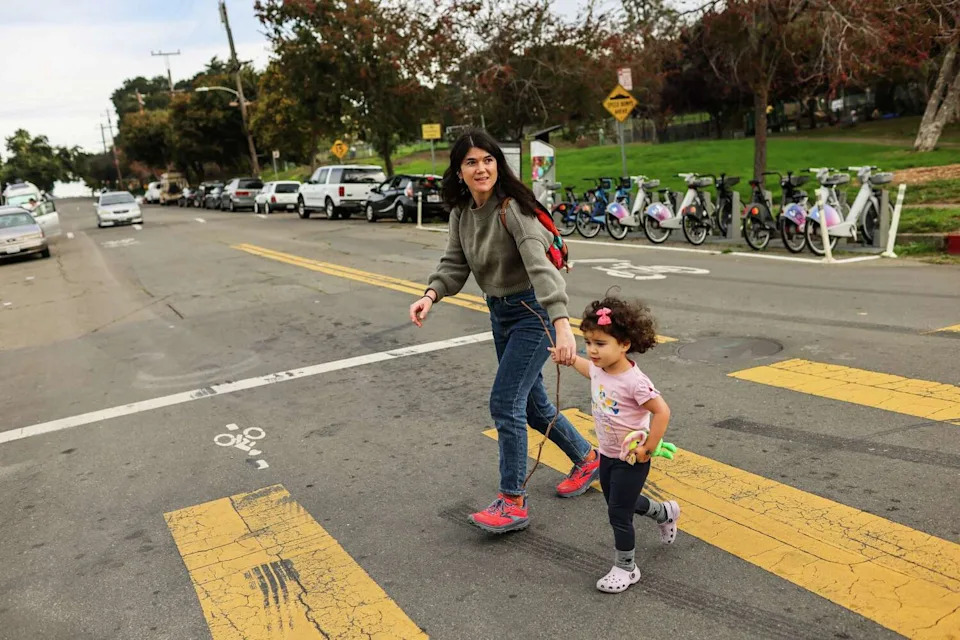
Alejandra Vargas Johnson and her daughter Francisca, 2, cross the street in Oakland, on Tuesday. Residents of Oakland’s San Antonio neighborhood are pressing for a new BART station to fill the gap between Lake Merritt and Fruitvale. (Gabrielle Lurie/S.F. Chronicle)
Officials at BART, however, said there is no plan underway to construct a station at San Antonio, nor does the agency have any funds for a study.
“Our priority right now is focused on BART’s long term financial sustainability and maintaining our current infrastructure and asset management,” spokesperson Alicia Trost said.
During BART’s last board meeting, Director Robert Raburn expressed misgivings, less about the station idea itself than about how his agency was being pressured to handle the logistics.
“The Oakland resolution, as I see it, places all the burden on BART with no promise of an Oakland-led station-area study or upzoning,” he said. “That isn’t the way it works,” he added, with the wincing expression of someone who hates to be a scold.
In the past, BART board directors often chased flashy projects, even when they didn’t make sense. For years, the rail agency invested in extensions, stretching track down the Peninsula, deep into the East Bay, out to San Francisco International Airport and toward the center of Silicon Valley. Some of these efforts sparked controversy: BART spent $484 million on a 3.2 mile connector to Oakland San Francisco Bay Airport, at a time when the system’s rail cars and basic equipment were falling apart.
Ben Matlaw, a transportation planner who lives just outside San Antonio, is careful to acknowledge BART’s financial predicament, while encouraging the agency to embrace the art of the possible. Compared to other proposals, like the airport connector or an expansion to Livermore that the board narrowly rejected in 2018, a San Antonio station would be easy and “cheap,” Matlaw said.
Since track already runs through the crossing at East 12th and 14th Ave., BART need only add a box with platforms and fare gates. The infrastructure could be modest, the effect transformative. A station at San Antonio would patch the three-mile gap between Lake Merritt and Fruitvale and could catalyze new housing and commercial development in a space now occupied by a Burger King. Plans could include a walkway to the Brooklyn Basin housing development, currently separated from East Oakland by train tracks and Interstate 880.
“Look, even when we face a fiscal cliff, we need to be thinking big about mobility,” Matlaw said. “We need to think big about what our region, our state, our country is going to look like 20 years from now.”
At a moment of austerity, BART directors continue pondering how the system should grow. It may take another decade for the Santa Clara Valley Transportation Authority to build the long-awaited BART extension to downtown San Jose, and in the meantime, BART risks evisceration without the transit sales tax. Consultants for the agency have presented scenarios in which nine stations could close.
All the same, BART has partnered with Amtrak’s Capitol Corridor to create the Link21 program, a long-term effort to reimagine Bay Area rail with $11 million in funds, Raburn said. Conceptual maps published by Link21 include a rail line that runs through Alameda and dips back to the Oakland estuary, potentially at San Antonio. Whether that terminus could become a BART station is unclear; this summer the boards of BART and Capitol Corridor voted to use standard gauge rail technology, which is incompatible with BART trains.
Raburn remains open to aspiration and vision-boarding.
“This isn’t being ignored,” he said in an interview. But it’s not in the planning stage. BART is not in a position to act on anything right now except keeping the lights on.”
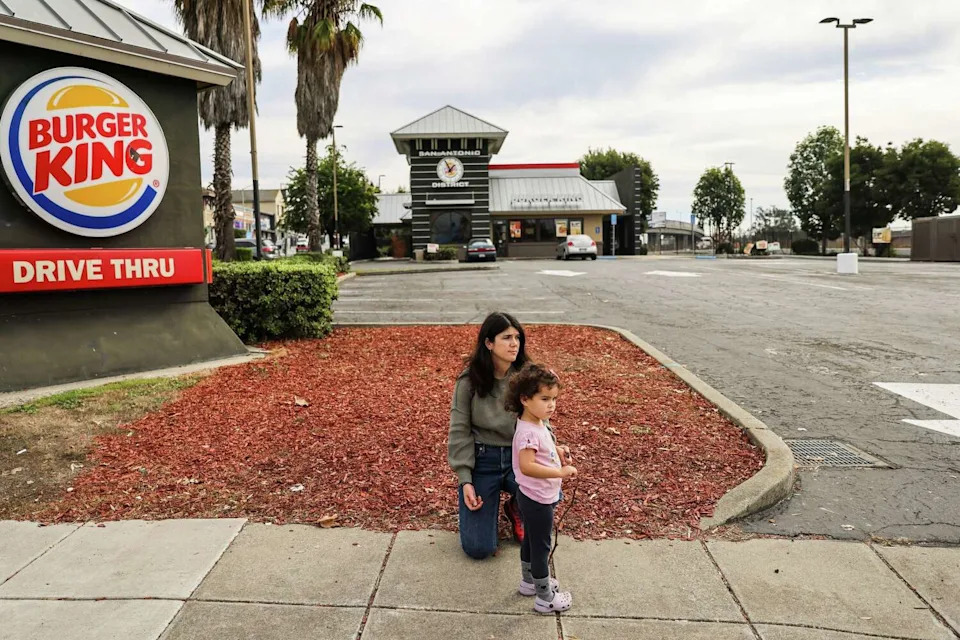
Alejandra Vargas Johnson, with her daughter Francisca, 2, would like to see the Burker King lot in Oakland’s San Antonio neighborhood replaced with a new BART station to fill the gap between Lake Merritt and Fruitvale. (Gabrielle Lurie/S.F. Chronicle)
Supporters of the new station formed a loose coalition called the San Antonio Station Alliance, and began rallying enthusiasm by throwing happy hours, circulating petitions and buttonholing political candidates. They found an ally in BART Board Director Victor Flores, who previously served as a council aide representing the Lake Merritt and San Antonio district, and said he was always perplexed by that hole in the BART line.
Granted, some people are dubious of the plans, regardless of BART’s budgetary quandary. A few have raised concerns that a new train stop, and the real estate development that would come along with it, could be the shock troops of gentrification. Moreover, transportation projects have a history of division in Oakland. AC Transit overcame fierce merchant pushback to build Tempo, the rapid bus line that runs through Fruitvale and into San Leandro, with a stop roughly a hundred feet from the proposed San Antonio station.
Organizers such as Matlaw and Sara Rowley, who lives in the East Lake area, say a better connection to BART would vastly improve their lives.
“A lot of the businesses around here are concerned about safety, and having a station here would mean eyes on the ground, which would help with sideshows and sex trafficking,” Rowley said.
Another resident, Alejandra Vargas-Johnson, got enticed by the station concept after seeing fliers in San Antonio Park. She primarily wants a viable commute to work.
Previously, Vargas-Johnson experimented with different routes to San Francisco’s Financial District. The quickest involved driving to West Oakland to take a five-minute BART ride – seemingly a breeze, until Vargas-Johnson realized she had to pay $17 to park in the station lot.
Now, when she walks by the tracks at East 12th and 14th Ave., she might stare wistfully at the Burger King drive-through. Its blank pavement could be a bustling concourse, filled with people headed east toward Fruitvale or west across the estuary. She would join the rush-hour throngs and be whisked to San Francisco in 15 minutes, using the train ride to check emails on her phone.
Policymakers at BART generally favor this model of urban mobility, and Raburn said he’ll listen to any “public outcry for improved transit service.”
Except that now is a particularly bad time for public outcry.
This article originally published at BART’s fiscal crisis could close 9 stations. So why are people pushing for a new one in Oakland?.