
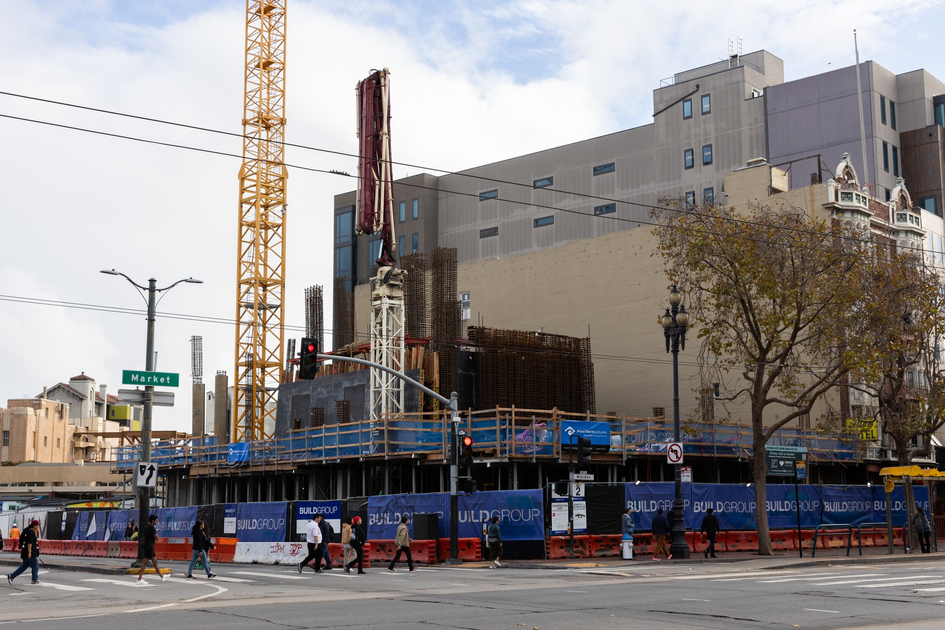
Thousands of applicants, from drag queens to street vendors making fork bracelets, are expected to apply for a lottery to get into sub-market-rent apartments in a 94-unit building designed to keep artists in the city.
The project at Gough and Market streets is the first of its kind prioritizing artists for affordable housing in the city. Part of the unique application process entails setting criteria for who, exactly, qualifies as an artist.
Dabbling in watercolors or enrolling in a poetry workshop is not enough — the city is holding these coveted units for people who earn a certain amount of income from their creative output or have had their commitment to the arts approved by a city commission.
“Everyone deserves a stable place to call home,” said Tiffany Bohee, president of Mercy Housing California, the nonprofit that is one of the developers for the 15-story tower. “For artists, that stability can make it possible to continue creating, building community, and pursuing their work.”
 The “hub” location was chosen for its proximity to arts groups and public transit. | Source: Brennan Smart For the SF Standard
Housing projects often give priority to certain categories of people, such as seniors, veterans, and families. In this case, determining who is an artist was not as simple, requiring legislation sponsored by Board president Rafael Mandelman and approved last fall.
Applicants will be approved if they can demonstrate they earned $10,000 or more in three of the last five years for work in performing, literary, visual, folk, media, and mixed-discipline arts or if they received a grant from a nonprofit, foundation, or government office in the last three years. If artists don’t meet those criteria, they can still submit their oeuvre to be evaluated for “engagement in and professional commitment to artistic practice” by the San Francisco Arts Commission.
“It creates flexibility if it turns out that on the first two we’ve missed something,” Mandelman said. “It allows the body in the city that thinks about arts the most to have additional criteria.”
As a crisis unfolds in San Francisco, with rents up about 20% this year, this project aims to let residents move in in 2028.
 The property at Gough and Market has been challenging for retailers and restaurants. | Source: Brennan Smart For the SF Standard
 Supervisor Rafael Mandelman, who sponsored the legislation, said filling storefronts “would be great” for the neighborhood. | Source: Brennan Smart For the SF Standard
It is the result of a $100-million private donation in 2024 to SFJazz founder Randall Kline’s Artists Hub on Market nonprofit. The organization was named for the “hub” location of the site at 1687 Market, which was chosen for its proximity to dozens of arts organizations, public transit lines and a location that is somehow simultaneously close to Hayes Valley, Civic Center, the Mission, and the Castro.
It will also enliven a neglected section of Market that has struggled to fill its ground-floor retail space. For nearly a century, the site was home to the McRoskey Mattress Co., but the showroom closed after the family-run company was sold to a Fresno-based manufacturer in 2018. Mandelman was hopeful about the foot traffic that could be generated by the lower-floor commercial spaces.
“An art space could be very good,” he said. “A non-vacant storefront would be great.”
Mercy will own and operate the upper affordable housing levels, according to a representative, while AHOM will own and operate the planned arts programming within the development, including rehearsal and practice studios for music and dance, a 99-seat black box theater, and office and program space for artists and arts organizations.
The project will also include a café and arts programs open to the public. Vendors for those spaces have not been chosen yet, but an advisory group made up of leaders from more than 15 city arts organizations is providing feedback.
That group of organizations also helped inform the parameters for the artist certification process. Other than the artist preference, it will mirror other affordable housing lotteries held by the Mayor’s Office of Housing and Community Development.
Certified artists who already live or work in San Francisco will receive additional priority, and 40% of the units are set aside for those who live in the neighborhood, as well as 20% for tenants who have been displaced due to Ellis Act or other no-fault evictions, fires or unaffordable rent increases.
 An artist’s rendering of the proposed 15-story tower. | Source: Courtesy Artists Hub on Market
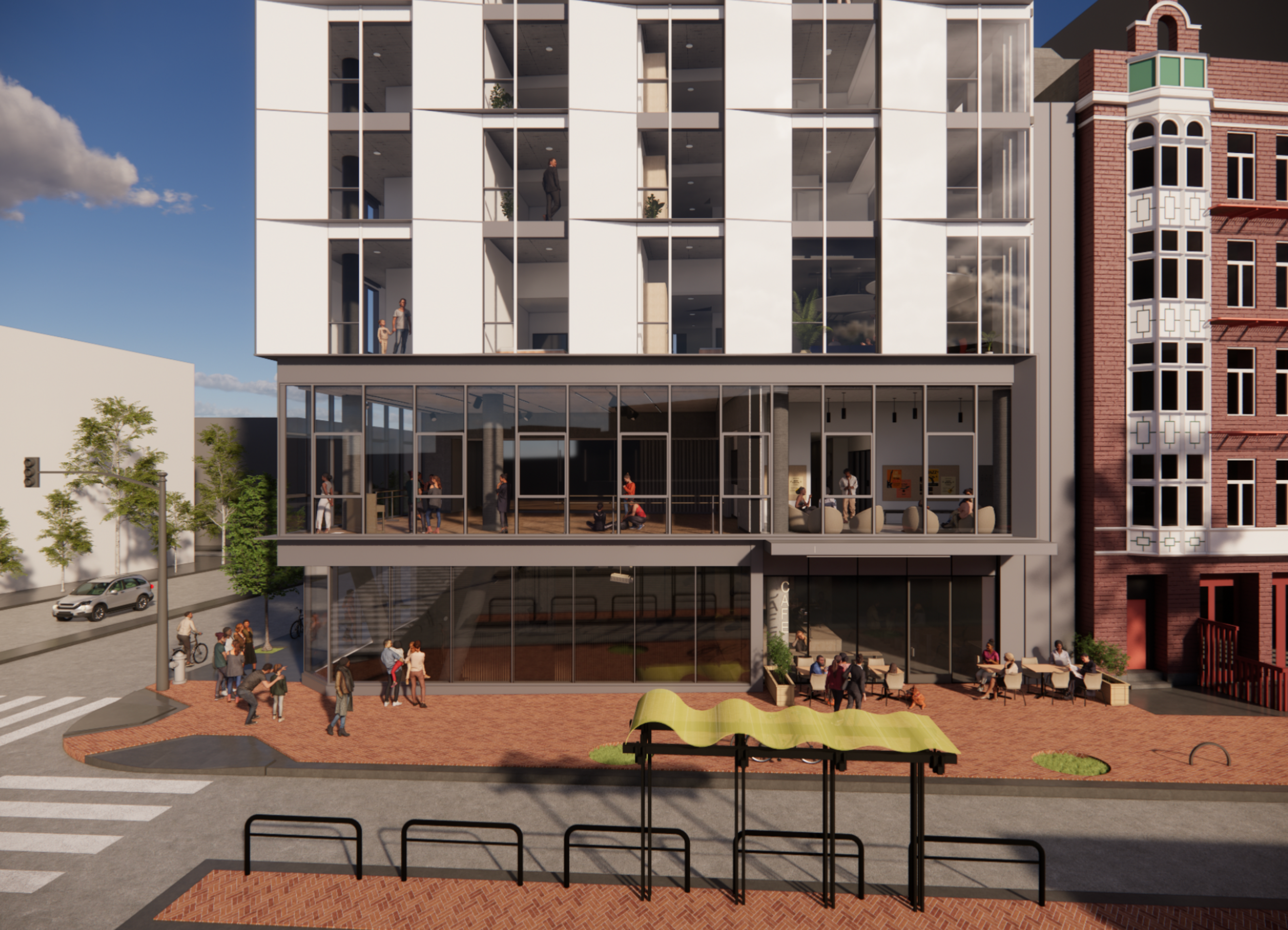 Housing will fill the upper floors, with arts programming and a café below. | Source: Courtesy Artists Hub on Market
“Artists give San Francisco its spirit and its soul, yet too many have been forced to leave because they can no longer afford to stay,” Kline said. “This partnership is an investment in artists across San Francisco, and in the cultural future of the city we all should be able to call home.”
Already, hundreds of people have filled out the commission’s interest form to be notified when the certification process officially opens, likely by next spring, according to Coma Te, the arts commission’s communications director. He hopes to see 10,000 people submit early interest forms, in the hopes of getting 1,000 who actually qualify based on their art and the income rules — as little as $46,440 for a family of two to get a $962-a-month studio, up to $167,120 for a family of five to score a $3,394-a-month two-bedroom.
Artists are less likely to have issues staying within those income requirements than teachers did when they tried to get into affordable housing the city built just for them. But without casting a wide net, it’s still possible the units will open to other affordable housing lottery applicants.
“We want to ensure this housing that was earmarked and gifted to support local artists goes to artists, and we create an amazing hub right in the heart of our city,” Te said.
The Entertainment Community Fund, which has created artist housing in New York and Los Angeles, is one of the key groups providing advice to the local development team. When filling its recent affordable project in Hollywood, they started with over 9,000 applicants, of which 5,700 identified as artists. They had to go through about half of those so-called artists to fill the 151-unit project.
Turning people away can be challenging for those in both affordable housing and the arts, said Keith McNutt, the fund’s western regional executive director.
“We tend to be all-inclusive, but this process is about being exclusive to people who are actually building their life around a career in one of these disciplines of the arts, and I think there’s a philosophical question that any community is going to get right off the bat: Who gets to tell me I’m an artist or not?” he said. “We are not here to help every weekend pottery class aficionado.”
The scoring rubric the arts commission will use is still being developed, Te said, but quality will not be a factor.
“We don’t want to limit or dictate what is art here in San Francisco, but our job is to review,” Te said. “If you say you’re an artist and you can back it up, you’re an artist.”