
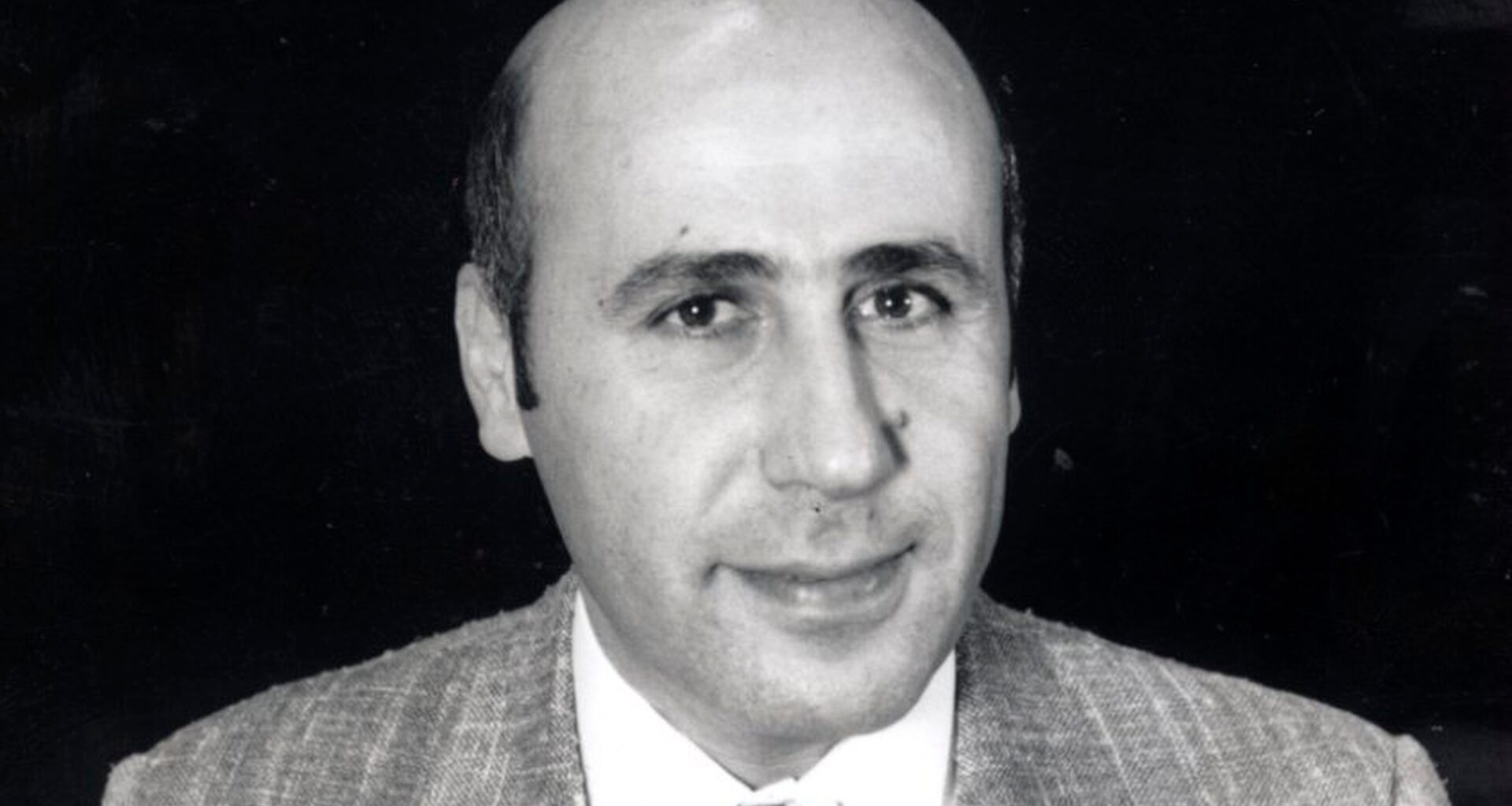
Before we dive too far into it, let’s be clear: This is a story about a very real guy, Alex Odeh, a husband and a father of three, who once lived in Orange County.
Odeh was a Palestinian-born Catholic who eventually moved to Southern California, where he became a spokesman for Arab Americans at a time when that role was rare. He also was a poet, a lecturer at Cal State Fullerton and, after being killed in a 1985 explosion at his office in Santa Ana, a martyr.
But any tale about Odeh is also a story about stories. I’m not usually wild about anything so meta; stories about stories, etc., tend to bore and/or confuse me. But, in this case, it feels apt.
You don’t have to squint to see how various chapters of Odeh’s story converge into something bigger than one guy, something that, decades later, still matters.
Justice?
One chapter in the Odeh story is about what he did with his life.
At the time of his death, at age 41, Odeh was revered in the Arab American community; a go-to source for national media, an important enough figure to be publicly name-checked by President Ronald Regan, and respected enough outside his world that, on the day of the bombing, he was scheduled to speak at a Fountain Valley synagogue.

Helena Odeh displays a 1985 family photo showing her father, Alex Odeh, with his daughters, taken just before his death. She is shown in 2024 next to the statue of her father, located outside the Santa Ana Public Library. (File photo by LEONARD ORTIZ, Orange County Register/SCNG)

Alex Odeh. (Courtesy of Odeh family)

A 1985 family photo shows Alex Odeh with his three young daughters. It was taken months before was assassinated on Oct. 11, 1985 by a pipe bomb in Santa Ana. (Photo by LEONARD ORTIZ, Orange County Register/SCNG)

Before police tore it down on Wednesday, a banner fluttered from the second floor balcony of UCI’s Physical Sciences Lecture Hall: “Alex Odeh Hall,” it said. It has been nearly 40 years since the Palestinian-born Odeh was murdered, but the killing is still officially unsolved (Photo by Leonard Ortiz, Orange County Register/SCNG)
Show Caption
1 of 4
Helena Odeh displays a 1985 family photo showing her father, Alex Odeh, with his daughters, taken just before his death. She is shown in 2024 next to the statue of her father, located outside the Santa Ana Public Library. (File photo by LEONARD ORTIZ, Orange County Register/SCNG)
To this day, a statue of Odeh stands in front of the Santa Ana Public Library, a memorial that over time has been desecrated and vandalized. It’s also been supported and defended by many in the city’s Latino community.
Over the decades, this part of the story – about how Odeh was a multi-cultural guy, and how his push for peace was controversial and ultimately led to his death – has become a become a staple in some households.
“I grew up in an Arab American community in Detroit, and I just knew about (the Odeh story) from community events and people talking about it. His name was sort of a cautionary tale of the dangers of being too outspoken and too public.
“Odeh was one of those stories you have inside you, that you grow up with, if you’re Arab American.”
So says Will Youmans, a former rapper (Iron Sheik) who is now an associate professor of journalism and strategic communication at Northwestern University in Qatar.
Youmans also is co-director of another chapter of the Odeh story, the documentary “Who Killed Alex Odeh?”
This part of Odeh’s tale centers on what happened after his death. The movie, also co-directed by Jason Osder, an adjunct professor of media at George Washington University (and very much not an Arab American, more on that later), won the Special Jury Award for Journalistic Excellence this year at the Sundance Film Festival. It premiered earlier this year in Berlin, and was shown last month at the Newport Beach Film Festival, and it’s slated to open a six-day run Thursday, Nov. 5, at the Frida Cinema in Santa Ana, not far from where Odeh lived and died.
Youmans and Osder both admit their film is poorly named. Instead of “Who Killed…” a more apt title might be “Why Haven’t the People Suspected of Killing Alex Odeh Been Extradited to the United States At Some Point Over the Past, Oh, 40-plus Years?”
Too long? Fair, but you get the gist; early on, the movie identifies three men the FBI previously identified as key suspects in the Odeh bombing. All three once lived in Southern California and were members of the Jewish Defense League, an organization linked to violence, but soon after Odeh’s death they moved to Israel.
So it’s no whodunnit. Instead, the mystery at the center of the film is about how, over the years, several regimes of various political stripes – in the United States and in Israel – have vigorously done nothing to bring Odeh’s suspected killers back to the United States for a possible trial. The movie illustrates how people sometimes get away with stuff without punishment. And since the “stuff” in this case is Odeh’s death, it essentially asks this question:
“Who can get away with murder?”
“It’s about impunity,” Osder said.
“(Odeh’s death) was a killing, on U.S. soil. But actions were not taken to bring this to justice. And we have to ask why?”
Winds change
The idea to make a documentary about Odeh started about 10 years ago, when Youmans, who describes himself as being overly fond of “very boring, academic” research, brought it to Osder, who has made other documentaries.
Osder, at that point, hadn’t heard much about Odeh. He also hadn’t thought much about the roiling, seemingly endless violence in the Middle East.
That quickly changed.
“Making this movie was really my first exposure to looking at the issue of Israel and Palestine in a serious way. I was raised Jewish and secular in America. And I think there are a lot of American Jews, and non-Jews, who kind of punt on this issue. They say, ‘It’s so complicated,’ or, ‘I haven’t thought about it enough to form an opinion.’”
“But it’s an issue worth learning about,” Osder added. “We have a responsibility to learn it.”
It’s also an issue that shifted during the decade or so that it took to finance, report and film the Odeh documentary.
The film – which received funding from Jewish and Arab American organizations, as well as schools and others – was close to being ready for release three years ago. But that changed in the wake of the Oct. 7, 2023, attacks in which Hamas terrorists and Palestinian militants from Gaza invaded Israel, killed nearly 1,200 people and took 253 others hostage. The organized attack, which touched in some 20 Israeli communities near the border, included sexual assaults, torture and infanticide.
Israel responded, waging war in Gaza and the West Bank, the same strip of land where Odeh was born, in 1944, when it was named Mandatory Palestine. As of this month, fighting in the West Bank and Gaza Strip has resulted in more than 74,600 deaths, mostly civilians, in the region, according to the U.S. State Department.
The horror has also prompted friction between Jews and Arabs and others around the world. And it has been the subject of protests in places as distant as UC Irvine.
In 2024, when students occupied part of the UCI campus to express their outrage over the violence in Gaza and the West Bank – and, in some cases, to denounce Jews and call for the end of Israel – some of the protesters hung a banner on the Physical Sciences Lecture Building.
It read: “Alex Odeh Hall.”
Students born decades after Odeh lived and died knew his story well enough to see him as an inspiration.
The Odeh story, which Youmans said was re-edited in 2023, also had a new reason to be told.
“We realized, early on in the reporting process, that this wasn’t just a story about history. It was about how history resonates in the present,” Osder said.
“I think that just continued in the aftermath of Oct. 7 and the response to that,” he added. “The story still matters, maybe more than when we started.”