
Sacramento Mayor Kevin McCarty will outline his priorities for the city’s future during his second State of the City address Thursday morning at the Crocker Art Museum. The event could offer a preview of major city initiatives and priorities for the coming year.
Unlike traditional State of the City addresses, the event will feature a question-and-answer session with a yet-to-be-announced interviewer. Potential topics include homelessness, economic development and a projected $40 million city budget deficit.
Facing a $66.2 million budget shortfall in 2026, the city avoided widespread layoffs by eliminating vacant positions, raising fees and cutting homelessness spending. Many of the cuts produced ongoing savings, but the city must increase revenue or make additional cuts to balance future budgets.
Addressing homelessness was a central promise of McCarty’s 2024 mayoral campaign. McCarty touts “significant process” in sheltering homeless people, pointing to the opening of 500 new beds in his first 15 months as mayor and a 19% reduction of people living unsheltered within city limits between 2024 and 2026.
His signature initiative has focused on expanding shelter capacity for unhoused residents. In the spring, the city opened a 96-bed safe camping site in the River District, but the mayor’s primary focus has been developing tiny home “micro-communities” for homeless older adults.
The tiny home villages have faced opposition since they were proposed, particularly a planned site along Arena Boulevard in Natomas, which Councilmember Lisa Kaplan has staunchly opposed. The Sacramento Bee reported that the projected cost of the Natomas site had nearly doubled from initial cost estimates. In a memo, City Manager Maraskeshia Smith told council members that the project was on hold.

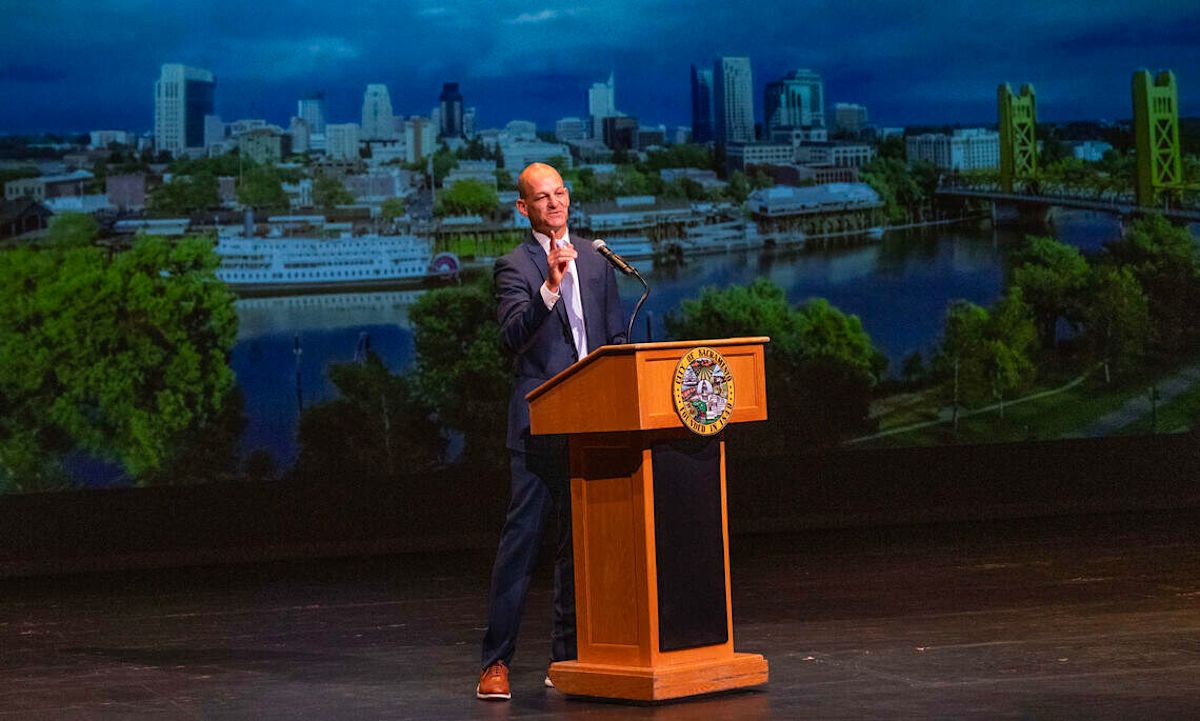
Sacramento Mayor Kevin McCarty gives his first State of the City address on Monday, Oct. 20, 2025, at the B Street Theatre in Sacramento.
Cost estimates for the other two sites in south Sacramento have also ballooned, forcing the city to reduce the number of planned tiny homes at each location by 25%. McCarty said the two sites were expected to begin accepting residents by early 2027.
McCarty’s six-point homelessness plan also called for securing state grants to build more substantial tiny homes as permanent supportive housing for older adults and veterans. The city received $42 million in Project Homekey+ funding to build 100 affordable tiny homes at Rio Linda Boulevard and Las Palmas Avenue.
At last year’s “fireside chat” with Capital Public Radio’s Vicki Gonzalez, McCarty announced a joint campaign with West Sacramento to bring a permanent Major League Baseball team to the region.
He also announced a citywide ballot initiative that would have provided assistance to first-time homebuyers and renters at risk of homelessness while funding several tiny home developments through a real estate transfer tax on high-value property sales. McCarty said the measure would help residents achieve the “American Dream.”
Local real estate agents largely rejected the plan, and McCarty dropped plans to place it on the November 2026 ballot after a city-sponsored poll showed limited support. He said at the time that he would consider reviving the measure in future years and continuing discussions with opponents.