
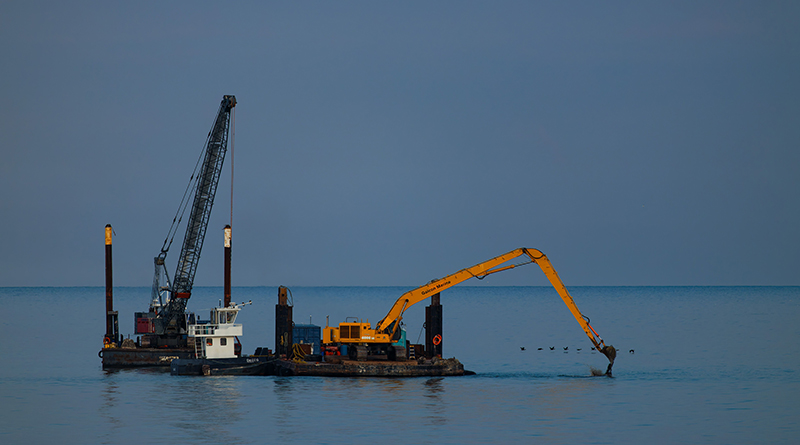
More than 400,000 cubic yards of sediment will be removed from the Alamitos Bay entrance channel and reused along Peninsula Beach, improving vessel access while adding protection to an eroding stretch of shoreline.
LONG BEACH — More than two decades after the entrance to Alamitos Bay was last dredged, a major project is underway to deepen the heavily traveled channel while using the removed sand to reinforce a stretch of the Long Beach Peninsula vulnerable to erosion and winter storms.
The City of Long Beach began dredging the Alamitos Bay entrance channel Oct. 20 as part of an $11.4 million project expected to continue through February 2027. Approximately 415,000 cubic yards of sandy sediment will be removed from the channel, restoring federally authorized navigational depths and improving access for recreational vessels traveling between the Pacific Ocean and Alamitos Bay.
For boaters, the work addresses a problem that’s gradually developed beneath the surface. Sand and sediment naturally move along the Southern California coastline, and over time that material can accumulate in navigation channels. As the bottom rises, available water depth decreases, potentially creating difficult conditions for vessels, particularly those with deeper drafts or operating during lower tides.
The Alamitos Bay entrance hasn’t been dredged in more than 20 years. Restoring the channel is intended to maintain safe access to one of Long Beach’s primary recreational boating areas and the network of marinas, launch facilities and waterfront destinations connected to it.
Beyond the entrance are Alamitos Bay Marina, Davies Launch Ramp, Marine Stadium, Naples Island, and Spinnaker Bay, along with thousands of recreational boaters who use the bay and its surrounding facilities throughout the year.
Rather than hauling the dredged material away, Long Beach is putting the sand back to work.
Material removed from the channel is being transported onto Peninsula Beach between approximately 61st Place and the jetty at 72nd Place. The beach nourishment portion of the project is expected to widen the targeted shoreline by roughly 200 feet, providing additional sand between the ocean and nearby homes and infrastructure.
The approach allows one coastal problem to help address another. Sediment that’s accumulated where boaters need deeper water can be relocated to an area where the shoreline needs additional material.
The timing has made that second purpose particularly noticeable.
Recent storms have taken a toll on the Long Beach Peninsula, stripping sand from portions of the beach and damaging sections of the boardwalk, seawall and nearby properties. High tides and the possibility of additional winter storms have kept coastal flooding and erosion at the forefront for residents throughout Southern California.
Adding hundreds of thousands of cubic yards of sand won’t eliminate the effects of future storms, but a wider beach can provide an additional buffer by giving waves more shoreline to cross before reaching homes and other infrastructure. Beach nourishment can also help maintain recreational space and public coastal access in areas affected by erosion.
The project reflects a broader sediment-management strategy in which suitable material removed during dredging is beneficially reused rather than treated solely as material for disposal. In Alamitos Bay, the sandy composition of the dredged sediment provides an opportunity to combine navigation maintenance with shoreline nourishment.
Manson Construction is performing the work, with equipment including the cutter-suction dredge H.R. Morris and derrick barge DB Freya. Mobilization began Oct. 14, followed by the start of dredging Oct. 20.
The project is being funded through Marina and Tidelands funds and has received regulatory approvals involving the U.S. Army Corps of Engineers, California Coastal Commission, and Regional Water Quality Control Board.
Boaters should expect construction activity around the entrance channel while work continues. Dredges, barges, pipelines and support vessels can create operating conditions different from a normal transit through the area, making reduced speeds, additional awareness, and attention to temporary navigation instructions particularly important.
The work is also affecting shoreside access. The 72nd Place parking lot is being used as a staging area for city crews and contractors, resulting in parking restrictions posted at the site.
For Long Beach’s boating community, however, the long-term objective is straightforward. Alamitos Bay depends on a navigable connection to the ocean, and that connection requires periodic maintenance as sand continues to move along the coastline.
After more than 20 years of sediment accumulation, the current removal project will restore authorized channel depths while relocating that material only a short distance away, where it can serve an entirely different purpose.
By the project’s scheduled completion in February, the entrance to Alamitos Bay should be deeper — and Peninsula Beach considerably wider — making the $11.4 million undertaking as much a shoreline project as it is a boating project.