
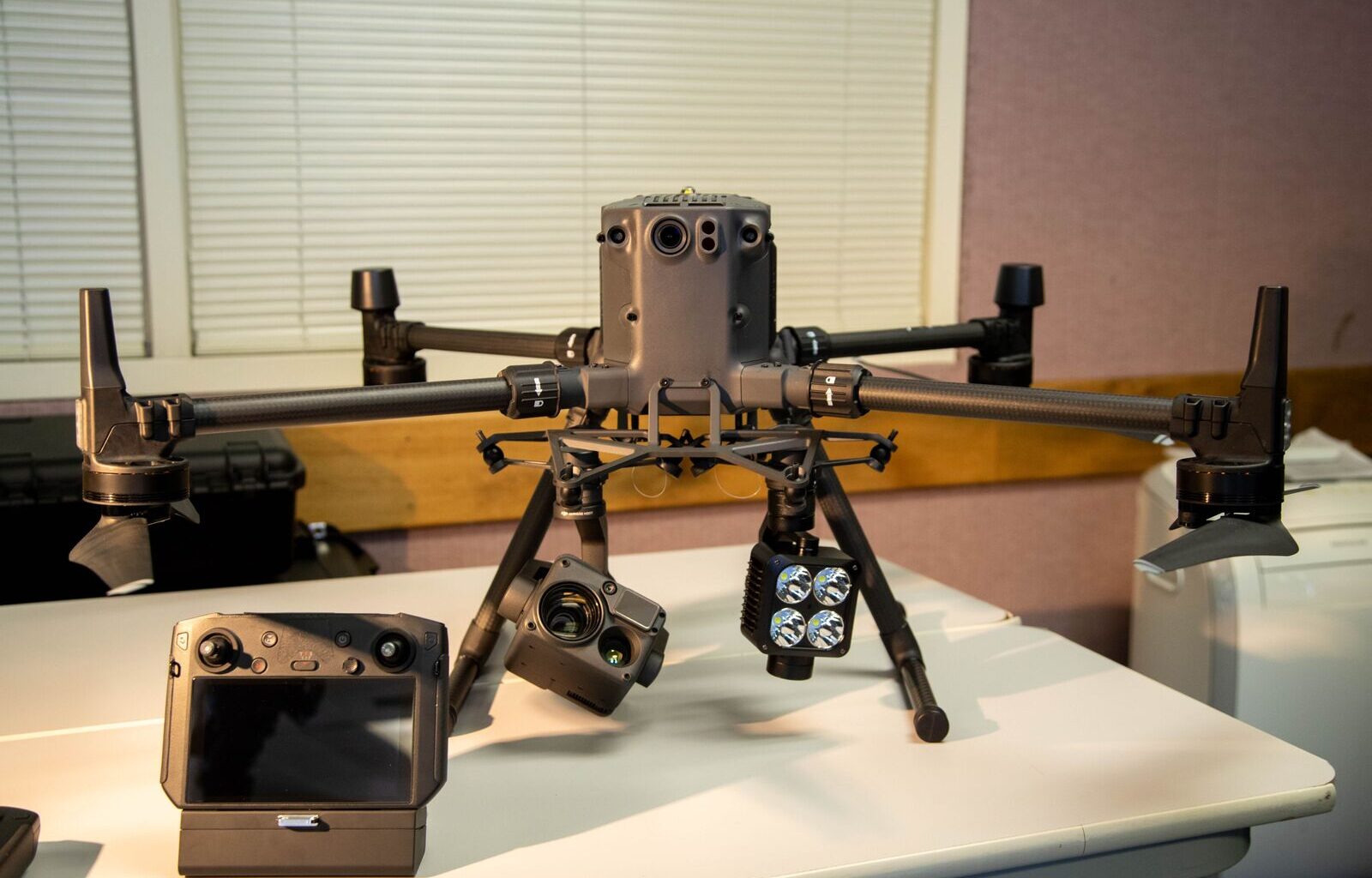
Oakland police are seeking a green light to station six drones on rooftops at three locations across the city. These nimble aircraft, with powerful built-in surveillance sensors, would be ready to fly at a moment’s notice to emergencies like fires, car crashes, shootings, and robberies.
The drones, piloted by OPD officers working from the department’s headquarters, would transmit live video to officers, giving them a bird’s-eye view of crises before patrol officers arrive. In some cases, police say, the footage could help them determine whether officers need to respond at all.
OPD leaders say the new drones could help officers reach emergencies faster, assess potentially dangerous situations, and free up limited police resources.
Last month, the Police Commission unanimously approved the department’s request to buy more equipment as part of its proposed “drone-as-first-responder” program, and policies for the program. OPD’s request had been approved unanimously by the Privacy Advisory Commission earlier in October.
The proposal is part of a broader effort to expand OPD’s existing drone fleet, which launched in 2022 and has primarily been used during high-risk incidents, searches for missing people, and emergency rescue operations.
But the proposal has also raised concerns about privacy, oversight, and how OPD would prevent drones from being used to monitor people who aren’t suspected of committing crimes.
At the Oct. 22 Police Commission meeting, Acting Capt. Omar Daza-Quiroz defended the proposal as a way to improve public safety without significantly increasing the department’s staffing.
Daza-Quiroz said he has spent several years researching drone-as-first-responder programs in other cities, including Chula Vista and Redondo Beach.
“What I’m trying to do is come up with a technology that works and assists us where we don’t necessarily always have to send a police officer to a certain location,” said Daza-Quiroz, who oversees OPD’s drone program.
How would the drone-as-first-responder program work?
OPD already has a “field-based” drone program, in which trained officers transport drones in their patrol cars and launch them at the scene of an incident. Each deployment requires permission from a lieutenant or higher-ranking officer.
Daza-Quiroz said the existing system has limitations. An operator must be on duty, available to respond, and able to drive to the scene before launching a drone. Those requirements, he said, can delay officers’ ability to obtain aerial footage, particularly when officers are responding to emergencies farther away.
The drone-as-first-responder program would eliminate the need for an operator to travel to the scene of an incident.
“It gives us information. It gives us time. It gives us distance. It helps mitigate the use of force, so you’re not going into the unknown,” Daza-Quiroz said.
As part of the DFR program, the drones would sit inside waterproof docking stations on rooftops, where they could recharge between flights. A certified operator at OPD’s real-time operations center would review 911 calls, determine whether a drone should be deployed, and remotely send the aircraft to the location.
The department wants to place two drones at each of the three locations, providing coverage across OPD’s six patrol areas. Having two at each site would allow one drone to replace the other when its battery runs low, Daza-Quiroz said. He did not state where the docking locations would be, but the city’s municipally owned buildings are clustered around downtown Oakland, Eastmont, and the city’s municipal service center near the Coliseum.
The drones would be equipped with thermal imaging cameras, allowing officers to identify heat emitted from a person or animal in the dark or in conditions where visibility is limited.
Daza-Quiroz cited two recent incidents in which he said the drones could have been useful.
On the morning of Oct. 20, about 20 officers responded to reports of a person sleeping inside a car with a rifle near 17th Avenue and East 15th Street, in East Oakland’s San Antonio neighborhood. It took officers two hours to detain the person and recover the firearm, according to Daza-Quiroz. At the time of the incident, OPD had 138 pending calls.
“That is 138 calls for service that we can’t go to, that officers still have to respond to after,” Daza-Quiroz said.
The following evening, two hikers called 911 from the Oakland Hills after spotting two mountain lions and hiding in a tree. OPD requested aerial assistance from the California Highway Patrol, but it took about two hours for the helicopter to arrive.
“By the time CHP got there, it is my understanding that the mountain lions may have moved,” Daza-Quiroz said.
A drone equipped with heat sensors, he said, could have helped officers determine whether the mountain lions were still nearby and rescue the hikers sooner.
The program would cost approximately $2.6 million over five years. OPD plans to use funding from Measure NN, the public safety parcel and parking taxes approved by Oakland voters in 2024.
Separately, the department wants to purchase seven new field-based drones for around half a million using existing asset forfeiture funds. Those drones would replace aging equipment, some of which has been in service for several years, Daza-Quiroz said.
OPD initially sought to acquire up to 30 smaller drones designed to operate inside buildings, including during incidents involving barricaded suspects or hostage situations. Those drones, which cost $1,000 to $1,200 each, would be donated by officers rather than purchased with city funds.
After Police Commission members questioned why the department needed so many drones when it only had 19 certified operators, Daza-Quiroz agreed to reduce the request to 19 interior drones.
Altogether, the first-responder drones, new field-based drones, and drones designed to operate in buildings would constitute a significant expansion of OPD’s drone fleet.
Daza-Quiroz pointed to the department’s staffing shortages and lengthy response times as reasons to expand the drone program. According to OPD’s latest report to the Police Commission, the department has roughly 600 officers, but only 530 are available for duty after accounting for those on medical leave, administrative leave, or other absences.
OPD recorded 131 drone deployments in 2025, compared with tens of thousands of calls that Daza-Quiroz said could potentially have benefited from aerial assistance.
Since launching its field-based drone program, OPD has conducted 609 flights, located 1,102 missing people, and recovered 146 guns, according to Daza-Quiroz. He said there haven’t been any known violations of the department’s policies — drafted in partnership with the Police Commission and Privacy Commission — governing drone use.
Those figures, however, have not established how many incidents were resolved with the help of drones or whether their use reduced police response times or uses of force. When Police Commissioner Angela Jackson-Castain asked whether there was a direct correlation between drone deployments and reductions in police canine deployments, Daza-Quiroz said no such correlation had been established.
Concerns about drones’ impact on privacy
OPD will not be allowed to equip drones with weapons or use facial recognition technology. The department is also barred from using the drones for general surveillance or immigration enforcement. OPD would also be prohibited from deploying drones solely to monitor people exercising their First Amendment rights, such as participating in protests.
Daza-Quiroz told the Police Commission that drones would not record video while traveling to or returning from a call for service. Recording would generally begin once a drone reached its destination, although operators could start recording earlier if they encountered another incident requiring an emergency response.
The proposal would also change how the department approves drone deployments. Unlike the field-based program, which requires authorization from a lieutenant or higher-ranking officer before each flight, the DFR program would allow trained operators to make deployment decisions based on incoming 911 calls.
That distinction raised questions for the Police Commission regarding how broadly the drones could be used and what would prevent operators from deploying drones to investigate activity unrelated to the original call.
During the Police Commission’s review of the program last month, Commission Vice Chair Shawana Booker said OPD needs to consider how the first-responder program might affect residents who have historically had negative interactions with police. She pointed to concerns raised in emails to the commission about the possibility of people being captured on drone footage during investigations in which they had no involvement.
Booker also questioned whether operators could redirect a drone if they observed something unrelated but suspicious while flying to an incident.
Daza-Quiroz said deployment decisions would depend on the circumstances and priority of the incident, comparing the situation to an officer responding to one call who encounters a more serious emergency along the way.
Commissioners also raised concerns about the possibility of drones being used to observe protests of federal immigration authorities.
Commissioner Evelio Grillo asked how OPD would distinguish between responding to criminal activity and assisting U.S. Immigration and Customs Enforcement officers. Daza-Quiroz said OPD would still need to respond to emergencies involving injured people or threats to public safety, even if they occurred during a protest against ICE.
In those instances, he said, an incident commander or lieutenant would determine whether deploying a drone is appropriate.
Commissioners also questioned how long OPD would retain drone footage and whether it would remain available for investigations into potential police misconduct.
Under the proposed use policy, footage without criminal or internal significance would be deleted after five days. Recordings considered evidence in criminal cases or internal investigations could be kept longer.
The public had a chance to weigh in on OPD’s drone proposal at last month’s Police Commission meeting.
District 4 resident Rajni Mandal urged commissioners to approve the plan, saying OPD’s staffing shortages and long response times make the technology necessary.
“Public safety cannot wait,” Mandal said.
Oakland resident Jane Cramer said the drones could potentially be useful, but that the department needed to do more to address residents’ concerns about surveillance.
Madeline Stacy, another Oakland resident, expressed concerns about the companies OPD would buy the drones from. OPD’s impact report states that the seven field-based drones and the six first-responder drones would be purchased from Skydio, an autonomous drone manufacturer based in San Mateo, with software from Axon Air.
“Skydio is being used by ICE and police departments to spy on protesters, and their drones are used to commit genocide in Palestine and to commit human rights abuses in the Philippines,” Stacy said. “We need to not have any contracts or relationships with vendors that support genocide and work with Border Patrol.”
District 3 resident Anne Janks asked why OPD needed sworn officers to operate the drones instead of hiring civilian operators, particularly when OPD has repeatedly cited a shortage of officers available to respond to emergencies. Daza-Quiroz said that trained, Federal Aviation Administration-licensed officers would be better equipped to interpret what they saw and communicate relevant information to patrol officers responding to the incident.
The department recently saw two of its FAA-licensed helicopter pilots indicted by a federal grand jury for fraud, a development that has partly grounded OPD’s helicopters.
A handful of other law enforcement agencies have similar drone programs
OPD would not be the first local law enforcement agency to use drones as first responders. The Fremont police and fire departments launched a drone first responder program in 2022, making it the first in the country, according to city officials. Similar programs exist in Los Angeles, San Francisco, and Elk Grove.
The Alameda County Sheriff’s Office also already operates a similar program through its real-time information center, which is connected to its 911 system and allows deputies to remotely deploy drones to emergencies, according to agency spokesperson Sgt. Roberto Morales.
“Nine times out of 10, a drone will get there first,” Morales told The Oaklandside.
He described a recent incident on Interstate 580 involving a wrong-way driver in which deputies deployed a drone to track the car without pursuing it directly. The drone provided real-time aerial footage as deputies worked to apprehend the driver.
Morales said the sheriff also uses smaller drones that can enter buildings or broadcast commands to people during potentially dangerous encounters. Those aircraft are separate from its first-responder drones, which can travel farther, fly higher, and have longer battery life, he said.
The sheriff’s office has also used drones to locate missing people and assist firefighters during emergencies. In one incident, Morales said, a drone located a woman near a burning vehicle who could not tell dispatchers where she was, allowing emergency personnel to find her and extinguish the car fire.
“It provides a lot of safety for our community and for our first responders,” Morales said.
The agency’s first responder aircraft were originally developed by Aerodome, a company acquired in 2024 by Flock Safety, a surveillance technology company that has come under fire for its automated license plate readers.
Morales said the sheriff’s office aims to expand the program by placing drones in additional locations throughout unincorporated Alameda County. Its current deployment area is limited by the distance the aircraft can travel, meaning drones based in San Leandro cannot reach emergencies in the Tri-Valley area.
In late October, the county Board of Supervisors approved a 10-year contract with Flock Safety for two fixed drone docking stations as part of the sheriff’s office’s existing first responder program. The new equipment, first reported by the Mercury News, would be installed on top of Alameda County Fire Station 23 in Cherryland.
The sheriff’s office can also provide drone assistance to other local law enforcement agencies when equipment and operators are available, Morales said, although responding to incidents within its own jurisdiction takes priority.
“*” indicates required fields