
Many still recall the explosion in the Port of Los Angeles that is coming up on its 50th anniversary.
To commemorate the disaster that many still remember, the San Pedro Heritage Museum will host a story-telling time from 10:30 a.m. to noon on Saturday, Nov. 7, at Warehouse 9, 2451 Signal St.
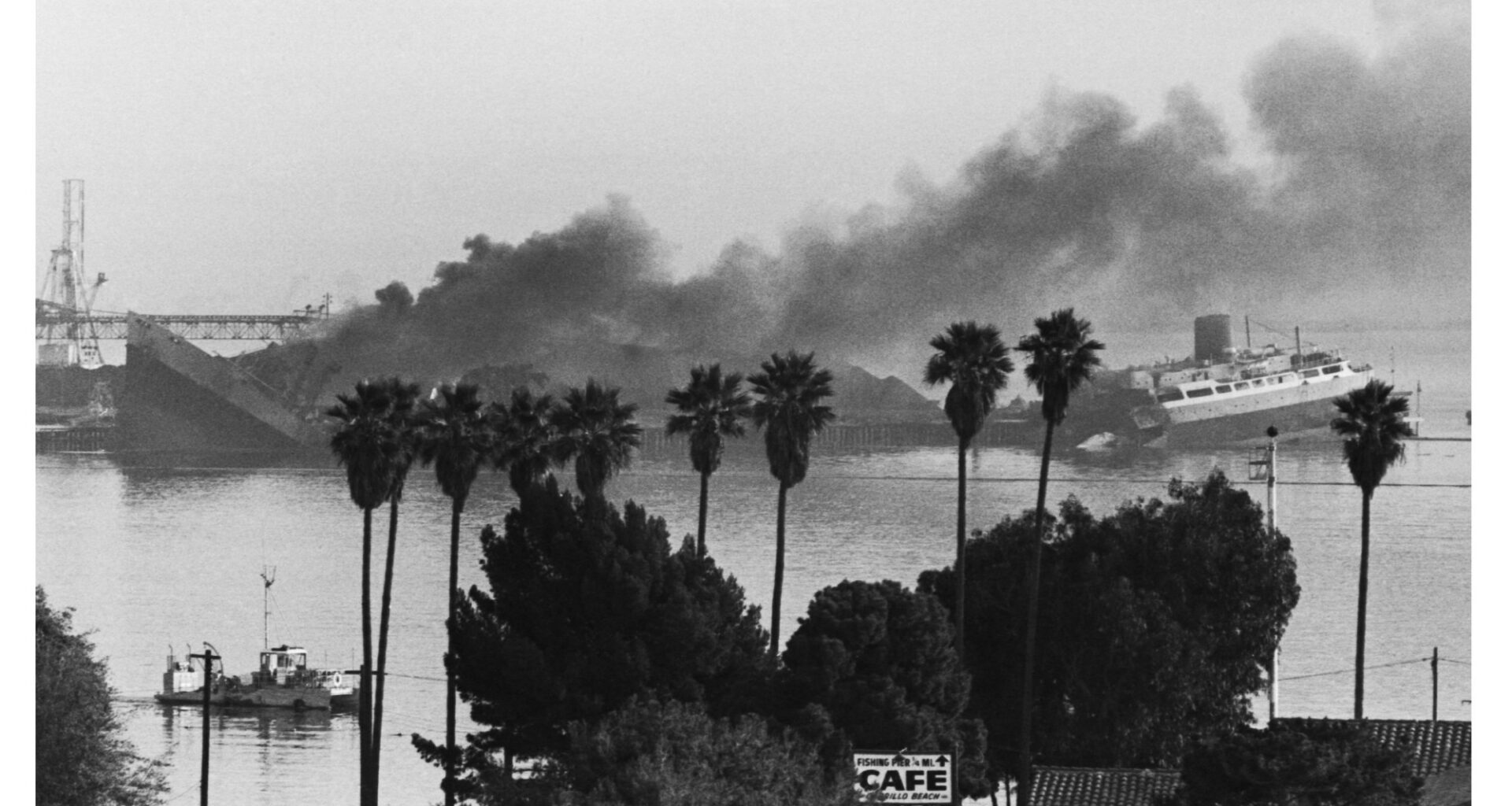
The blast destroyed the Liberia oil tanker SS Sansinena at Berth 46 in the Port of Los Angeles at 7:33 p.m. Dec. 17, 1976 — and killed nine people (crew and terminal personnel), leaving dozens injured. It sent ship parts flying through the air, shattered windows 25 miles away and sparked a major fire at the Union Oil Terminal nearby.
The cause was eventually pinpointed as a build-up of flammable hydrocarbon vapors igniting during ballasting and refueling. Today, those vessels are required to be checked by fire officials before entering the ports of Los Angeles and Long Beach.

Nine crew were killed and 46 people were injured when the tanker Sansinena exploded in the Los Angeles Harbor on December. 17, 1976, spilling 1.3 million gallons of oil. (Press-Telegram file, Los Angeles Fire Department Historical Archive)

Nine crew were killed and 46 people were injured when the tanker Sansinena exploded in the Los Angeles Harbor on December. 17, 1976, spilling 1.3 million gallons of oil. (Press-Telegram file, Los Angeles Fire Department Historical Archive)

Nine crew were killed and 46 people were injured when the tanker Sansinena exploded in the Los Angeles Harbor on December. 17, 1976, spilling 1.3 million gallons of oil. (Press-Telegram file, Los Angeles Fire Department Historical Archive)
Show Caption
1 of 3
Nine crew were killed and 46 people were injured when the tanker Sansinena exploded in the Los Angeles Harbor on December. 17, 1976, spilling 1.3 million gallons of oil. (Press-Telegram file, Los Angeles Fire Department Historical Archive)
The sights and sounds of the Sansinena blast, though, still reverberate for those who witnessed it.
Some of those stories will be shared during Saturday’s event in San Pedro in commemoration of the 50th anniversary of the disaster.
“We have a retired police officer who was working that night,” said Megan Barnes, a San Pedro Heritage Museum board member. Those at the local IHOP, she said, thought a car had crashed into the building when the explosion occurred.
The museum has also collected memories from those in the community that will be shared at the event, Barnes said, and they will be made available online also.
Among those who will narrate the program is Lou Roupoli, who was a young Los Angeles city firefighter at the time who was born and raised in San Pedro. He later retired as an L.A. assistant fire chief and still lives in San Pedro.
“I was just finishing up my (one-year) probation and working at Fire Station 45 on Olympic and Crenshaw (boulevards),” he recalled about that night in a telephone interview.
“The alarm came in, and normally those alarms were short,” he said. But not this one, Roupoli added — it “went on and on.”
Fire engine after fire engine in the vicinity, about 25, were called in to respond to the explosion, Roupoli recalled.
“We rode the back of the tail onto the 10 and the 110 (freeways) and we’re flying,” he said. “As we got off onto Gaffey Street, I remember there was glass in the middle of the street. The windows on all the commercial buildings, from getting off the freeway to 22nd Street, were all blown out. It was just unbelievable.”
When they reached 22nd and Miner streets, they could see “this super tanker and the middle of the ship was on the dock, and I thought, ‘How could this have happened?’” he said. “The bow and stern were in the water, facing the sky.”
A piece also landed on top of the guard shack, which was on fire.
“I was laying on a 2.5-inch hose for hours, just pumping water and foam onto this thing and all around me were these rivets,” which had flown off the ship, he said. They were solid steel, measuring about 2 by 1 inches. He still has one and it is among items that will be shared at the event on Saturday.
“I was there for three days until the fire was out,” Roupoli said.
The destruction of the vessel and the terminal was massive — amounting to $21.6 million.