

View of the San Pedro side of the Vincent Thomas Bridge. (Photo by Dean Musgrove, Los Angeles Daily News/SCNG)

The Vincent Thomas Bridge closes just after midnight Friday for a projected 16 months to replace the deck in San Pedro on Thursday, November 5, 2026. (Photo by Drew A. Kelley, Press-Telegram/SCNG)

The Vincent Thomas Bridge closes just after midnight Friday for a projected 16 months to replace the deck in San Pedro on Thursday, November 5, 2026. (Photo by Drew A. Kelley, Press-Telegram/SCNG)

The Vincent Thomas Bridge closes just after midnight Friday for a projected 16 months to replace the deck in San Pedro on Thursday, November 5, 2026. (Photo by Drew A. Kelley, Press-Telegram/SCNG)

The Vincent Thomas Bridge closes just after midnight Friday for a projected 16 months to replace the deck in San Pedro on Thursday, November 5, 2026. (Photo by Drew A. Kelley, Press-Telegram/SCNG)

The Vincent Thomas Bridge closes just after midnight Friday for a projected 16 months to replace the deck in San Pedro on Thursday, November 5, 2026. (Photo by Drew A. Kelley, Press-Telegram/SCNG)

The Vincent Thomas Bridge, shown on Thursday, Oct. 29, 2026, is set to close for 16 months. (Photo by Howard Freshman, Contributing Photographer)

Some repair work has already begun on the Vincent Thomas Bridge, shown here on Thursday, Oct. 29, 2026, ahead of a 16-month closure slated to begin On Nov. 7. (Photo by Howard Freshman, Contributing Photographer)

The Vincent Thomas Bridge, shown on Thursday, Oct. 29, 2026, is set to close for 16 months. (Photo by Howard Freshman, Contributing Photographer)

Traffic flows southbound across the Vincent Thomas Bridge on Thursday, Oct. 29, 2026, ahead of a 16-month closure slated to begin on Nov. 7. (Photo by Howard Freshman, Contributing Photographer)

Crews work in a southbound lane on Thursday, Oct. 29, 2026, ahead of the Vincent Thomas Bridge’s upcoming 16-month closure. (Photo by Howard Freshman, Contributing Photographer)

Trucks cross the Vincent Thomas Bridge on Thursday, Oct. 29, 2026, ahead of the upcoming 16-month closure. (Photo by Howard Freshman, Contributing Photographer)

A Caltrans poster, shown at a media conference in San Pedro on Thursday, Oct. 29, 2026, outlines traffic control officer locations during the upcoming Vincent Thomas Bridge 16-month closure. (Photo by Howard Freshman, Contributing Photographer)

Public information officer Nathan Bass speaks at a Caltrans media conference in San Pedro on Thursday, Oct. 29, 2026, regarding the upcoming Vincent Thomas Bridge 16-month closure. (Photo by Howard Freshman, Contributing Photographer)

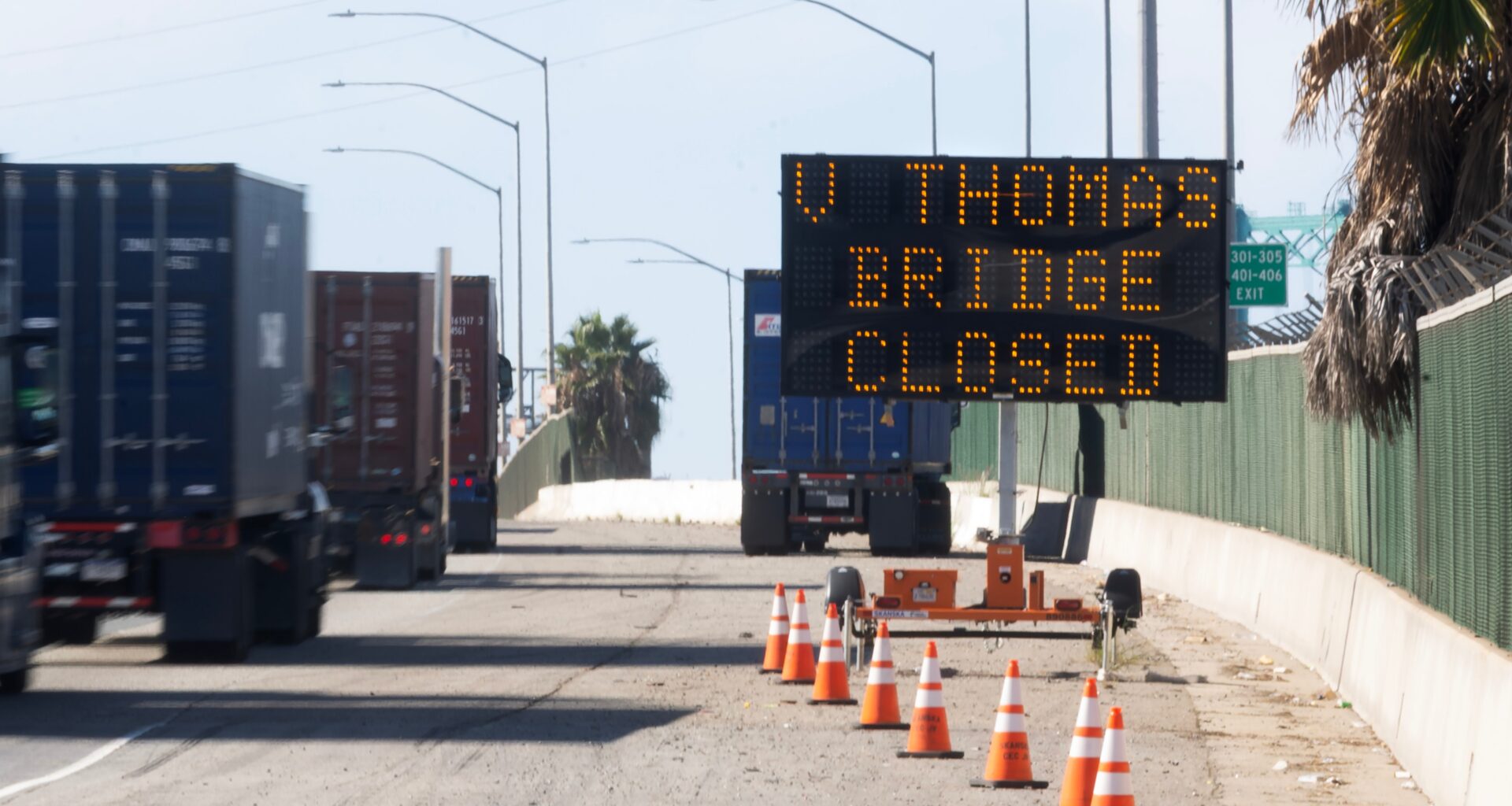
A digital sign alerts drivers of the upcoming Vincent Thomas Bridge 16-month closure on Thursday, Oct. 29, 2026, in San Pedro. (Photo by Howard Freshman, Contributing Photographer)

A digital sign alerts drivers of the upcoming Vincent Thomas Bridge 16-month closure on Thursday, Oct. 29, 2026, in San Pedro. (Photo by Howard Freshman, Contributing Photographer)

Traffic flows southbound across the Vincent Thomas Bridge on Thursday, Oct. 29, 2026, ahead of a 16-month closure slated to begin on Nov. 7. (Photo by Howard Freshman, Contributing Photographer)

Traffic flows southbound across the Vincent Thomas Bridge on Thursday, Oct. 29, 2026, ahead of a 16-month closure slated to begin on Nov. 7. (Photo by Howard Freshman, Contributing Photographer)

Port of Los Angeles officials and community leaders gather for a ribbon-cutting ceremony, celebrating the completion of the $139 million SR 47 Interchange Project connecting the Vincent Thomas Bridge and the LA Waterfront, on Thursday October 29, 2026. (Photo by Axel Koester, Contributing Photographer)

Caltrans officials address the media under the Vincent Thomas Bridge in San Pedro on Thursday, Oct. 29, 2026. (Photo by Howard Freshman, Contributing Photographer)

Daniel Nnodim, in charge of structures construction, discusses the upcoming Vincent Thomas Bridge 16-month closure at a Caltrans media conference on Thursday, Oct. 29, 2026, in San Pedro. (Photo by Howard Freshman, Contributing Photographer)

LA Executive Director Gene Seroka speaks before the signing of a Memorandum of Understanding to evaluate long-term options for replacing or modifying the Vincent Thomas Bridge aboard the Battleship Iowa in San Pedro on Thursday, July 30, 2026. (Photo by Drew A. Kelley, Press-Telegram/SCNG)

From left, LA Mayor Karen Bass, Port of LA Executive Director Gene Seroka, California Secretary of Transportation Toks Omishakin and Caltrans District 7 Director Gloria Roberts sign a Memorandum of Understanding to evaluate long-term options for replacing or modifying the Vincent Thomas Bridge aboard the Battleship Iowa in San Pedro on Thursday, July 30, 2026. (Photo by Drew A. Kelley, Press-Telegram/SCNG)

Caltrans District 7 Director Gloria Roberts speaks before the signing of a Memorandum of Understanding to evaluate long-term options for replacing or modifying the Vincent Thomas Bridge aboard the Battleship Iowa in San Pedro on Thursday, July 30, 2026. (Photo by Drew A. Kelley, Press-Telegram/SCNG)

From left, LA Mayor Karen Bass, Port of LA Executive Director Gene Seroka, California Secretary of Transportation Toks Omishakin and Caltrans District 7 Director Gloria Roberts sign a Memorandum of Understanding to evaluate long-term options for replacing or modifying the Vincent Thomas Bridge aboard the Battleship Iowa in San Pedro on Thursday, July 30, 2026. (Photo by Drew A. Kelley, Press-Telegram/SCNG)

Port of Los Angeles Executive Director Gene Seroka presented renderings of the proposed renovation and replacement of the Vincent Thomas Bridge during the 11th annual “State of the Port” address at Alta Sea in the Port of Los Angeles on Thursday January 22, 2026. (Photo by Axel Koester, Contributing Photographer)

Caltrans has canceled a full southbound overnight closure on the Vincent Thomas Bridge that was set for Friday, Nov. 14, because of rain forecast for Southern California. (Photo courtesy of Caltrans)

Assemblyman Vincent Thomas stands under the Vincent Thomas Bridge on Nov. 11, 1978. (UCLA Library Department of Special Collections)

Assemblyman Vincent Thomas points out a drawing of proposed San Pedro tube between San Pedro and Terminal Island in this May 18, 1960 photo. He spearheaded the drive for underwater auto-truck tube between San Pedro and Terminal Island, and later championed the plan for a bridge project for on which construction began in 1960. (USC Digital Library)

The Long Beach International Gateway Bridge central support towers and cables frame the sunset recently. (Photo by Chuck Bennett, Contributing Photographer)

The Long Beach International Gateway bridge is lit up blue and yellow to show support for Ukraine in Long Beach, CA, on Tuesday, March 1, 2022. (Photo by Jeff Gritchen, Orange County Register/SCNG)

The massive new bridge at the Port of Long Beach was bathed in colorful lights for the first time Monday night December 14, 2020 (Photo by Chuck Bennett, Contributing Photographer)

The new, cable-stayed bridge at the Port of Long Beach will replace the Gerald Desmond Bridge, which has served the complex for more than 50 years but was rapidly becoming obsolete. The two bridges are seen here.

The Gerald Desmond sits next to a new cable-stayed bridge in the Port of Long Beach in Long Beach, CA, on Wednesday, September 30, 2020. The bridge spans the Back Channel with a deck rising 205 feet above the water. (Photo by Jeff Gritchen, Orange County Register/SCNG)

The new Gerald Desmond Bridge nears completion September 2020. (Photo courtesy of the Port of Long Beach)

Zero and near-zero emission semi-trucks, five vintage planes, vintage cars and a flotilla of fire and police boats were on hand for the virtual grand opening of The Gerald Desmond Bridge Replacement Project in Long Beach on Friday, October 2, 2020. The bridge will open to the public on Monday, October 5, 2020. (Photo by Brittany Murray, Press-Telegram/SCNG)
Show Caption
1 of 38
View of the San Pedro side of the Vincent Thomas Bridge. (Photo by Dean Musgrove, Los Angeles Daily News/SCNG)
Need to go somewhere via the Vincent Thomas Bridge?
You’d better get to it.
Following years of planning and public meetings — and after the initial community shock, disbelief, angst and arguing faded into gradual public acceptance — the inconvenient moment has arrived:
San Pedro’s iconic Vincent Thomas Bridge will close just after 11:59 p.m. Friday, Nov. 6..
It won’t be forever — but for commuters, it might feel that way.
The expected closure, to replace the bridge’s roadway, is expected to last 16 months, with the crucial span not coming back into service until early 2028. And for many, that will certainly feel like a long time to go without the handy, go-to connector that links San Pedro, Long Beach, and both the Ports of Los Angeles and Long Beach.
So why is all this necessary?
For years, the California Department of Transportation has been repairing and patching the roadway as problems cropped up and needed attention.
But the four-lane bridge, which debuted in 1963, has seen increasing wear and tear.
Now, state officials said, “concrete fatigue” caused by all of that heavy traffic, much of it connected to the ports — along with environmental deterioration caused by age and the marine environment — requires a full roadway, or deck, replacement. And safety requires that it be done now, Caltrans officials have said.
But full and actual acceptance of the disruption once the bridge closes will likely take a bit of time and no shortage of adjustments.
In his Oct. 29 State of the District address, in fact, Los Angeles Councilmember Tim McOsker spoke about the project and it’s anticipated consequences.
“It will have a major impact on traffic,” McOsker said, before pledging to work to minimize disruptions as much as possible. “Throughout the closure, we will continue working to address traffic impacts, prevent trucks from cutting through residential neighborhoods and work with enforcement officers to ticket rogue truck drivers who violate posted restrictions.
“We know the bridge closure is going to be disruptive,” the councilmember added. “But my responsibility is to make sure that the Harbor Area doesn’t just bear the burden of this project. We need to come out of it better.”
In the years leading up to the project, McOsker added, his office struck a deal with Caltrans, requiring that streets used for detours be repaired and repaved before the closure. That work, he said in his speech, has been completed.
Detour streets will also be repaired and repaved in February 2028 when the bridge reopens — in time for the Summer Olympics.
“Our communities,” McOsker said, “should not absorb the consequences of a major state infrastructure project without meaningful and enforceable mitigations.”
So what’s ahead in the big picture?
The $750 million project, which also includes modernizing some components of the bridge, will replace the entire concrete deck in sections, as well as the center median, railing, fencing and signage.
After reopening to traffic in early 2028, it will undergo a “final” phase during which Caltrans will remove the previously installed temporary features, and install new seismic sensors and utilities on the bridge.
The look of the bridge — featured in multiple television shows and movies, and used often as the San Pedro icon on stationary, post cards and posters — will remain the same, state officials said. And yes, that includes the blue LED decorative lights.
Speaking of those lights, the bridge will go relatively dark during the closure. The only illumination during that time will be from the red navigation lights on top of the two towers, and the ship navigation lights above the channel, below the bridge, said Caltrans spokesperson Diana K. Jimenez.
Bridge detours
So how will folks cope?
Detours.
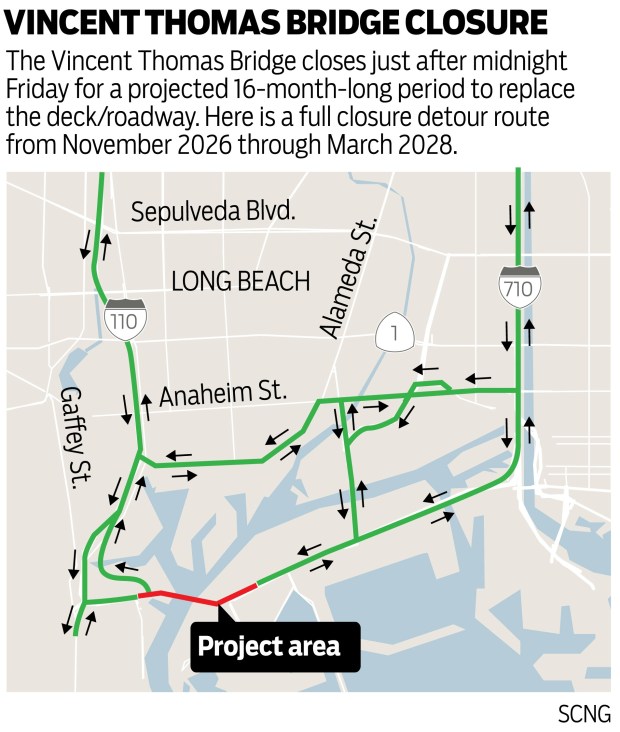
Southern California commuters are quite familiar with construction-caused detours — but they’re inconvenient all the same.
Still, Caltrans has provided a map of detour routes and has said the agency will minimize local traffic impacts by using a combination of infrastructure improvements, manual traffic control strategies and enhanced communication efforts.
Recent temporary bridge closures, which were necessary to conduct pre-construction work, has already gotten locals accustomed to using two primary surface streets linking San Pedro to Long Beach: Anaheim Street and Pacific Coast Highway.
But the main detour for those trying to get to Terminal Island is to take Harry Bridges Boulevard to State Route 47. Harry Bridges Boulevard is also the detour to the 710 Freeway.
Local road improvements have been ongoing on the designated debut routes, including resurfacing and striping roads and intersections, installing traffic cameras, and settingup temporary traffic signals.
During the bridge closure, traffic control officers will be deployed to 18 key intersections in the area to monitor and manually facilitate traffic flow.
Local police will also expand commercial trucking enforcement. Heavy truck traffic is especially a concern for the Wilmington community, which has seen port-related traffic increases on their streets.
Caltrans will provide its QuickMap traffic app to raise awareness of the project and help divert traffic from the areas impacted by the construction.
Travel GPS apps also have been updated to direct motorists around the bridge, Caltrans has said.
Three construction phases
The preliminary phase has already been underway for some time. That involved preparing for the 16-month closure, such as by installing temporary working platforms, staircases and structural bracing on the bridge to allow for a safe and efficient construction process. Infrastructure improvements are also being completed throughout the region to help minimize traffic impacts.
The primary phase is expected to span 16 months, beginning Saturday. That phase will replace the concrete bridge deck, center median, railing, fencing and signage.
After opening to traffic in early 2028, the bridge will undergo a final phase to remove previously installed temporary features and put in the new seismic sensors and utilities on the bridge.
Long-term future
While this project will give the bridge some long-term stability, the bridge is still aging. That has led to some in the community asking a perhaps inevitable question: ls the beloved San Pedro icon in the twilight of its life?
While the current work would put the bridge in a position to be operational for another 70 years, according to Caltans, a recent push has been launched to replace it altogether.
Driving that idea is the need for more air clearance between the bridge roadway and the water below so that newer, cleaner cargo and cruise ships — which are also much larger now — can glide beneath it.
Then there’s the increasing burden the beloved emerald green suspension bridge must carry these days: It has become more critical for Port of Los Angeles operations — and motorists in general. With only two lanes in either direction (and no pull-off lane in case of disabled vehicles), the bridge can frequently become overly congested.
It is now busy with steady and often heavy traffic generated by trucks hauling shipping containers, port union workers traveling in cars to and from work at all hours, and the growing number of residents who rely on the span to connect them conveniently between San Pedro and Long Beach, as well as to the northbound 710 Freeway to the east.
Some 53,000 to 54,000 vehicles travel across the bridge daily.
With that growing traffic, the bridge now faces a different problem from when it was first conceived. Far from a “bridge to nowhere,” as early critics called it, the span has become too small for its time and the needs of the largest port in the Western Hemisphere.
In July 2025, Port of L.A. Executive Director Gene Seroka proposed pairing the current bridge work with a simultaneous project to raise the bridge higher over the water to increase its ship clearance. But that effort failed to get a sign-off from Caltrans.
So port and state officials began thinking bigger.
Port officials formally announced on July 30 that the Vincent Thomas Bridge was in line for a possible full replacement, a project that would be a massive undertaking both in its cost and engineering scope.
Port and state officials gathered aboard the Battleship Iowa in July to sign a partnership to kick-start what will be a massive effort. It will involve raising many billions of dollars — early port projections range from $3 billion to $5 billion.
“The port envisions a completely new bridge to meet future requirements to be built after re-decking of the current bridge is complete. Community is top of mind here, as we want to minimize the current closure time,” the port said in a July statement. “It’s important for us to collaborate with our transportation partners, engineering experts and others to get a full picture of what is feasible.”
Construction could start shortly after the road replacement finishes, a project Caltrans said is still necessary for immediate safety and could not be further postponed.
If a new bridge is built, the Vincent Thomas watch its successor rise up parallel to it while still remaining operational.
A new bridge would have the advantage of not only being taller so the larger container vessels (and newer cruise ships) could pass underneath — 40% of the port’s terminals now sit behind the bridge — but it would also be wider, providing a much larger vehicle roadway, six lanes with emergency shoulders on both sides.
The Vincent Thomas, comparatively, has four lanes, two in each direction — and nowhere to pull over during an emergency or breakdown.
Building a new bridge, however, will be a herculean task. The entire process, including planning, fundraising and construction, is expected to take up to 10 years. But that’s just the estimate and the actually timing will be determined as the planning process gets underway.
Fundraising efforts have already begun and design contacts are being lined up.
And Seroka has received verbal encouragement from U.S. Department of Transportation Secretary Sean Duffy, who said the federal government could consider providing financial help.
The port has also set aside $5 million toward the goal of a new bridge.
“I’d like to see a new bridge built,” Seroka said in June, on the day Duffy visited to the port. “I’d like to see it wider and taller and have safety lanes. But there’s a lot between ‘here and there.’”
Indeed.
The Vincent Thomas Bridge needs to look no further than its sparkling neighbor to see what such an endeavor would take.
That neighbor is the new Long Beach International Bridge, which opened in 2020 after 10 years of planning. It replaced the smaller, aging Gerald Desmond Bridge, which was in such bad shape that “diapers” had to be installed beneath it to catch falling pieces.
The Long Beach span became California’s first cable-stayed bridge for vehicle traffic, with 515-foot-tall towers, a 205-foot vertical clearance for cargo ships and six total traffic lanes.
But it didn’t come cheap.
When that bridge was first approved in 2010, it was estimated to cost $950 million.
In the end, it ultimately cost $1.46 billion — a 57.9% increase over the initial estimate.
So while the Vincent Thomas Bridge, long an iconic part of the San Pedro skyline, could eventually fade into history, that day is still a ways off.
But for the next 16 months, motorists will get a glimpse of what life on the highway is like without the Vincent Thomas Bridge — or a splendid successor.
Bridge facts
Here are some quick facts about the Vincent Thomas Bridge:
The 6,060-foot suspension bridge carries State Route 47 across the Port of Los Angeles main channel, linking San Pedro and Terminal Island.
The bridge sees some 53,000 to 54,000 vehicles daily between San Pedro and Terminal Island.
It opened on Nov. 15, 1963, and was named after California Assemblymember Vincent Thomas. Launching the project took some convincing, though, as critics dubbed the idea as a “bridge to nowhere.” A ferry service took workers between San Pedro and Terminal Island before that.
The bridge has a 1,500-foot main span, 365-foot tower height and 185-foot water clearance.
At night, it is illuminated by blue solar-powered LED lights, installed in 2005 after a long community fundraising effort led by Louis Dominguez to put decorative lights on the bridge. Among the issues that had to be navigated were the impacts on native and nesting birds, which was resolved with the LED solar powered light solution.
The bridge has been closed for several hours on Labor Day each year for a popular run-walk across the span raising money for nonprofits.