
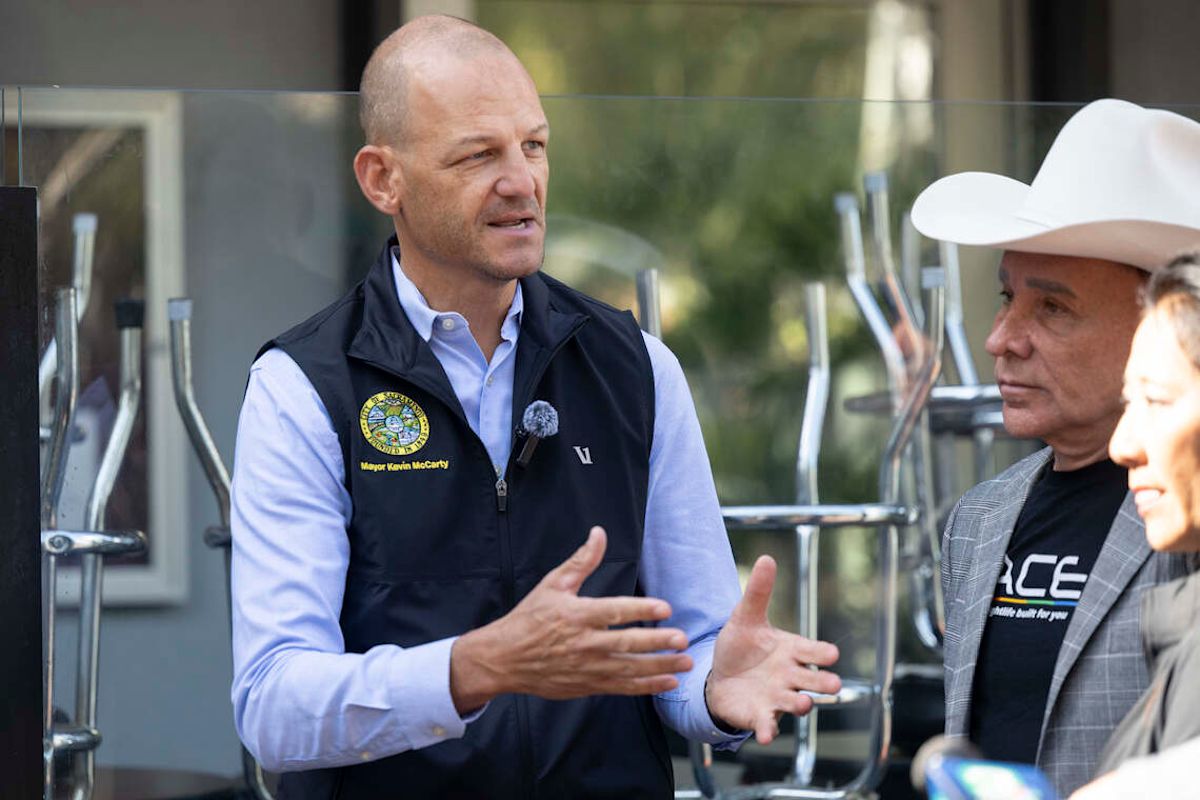
Mayor Kevin McCarty outlined plans to build more tiny homes, bring a Major League Baseball team to Sacramento and lobby for changes to the state court system that would connect people with severe mental illness to potentially lifesaving services.
During an hourlong question-and-answer session at the Crocker Art Museum with Fox 40 anchor Nikki Laurenzo, McCarty highlighted The Sacramento Bee’s five-part series chronicling Chris Carlisle’s efforts to save his 32-year-old daughter, Califia Carlisle, once a promising young college student, from a desperate and dangerous life on the streets. His efforts to secure help through CARE Court have fallen flat because Cali has refused services.
McCarty said the five-part series by former Bee columnist Tom Philp “shook” him and sparked immediate action.
“I sent it right away to the Speaker of the Assembly, to the Pro Tem of the Assembly and to Governor-elect (Xavier) Becerra, and I said we need to work,” he said.
During a City Council discussion about behavioral health services last month, McCarty said that he was leading an effort by a coalition of big-city mayors to push for changes to CARE Court that would make it easier to order involuntary treatment.
“Cali said ‘no,’ so she’s still there on Howe and Folsom,” he said. “This is something that’s very, very frustrating to mayors across the state and we’re not able to fully address homelessness without focusing on this issue.”
McCarty said he expected county supervisors to cooperate with the city in a new partnership agreement, but Sacramento County’s behavioral health department has historically been ideologically opposed to involuntary care for people with substance use disorders.
Other topics discussed at Sacramento’s State of the City
In other respects, McCarty described himself as a “boring” and “steady” mayor looking to build on efforts to reduce the city’s unsheltered population and bolster revenue for the city through economic development.
Tiny homes collaboration: McCarty announced a collaborative grant program inspired by Robin Moore, a former preschool teacher who took it upon herself to build tiny homes in her backyard to house homeless families. Under the program, three local nonprofits will receive up to $10,000 per unit to build three to five tiny homes on their properties.
“A lot of groups said, ‘we want to help, what can we do?'” he said. “This allows the private sector to help with homes as well, especially the faith-based community.”
The three partners are Collective Liberation, Calvary Christian Center and Color the Block’s Estate Farms, which is located outside city limits.
Data centers: Large-scale data centers aren’t coming to Sacramento anytime soon because the city’s zoning code does not permit them, but McCarty planned to hold a City Council study session about them in February. He said he wanted to assess demand for computing infrastructure among local governments and businesses, as well as the potential environmental effects and impact on residents’ quality of life.
“I want to make sure that we focus on the long-term impact for Sacramento residents and taxpayers,” he said.
Parking fees: Despite complaints from midtown businesses and residents about higher parking costs, McCarty said the city would not reduce parking fees or enforcement hours. The revenue generated by higher parking fees was a key factor in closing a $66 million budget gap this fiscal year.
“We were looking at laying off police officers and firefighters, or making revenue increases such as parking,” he said. “We need to grow our economy, that’s how we turn it around.”
Sports: Sacramento and West Sacramento officials remained hopeful about bringing a Major League Baseball team to the region. McCarty said that officials were looking for an architecture firm to design a proposed stadium in West Sacramento.
He also said that Sacramento was “in the mix” for a Major League Soccer team and suggested an announcement could come soon.