
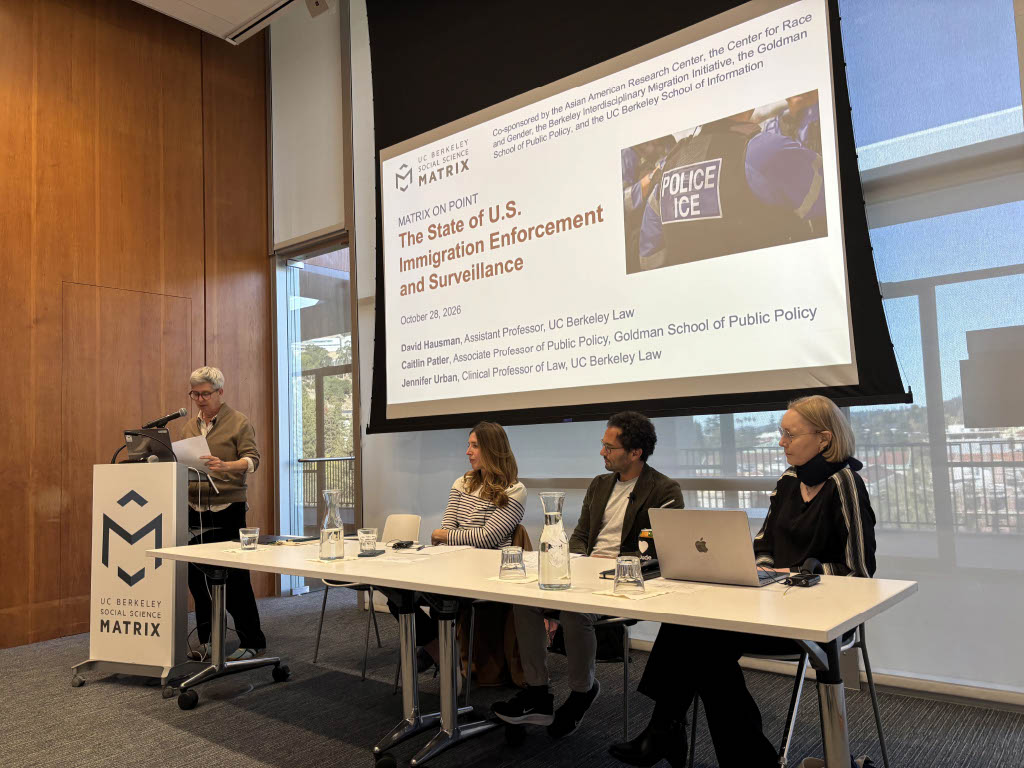
Under the second Trump administration, Immigration and Customs Enforcement (ICE) deportations across the country have risen. At the same time, the administration has made it easier to collect data on undocumented immigrants in the country in an effort to increase deportations, according to UC Berkeley researchers. But how are the increased deportations being tracked by lawyers and concerned citizens?
These are the trends and questions that Berkeley Public Policy Professor Caitlin Patler, Berkeley Law Professor David Hausman and Berkeley Clinical Law Professor Jennifer Urban discussed at a recent UC Berkeley Social Science Matrix panel “The State of U.S. Immigration Enforcement and Surveillance.”
“Historically, there have been important constraints in the form of protections for personal data put in place decades ago, in response to government surveillance abuses,” Urban said. “There has been a profound rupture in the second Trump Administration, contravening those protections and undermining the democratic values that were embedded in them. One form this takes is the Department of Homeland Security (DHS) collecting and using personal information to aid immigration enforcement and quell protests against ICE.”
In an effort to understand the number of deportations across the country, Hausman began collecting this data through the Deportation Data Project, a collaboration at UC Berkeley and UCLA. They request data from the government under the Freedom of Information Act and directly upload it to their site.
However, according to Hausman, ICE responds slowly, if at all, to requests for data. As a result, when ICE fails to respond to a request for data promptly, he and his colleagues sue the government in an effort to obtain it.
“I think it’s fair to say that a major pattern under the new administration is a pattern of indiscriminate arrests by ICE,” Hausman said. “There have been quotas put in place where ICE officers are trying to make as many arrests as possible, and that’s resulted in them being less choosy about whom to arrest.”
Patler was able to take the data from the project and analyze it. Prior to the second Trump administration, most arrests were of undocumented immigrants who had a criminal conviction, she said. However, now under the second Trump administration, that number is at an “all-time low,” while the overall total of deportations is increasing, she noted.
Urban noted that the administration has used more unconventional tactics for immigration enforcement, such as placing undocumented immigrants onto the Social Security Death Master file to encourage self deportation. The file is a list of deceased individuals and their social security numbers — meaning those placed on the list have difficulties gaining employment, managing finances and receiving any government benefits. According to Urban, without a Social Security number to open a bank account that can be authenticated by the government, “you are in some ways a non-person.”
“The arrests we’re seeing under the second Trump administration are truly unprecedented,” Patler said. “Even though some of you might be saying, ‘Well, I haven’t seen as much of this in the news. Is this actually still happening?’ Well, it is, and it’s actually happening with increasing frequency.”