
Part two in the series about San Diego’s canneries
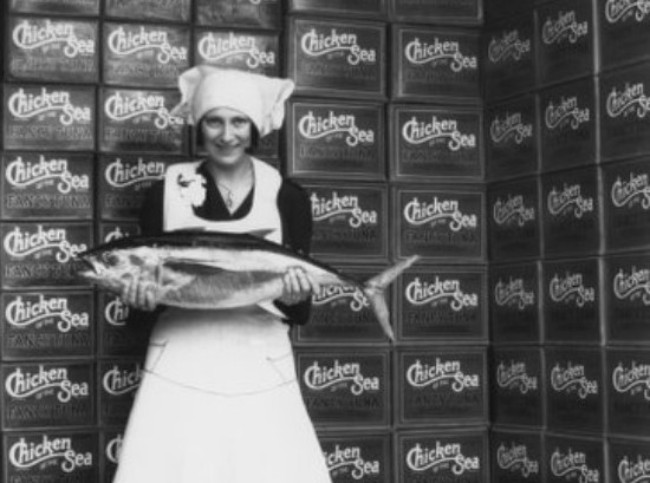
One of the best-known brand names associated with San Diego’s tuna industry was “Chicken of the Sea,” used by Van Camp Seafood Co. for its tuna products.
 A young woman holding tuna in front of boxes of Chicken of the Sea fancy tuna inside building in 1931 at Van Camp Sea Food Co. (Photo courtesy of the San Diego History Center)
According to Chicken of the Sea’s official company history, fishermen in the early 1900s nicknamed white albacore tuna “chicken of the sea” because of its mild flavor and light color, and the first products carrying the brand name appeared in stores in 1930.
Of course, that was before the tuna industry became a controversial business within San Diego, but back then tuna was the name of the game.
Not only were canneries supplying food to families, but they were also helping the economy by creating jobs.
Early canneries
Early on, there were a handful of small canneries that opened in 1909, including Cabrillo Sardine Co. in La Playa, according to the City of San Diego Digital Archives. In 1911, the Pacific Tuna Canning Co. was formed and started to process albacore tuna at the bottom of F Street.
More canneries started to open in the area, and some sources report San Diego had its own Cannery Row. Between 16th and 28th streets in the 1930s, one could find a wide variety, with the Van Camp Seafood Co. among the more famous.
Many workers were attracted to this industry, including Italians, Portuguese, and Japanese immigrants. Those who worked in the fishing industry moved into various areas around the bay, including Point Loma and Little Italy. Many Latino workers were also moving into these areas, as they were entering the cannery workforce.
Fishermen would usually go out to sea for many months and return with nets full of fish. Processors were involved, as were shipbuilders, mechanics, and marine suppliers, all landing regular work within this industry during these early cannery days.
But as the boats got bigger and more expensive, there were more disputes, and unions became involved in representing workers in negotiations with employers.
Tuna industry soars
As time marched on, the tuna industry became an important industry within San Diego. By the 1960s, it was the third largest behind the Navy and aerospace industries. Thousands were employed to catch, sell, and process the fish, according to the Port of San Diego.
Because most goods and services became very competitive, it forced the canning industry to decline, and many companies moved away as new environmental laws were introduced.
Larger companies such as San Diego Tuna Co. and other canneries no longer processed tuna in areas they couldn’t afford. Van Camp Seafood Co., founded in 1914, left San Diego in 1984. The departure of the last cannery resulted in the loss of about 12,000 jobs, according to the San Diego History Center.
This would be the end of local tuna canning, as the city, workers, and residents would know it.
Sources:
San Diego History Center, “San Diego: All in a Day’s Work.”
San Diego History Center, “Before the War: The Japanese in San Diego.”
San Diego History Center, “TUNA! Celebrating San Diego’s Famous Fishing Industry.”
Port of San Diego, “History of Tuna Harbor.”
City of San Diego Digital Archives, “May 12, 1916 – Ordinance Regulating Fish Canneries.”
San Diego State University, “San Diego Mexican & Chicano History Chapter 8.”
Chicken of the Sea, “A Brief History of Chicken Of The Sea.”
San Diego History Center, “Fishermen of San Diego.”
San Diego History Center, “A Fish Tale.”