
Why book?
If you love Kyoto ryokans and Pacific Northwest scenery with equal measure, Snow Peak Campfield Long Beach is your place. Nestled along the shores of Long Beach, Washington, the campground marries Japanese minimalism with PNW ruggedness.
Set the scene
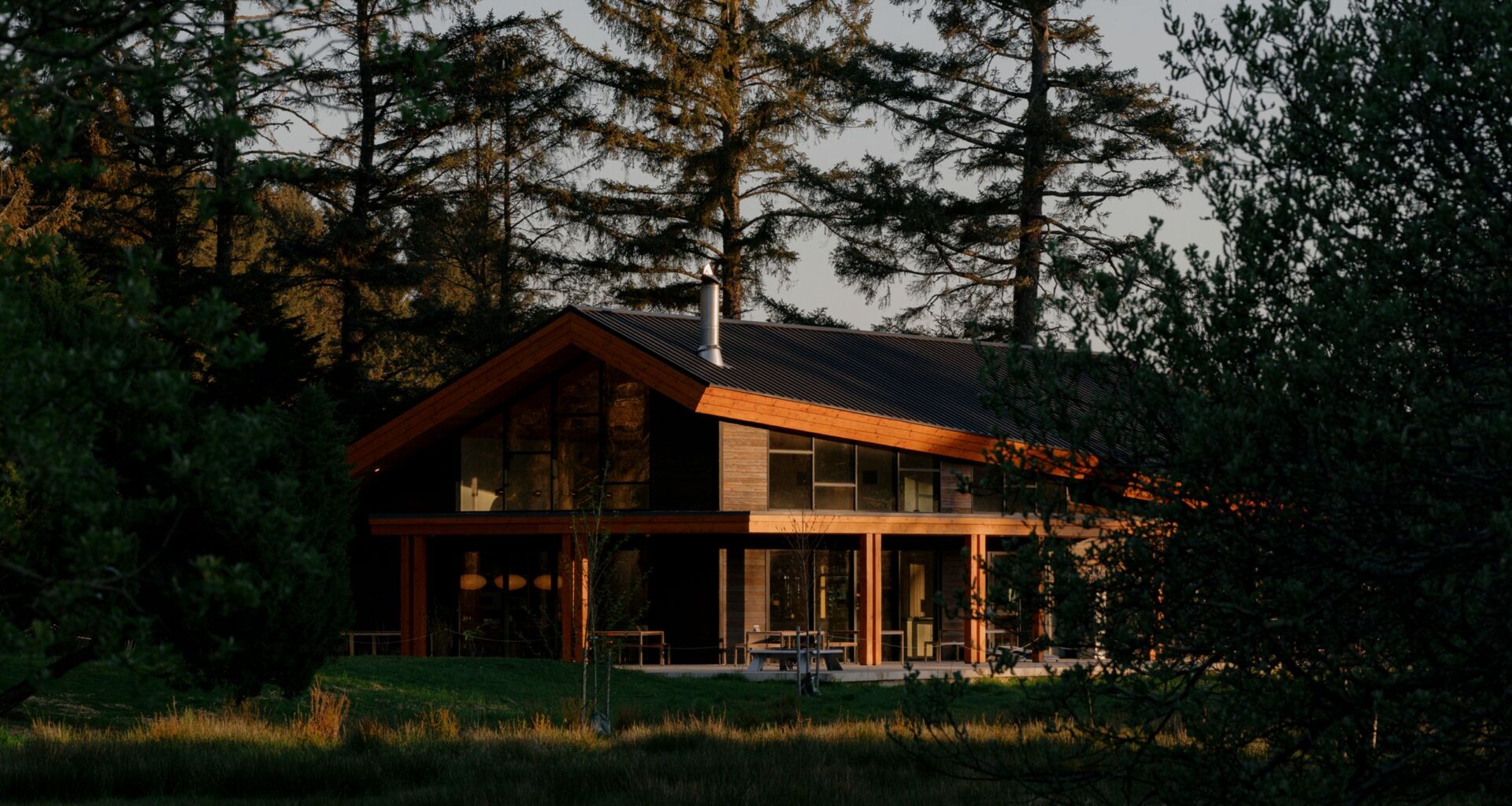
The grounds sprawl 30 acres across the sleepy coastal town of Long Beach, Washington (population: 2,000 or so). Walking in, you’re met with tall evergreens towering overhead; look down and you might see wild strawberries clustered along the trails. The site was originally an RV park in need of rehab. Now, it’s a leafy campground for people who want to feel one with nature (while still accessing hot showers). It’s dotted with a handful of buildings: a gatehouse where guests check in, a café and store to lounge and buy snacks, a communal wash house, and a spa. A walking path meanders from the gatehouse through the grounds, connecting the structures before looping back to the entrance.
Everything looks soothing and minimal. The camp buildings’ natural tones and elegant lines are tucked into an idyllic landscape of huckleberry bushes, shore pines, and vine maples. The structures are designed by local father-son team EFA Architects; the greenery is the work of Knot Studios, Portland, Oregon-based landscape architects. The result is a campground that feels like a tiny, cohesive village.
The crowd is a mix of diehard Snow Peak fans, first-time campers who like having everything already set up, and outdoorsy families sporting Patagonia fleeces. With public fire pits called takibi to gather around, the place has a communal vibe, so it’s perhaps not quite for solitary campers. You’re also joined by some locals—deer and geese that roam freely. If you’re lucky, you might even spot one of the resident beavers.
The backstory
Snow Peak, the Japanese outdoor brand behind this glamping ground, already operates five beloved Campfields throughout Japan’s countryside, along the grassy pastures and rivers of Niigata, Oita, Kyoto, Hokkaido, and Kochi. Long Beach is its first Campfield in the US.
The rooms
The campground offers three camping options: You can camp with your own tent at one of the 53 Field Sites, stay in one of the eight multi-person Tent Suites that the site team sets up for you, or luxuriously reside in one of the 14 Jyubako Suites.
A Jyubako Suite is a cozy, climate-controlled cabin with sand-colored walls, floor-to-ceiling windows that let in lots of light, and, outside, a personal fire pit and two camping chairs. Inside each cabin is a small kitchenette with an induction stovetop and mini fridge, a living area, a queen bed, and a private bathroom and shower with pretty good water pressure. It fits up to two adults and two kids.
It’s also functionally a Snow Peak showroom. The kitchenette is stocked with the brand’s cookware, including a kettle, coffee drip, and santoku knife (with carrying case). The living area is kitted with its modular futon and folding table. The light fixtures are Snow Peak lanterns. Everywhere you look, you’ll see the brand’s tiny snowflake symbol etched into the furniture—maybe to the point of absurdity. Other high-quality brands are present too: The kitchenette boasts local favorites Proud Mary coffee and Bardo tea; the bed, Pendleton blankets; the bathroom, Slowtide towels.
Food and drink
At the center of the campground sits the Campstore, a combined all-day café, lounge, and shop with food, camping gear, and ice and firewood for purchase. Inside feels airy and peaceful thanks to enormous windows and a cloud-like paper lamp hanging from the ceiling. Along the walls, shelves are lined with books on design, travel, and Japan, plus board games for guests to freely peruse. At the café, you can order snacks and light lunches. Go for one of the freshly handmade onigiris. You can nibble it at a long wooden table in the lounge that’s also an ideal spot for remote work—the Wi-Fi is excellent.
The shop is a treasure trove of curated local foods: teas by Portland, Oregon-based Bardo Tea, beers from Fort George Brewery in Astoria, Oregon, and Tre-Fin tuna from Ilwaco, Washington. Wine lovers, rejoice—award-winning local winery Syncline is the official wine partner, and there’s sake too. Plus, lots of Pocky for Japanese snack fans. The store is also a Snow Peak shopper’s paradise, displaying many of the brand’s products, from camping chairs to bento boxes to quilted sweaters.
The spa
The open-air Ofuro spa is the Campfield’s crown jewel. It’s built with hinoki, the fragrant, lemon-scented Japanese cypress used in many traditional Japanese bath houses. The cypress is imported from Japan by Nakamoto Forestry, a family-owned company that specializes in traditional charred lumber techniques. The no-glass structure feels like a natural outgrowth from its woodsy surroundings, and the whole space is hugged by a low, sloping ceiling, giving it a cozy yet grand feeling.
When you enter, you’re met with a wall of cloth barrels (Snow Peak-branded, of course) to store your clothes and shoes in, just like you would in a traditional onsen. Past that, you’ll find a temple-grade cypress sauna, a hot soaking pool, and a cold plunge. Take deep breaths in that sauna—the woody aroma in there is beautifully rich and heady. A strand of alder trees frames the view from the pool, which overlooks a natural pond and more forest.
The neighborhood/area
Long Beach is a tiny, toothpick-shaped bit of land that’s quiet but big on charm. In the center of town stands a large white archway emblazoned with the claim of “The World’s Longest Beach.” It’s not quite that, but it is the world’s longest beach on a peninsula, which isn’t too shabby a title either. The campground is just a short walk to the beach and its trails, but it’s worth peeking into town too. There’s Marsh’s Free Museum, a collection of kitschy antiques including old-fashioned vacuum cleaners and a roulette wheel allegedly from the Alaskan Gold Rush, and the Cranberry Museum, where you can learn about cranberry harvesting and tour the cranberry bogs outside its door. Be sure to try the homemade cranberry ice cream; it’s delightfully tart.
The service
Service is low-key and friendly. Need help with your fire pit? They’ve got you covered. Want recommendations for an ocean-view restaurant nearby? They’re happy to oblige. (Pickled Fish Restaurant; I recommend the poutine.) They also offer golf carts and hand carts to help you schlep your gear to your site, in case you don’t want to carry a cooler for half a mile.
Eco effort
The campground is built on a protected wetland, so there’s a mitigation plan in place, including meticulous planting of native flora such as wild strawberries, blackberries, huckleberries, Oregon ash, dogwood, and foxglove. It’s also a car-free campground (the parking lot is separated from it) with a limit of one car per reservation.
Accessibility
Two of the regular campsites are ADA accessible, and one Jyubako Suite is ADA accessible. Six of the Jyubako Suites are pet-friendly. Some visitors might find the car-free policy inconvenient: The distance from the entrance to the farthest campsite is half a mile, and the loop around the campground itself is a third of a mile. Again, those golf carts and hand carts come in handy for transportation.
Anything left to mention?
The best time to visit is early summer or early fall, when it’s not too hot and the landscape is emerald-green and dewy. (Unless you’re into moody Pacific Northwest weather, which has its own charm.)