
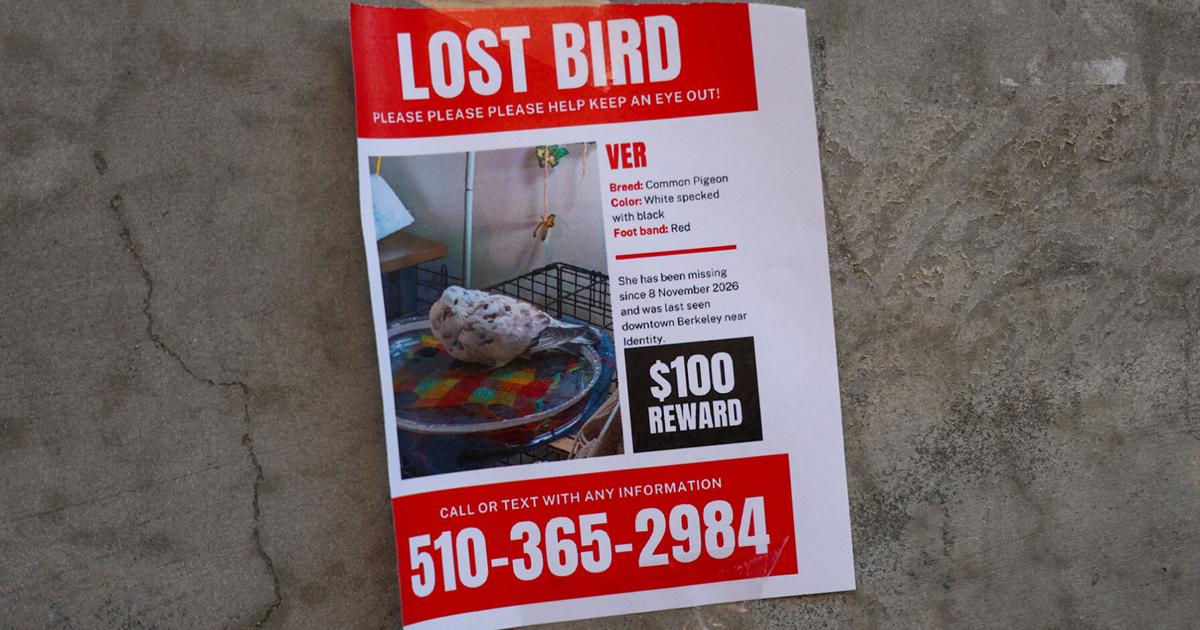
UC Berkeley community members have been looking high and low for a student’s lost pet pigeon. The pigeon, a white bird with black speckles and a red leg band, was last seen near 2024 Durant Ave. in Downtown Berkeley.
Verity — the pigeon’s name — was lost Sunday near the same address. Owner Vincent Jin has searched the area daily but said she has not seen Verity since the day she went missing.
“She’s a very curious bird,” Jin said. “She’s also very active as well. She would be flapping around all the time. In the morning she’d wake me up by just flying above my head and demanding that I open the curtains. And then in the morning she crows like a rooster.”
Domesticated pigeons are tame versions of feral pigeons, but both are classified as rock pigeons — the same species, according to campus integrative biology professor Rauri Bowie, who is also a curator of birds at the UC Berkeley Museum of Vertebrate Zoology. Domestic pigeons are raised and kept by humans, while feral pigeons, the type of birds often seen on the street, are descendants of released domesticated pigeons.
Native to North Africa and Southern Europe, rock pigeons have been selectively bred for different traits for hundreds of years. Rock pigeon breeds even helped Charles Darwin explain his theory of evolution, Bowie told The Daily Californian in an email.
“Some authorities report upwards of 800 different breeds, including spectacular breeds such as: Homing Pigeon, Jacobins, Fantails, Frillbacks, Tumblers, and Rollers—selected for their aerial acrobatics—and colored breeds such as the Archangel and Ice Pigeon,” Bowie said in the email.
However, as rock pigeons are not native to North America, the birds are not protected by state or federal laws. Reliant on human activity to survive, rock pigeons are not classified as pets or wildlife, leaving them in a legal animal welfare gap that can be “deadly,” according to Cynthia Bardouka-Large, co-director of Bay Area pigeon rescue organization Palomacy Pigeon & Dove Adoptions.
Palomacy rescues domestic birds in the Bay Area and provides support nationwide, equipped with a hotline and online resources for people who find injured birds. The organization encourages the adoption of their rescued domesticated birds as pets.
According to Bardouka-Large, when looking for a missing pet domesticated pigeon, “the more eyes you can get looking for that bird, the better.”
“You never know who’s going to see it and think, oh, there is that bird that’s kind of joined my local flock of pigeons,” Bardouka-Large said. “Now, in Berkeley, there are a lot of feral pigeons … I would ask people in the area, if you see big flocks — I think there’s a big flock near Berkeley High School — I might ask them to keep an eye out.”
Jin, who has been waking up every morning at dawn to search for Verity, has been unable to find her bird. Jin has started recognizing the other pigeons in the flocks around 2024 Durant Ave., where Verity went missing.
She said Verity may be more skittish than the typical domesticated pigeon and may be hiding out on balconies instead of joining a large flock, and told The Daily Californian that a bystander saw a white bird on Sonoma Avenue north of the UC Berkeley campus.
“If you live in an apartment building, look out for birds on your balconies, and if you see a white pigeon, speckled with black. She has a little red band on her foot. Call or text me or email me and I’ll be there as soon as I can. I really appreciate all the support everybody has been sending me,” Jin said.
Jin can be reached at [email protected].