
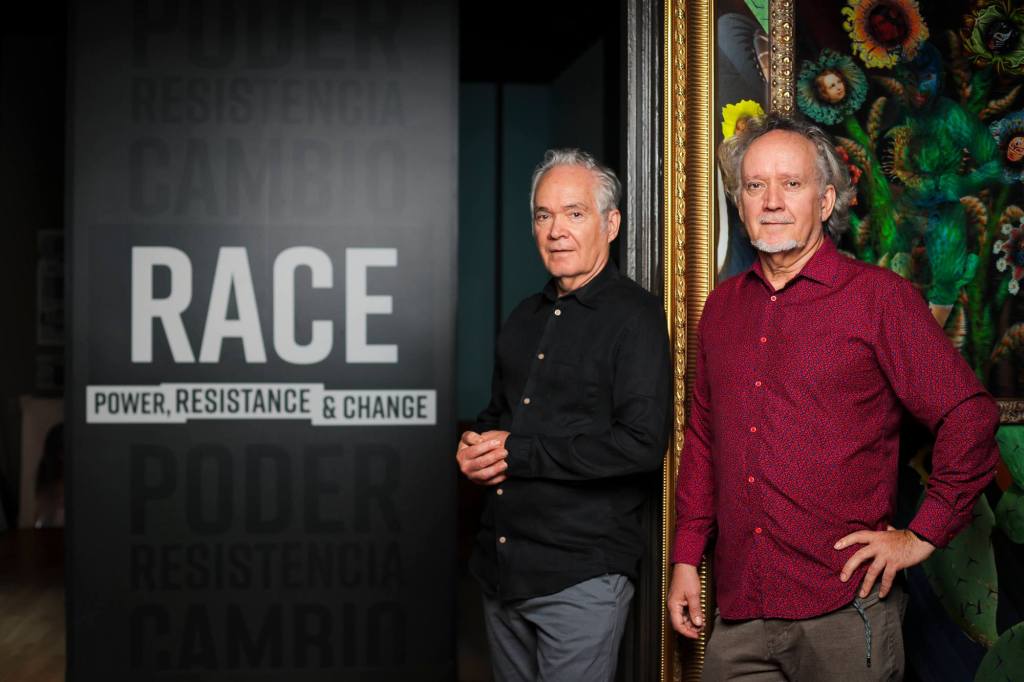
The De La Torre brothers saw it as an opportunity when they were asked to contribute their artwork to the Museum of Us’ new exhibition, “Race: Power, Resistance & Change.”
“It’s not the easiest of topics to work on, which presents a challenge,” says Einar, the younger of the two. “I think that, as an artist, you always want to be looking for challenges to talk about things in different ways.”
Einar and Jamex De La Torre are visual artists who were born in Mexico and migrated to the United States in the early 1970s, where they went to junior high and high school, and learned glass blowing, sculpture, and other forms of art in the art department at Cal State Long Beach. Growing up on both sides of the border has very much informed their work, which includes their studio work (sculpture), installation art, and public art. Their contribution to the new “Race” exhibition is called “Castaways,” a mixed media piece with archival lenticular prints, LED light boxes, and custom wallpaper.
According to the museum, the collaborative work on this exhibit began in 2018 and was shaped through close work with artists, scholars, community members, and the museum’s exhibits team, who combined research and lived experience into a shared narrative, reflecting the museum’s “values and efforts to uplift community voices, histories, and knowledge.” Presented in Spanish and English, the exhibition explores the construction of race and the ways that has shaped laws and daily life, locally and more broadly, using installation art, sculpture, photography, animation, poetry, and archival resources.
The brothers spent some time discussing the creation of “Castaways” and the 18th-century colonial, racial hierarchy Casta paintings it’s named for, and why they prefer to create pieces that help people start talking about tough subjects, rather than propose solutions to these larger questions. (This interview has been edited for length and clarity. For a longer version of this conversation, visit sandiegouniontribune.com/author/lisa-deaderick/.)
Q: Why was this exhibition something you wanted to contribute to?
Einar: I think that the very challenge of it, the fact that it wasn’t an obvious discussion. I think, when you talk about injustice of any sort, the obvious is obvious, so you can’t really talk about it. Also, who has agency, and all of these questions, are a minefield of possible problems. By the same token, art is a form of communication, first and foremost, whether it’s visual or written or dance, it’s always a communication. So, why not try to take something challenging, problematic, and see how you can help foster further discussion that is very much needed.
Jamex: I think, as artists, there’s so much to talk about on the subject, but I think we’re always reflecting on our personal identity, all of us, in this day and age. The fact that we’re still dealing with blatant racism in 2025 is absolutely incredible to me. It’s gotten worse and we’re all world suffering with all those expressions of racism around the country, and that manifests in our artwork, all of us.
Q: Walk us through your creative process for “Castaways”?
Einar: It was actually pretty tough in the beginning because it’s kind of like when we did work with another installation art festival at the border—when you start talking about the border, when it’s something so obvious, how do you address it? In this case, with race, it’s way more charged than even the border, for obvious reasons. To begin to structure an image, or something to create dialog, is very difficult without going to obvious tropes. The Casta paintings, and I do urge you to check them out, are an obvious one, but we knew that we also needed to start there as a basis for speaking because here we are with all these different bloods, and people are finding out a bunch of lies that they were told by their families, which is quite hilarious and maybe a great comeuppance. So, how do we open a dialog that creates, maybe, a kind of scaffolding so people can address these things in their own way, through their own experiences? It’s sort of like starting the conversation and giving avenues or paths, but not necessarily coming to any conclusion because that’s not our job, by any means. How do you come to conclusions with something that, to begin with, is a construct that’s already problematic? The idea that there is such a thing as race? We’re all the human race, but the way that we have interpreted all the Venn diagrams that are in our minds about these things, how do you extricate the most obvious one? That that socioeconomic classes are completely intertwined with all of these conversations, to different degrees in different countries and different ways of looking at it? For us, even touching on that and opening dialog is really what we wanted to do.
Jamex: This piece has roots in a piece that we made for the McNay Art Museum in San Antonio, Texas last year. Our basic premise was that, in the Casta paintings, we were doing different lenticulars, in which they have the mixed race couple and then the progeny of both of them. In all of them, there were beings made out of cactus leaves. As Mexican Americans, the cactus—nopal—is kind of an identity symbol. Basically, the pieces are saying, ‘Yeah, we’re all different, but we are all nopaleros,’ meaning we all come from the same tree. There’s not really different races, there’s only one race; one tree, we’re just variants.
Einar: If I could add to that, we also have the children coming out of the flowers because flowers are a great example of genetics—you’re breeding flowers for a certain color and for certain traits. I think, having the cactus being this family tree, humanity as a family tree, and linking it to our agrarian background and culture. That made humanity sort of explode because we have the ability to stay put and create food, as opposed to forage. Then we, of course, started breeding for certain food. The analogy is, for the people who are into eugenics and started thinking that humans needed to be bred for certain traits and all of that dangerous, bizarre stuff that’s quite Nazi, really. So, we are opening up all of these discussions that we are all different genetic varieties, but there’s also very dark undertones in the way that we were manipulated into seeing this as a divisive tool.
Q: Is there anything that you hope people see or understand when they engage with “Castaways”? That you hope the overall exhibition helps them understand about race?
Einar: I don’t think that there’s something specific because that would almost be agenda-driven, in our view. I think to talk about it, to open discussion. I think we have question our own affinities, all of us, and there’s nothing wrong with that because what is actually being from somewhere? What does belonging mean? What is community? What is culture? That’s the other Venn diagram—if race is one thing and class is one thing, there is another one, which is the culture. Are you proud? How are you proud of your culture? What part of it is culture, as opposed to nation building, which is the flag and all the constructs of nation building? All of those things, in terms of identity, are fascinating and we should always reconsider how we view it because we have to talk to others we might not agree with.
Jamex: Art is mirror of the artist’s time, and I think we reflect society with all its anxieties, and I think when a viewer is presented with something that challenges them to think, maybe we can be successful when they find the empathy to understand themselves involved in all this ridiculousness that is existence.