
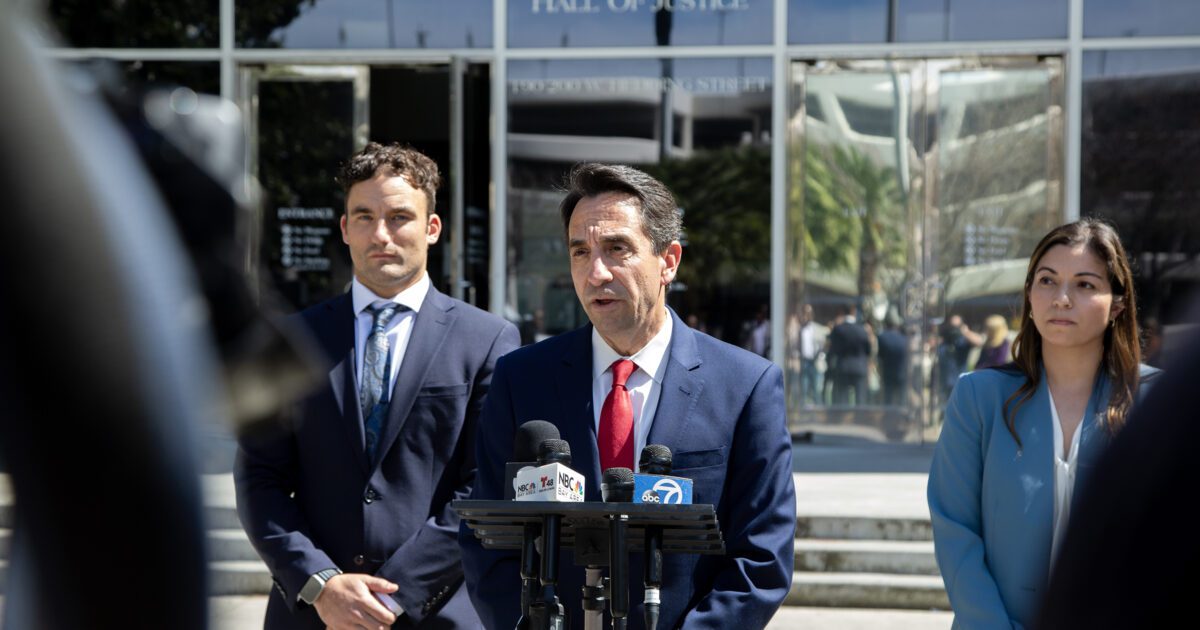
Santa Clara County’s sales tax increase passed amid competing ideas on how the money would be used. Now a rift has emerged among proponents — and District Attorney Jeff Rosen said he may investigate a new spending proposal that leaves out law enforcement.
County leaders chiefly characterized the five-eighths-cent sales tax increase, known as Measure A, as a lifeline for their massive public hospital system, which they warned was at risk of falling apart amid unprecedented federal spending cuts under President Donald Trump. But county law enforcement officials and workers only endorsed the tax after saying they gained assurances from the county that their budgets would get a portion of the funds.
Measure A passed by 57% of voters on Nov. 4. Some cities, including San Jose, will see general sales tax rates go up to 10% or higher.
On Monday, County Executive James Williams told this news organization he would recommend the Board of Supervisors put all Measure A dollars toward offsetting federal health care cuts. That recommendation isn’t final — and still needs approval from the county’s elected officials.
“With full transparency and oversight, the public will be able to see exactly how every dollar is spent as we continue to strengthen and protect access to care for everyone in our community,” Williams told San José Spotlight.
Williams’ message sent consternation through Measure A’s law enforcement allies.
“Along with many law enforcement leaders, I supported Measure A because we were assured it was a general tax that would support critical county programs and services such as our criminal justice system, deputy sheriffs and mental health services … Those assurances appear questionable,” Rosen told San José Spotlight.
Rosen signaled a possible investigation into the county’s activities around the tax measure.
“As district attorney, I have a duty to ensure the law is adhered to and determine whether voters were deliberately misled,” he said.
Measure A is a general tax where spending is not restricted to a specific use. The county opted not to author Measure A as a special tax, which would have legally restricted funds to hospitals. Special taxes require 66.7% voter approval — a more difficult threshold to win over an unusually short campaign cycle — whereas a general tax needs a simple majority.
Santa Clara County Government Attorneys Association President Max Zarzana — whose union representing county prosecutors endorsed the tax — shared Rosen’s reaction.
“Was an unethical electoral bait and switch perpetrated on county voters?” Zarzana told San José Spotlight. “It is clear that this was a single purpose tax and we are quite sure a deeper look is warranted as to who orchestrated this apparent bait and switch that will have devastatingly negative impacts to the safety of county residents.”
Looming legal disputes
Williams said law enforcement still benefits from Measure A because it softens the blows of H.R. 1 to the total budget.
“Measure A provides critical support to address the unprecedented federal Medi-Cal cuts and therefore that mitigates cuts to every county service, especially our criminal justice system,” Williams told San Jose Spotlight. “My focus—as should be the focus of every county leader—is on bridging the funding gap that remains so that we can preserve the vital services the county delivers across our entire community.”
Darien Shanske, a law professor at UC Davis, has authored papers on the California Constitution and Propositions 13 and 218, which set higher voter approval standards for special taxes in the state. He said he doesn’t see any illegality concerns with the county’s spending proposal.
“The notion that the county has turned a general tax into a special tax, by allocating this money to partially fill a hole left by H.R. 1, is not credible and not consistent with the law,” Shanske told San José Spotlight. “The local legislators are deciding how to spend it and have reasonably decided to spend it on this very serious emergency needlessly caused by the Trump administration.”
Dolores Alvarado is CEO of Community Health Partnerships, which runs a network of non-county primary care clinics that see tens of thousands of patients.
“The No. 1 issue the people chose was to use money for hospitals,” she told San José Spotlight. “That was a no brainer at the (Community Health Partnership). Without specialty care we would have to send people to who knows where, maybe San Francisco, and that would be really expensive.”
Measure A became a socioeconomic referendum in Silicon Valley. The county’s public hospital system is California’s second largest. It’s a critical safety net service for the region’s publicly-insured and uninsured patients. But county doctors warned that hospital cuts would impact everyone, as people who lose coverage will turn to emergency departments, delaying critical care and ambulance transports at hospitals across the Bay Area. Santa Clara County hospitals already routinely reach capacity, dragging out wait times for care and appointments.
At the same time, the health and hospital system has become the county’s biggest focus and budget expense. DA Rosen has been publicly critical of the county for costly hospital expansions while asking his department to make steep cuts.
Sheriff Bob Jonsen was more muted compared to other law enforcement reactions. Responding to Williams’ spending suggestion, Jonsen said he supported Measure A because it effectually reduced the severity of further cuts to his department.
“Before the passage of Measure A, the Santa Clara County Sheriff’s Office was facing significant budget reductions that would have impacted essential operations, services and public safety investments,” Jonsen told San José Spotlight.
Jonsen said he understands the tax measure’s mixed bag of support.
“As stewards of public trust and safety, we remain committed to using available resources responsibly,” he said. “We will continue to explore innovative staffing strategies, pursue grant opportunities and work collaboratively to ensure we can meet the needs of Santa Clara County’s residents and visitors.”
DA Rosen previously joined the applause on election night when Measure A’s favorable results flashed on screen. Standing on the patio of a restaurant in Willow Glen, he said he expected Measure A to help stave off cuts to his department.
“I expect if the measure passes, some of the revenue generated from it will go toward public safety just as some of the revenue will go toward hospitals,” Rosen told San José Spotlight on Nov. 4. San Jose Mayor Matt Mahan held off on endorsing Measure A during the campaign’s initial months. He even cast doubt on the county hospital system as he negotiated a Measure A endorsement with the county. He eventually stood alongside Rosen and the public safety unions endorsing the measure in October.
Mahan declined to comment.
The tax faced opposition from the Silicon Valley Taxpayers Association, the Libertarian Party of Santa Clara County and the Santa Clara County Republican Party. Opponents attempted to block the measure through a lawsuit that was rejected by a Santa Clara County Superior Court judge. An appeal now sits before state appellate judges.
Contact Brandon Pho at [email protected] or @brandonphooo on X.