

Racial discrimination was everywhere in Long Beach in 1940. If you were Black, you had a hard time owning a home in certain parts of the city, you couldn’t get on the police force or find other good jobs, you had to go to segregated schools.
Into this nightmare stepped Ernest McBride, one of nine children born into a farming family in Carrollton, Mississippi who had moved to California seeking a better life.
But he discovered that Long Beach had big racial problems, too, and he decided to do something about it. In 1940, when he was 31, he and several others founded the Long Beach branch of the National Association for the Advancement of Colored People and fought for civil rights for the rest of his life until he died at 97 in 2007.
The group’s first meetings were held secretly in the McBride home, often under police surveillance. In 2013 the first new high school in Long Beach in 18 years was built and named after him – the Ernest S. McBride Senior High School.
McBride’s life and legacy was honored by Dr. Sharifa Batts, the branch’s new president, and 350 other guests at the 85th anniversary dinner of the NAACP’s Long Beach chapter last month on the Queen Mary.
Long Beach City College student Priince Bass receives a scholarship from NAACP President Dr. Sharifa Batts at the chapter’s 85th anniversary celebration held Oct. 11, 2025, on the Queen Mary. (Photo courtesy of Dr. Sharifa Batts

Dr. Sharifa Batts is with husband Cameron Batts (left) and Ernest McBride Jr. at the Long Beach NAACP 85th anniversary celebration gala held Oct. 11, 2025 on the Queen Mary. McBride is the son of Ernest McBride Sr., one of the founders of the Long Beach chapter. (Photo courtesy of Dr. Sharifa Batts)
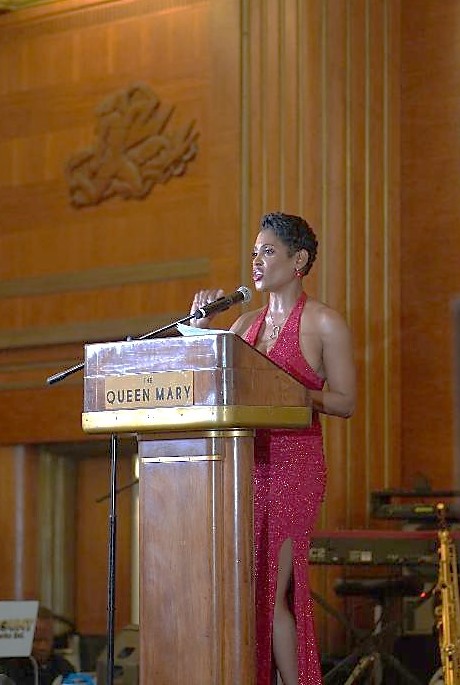
Long Beach NAACP President Dr. Sharifa Batts speaks from the podium at the chapter’s 85th anniversary gala held Oct. 11, 2025, on the Queen Mary. (Photo courtesy of Dr. Sharifa Batts)
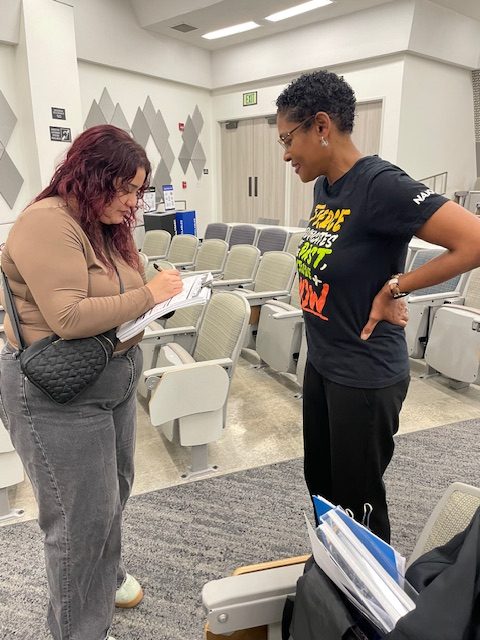
Long Beach NAACP President Dr. Sharifa Batts is interviewed at the recent Black Consciousness Conference at CSULB where she was a panelist speaker. She recruited 18 students to become members of the reactivated campus NAACP chapter. (Photo courtesy of Dr. Sharifa Batts)
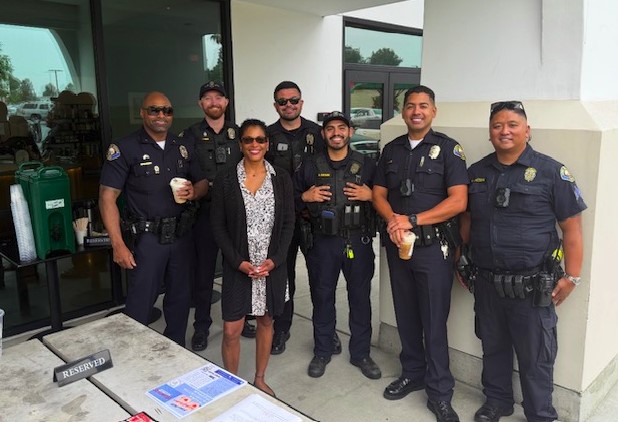
Long Beach NAACP President Dr. Sharifa Batts recently met with officers from the North Division of the Long Beach Police Department. (Photo courtesy of Dr. Sharifa Batts)
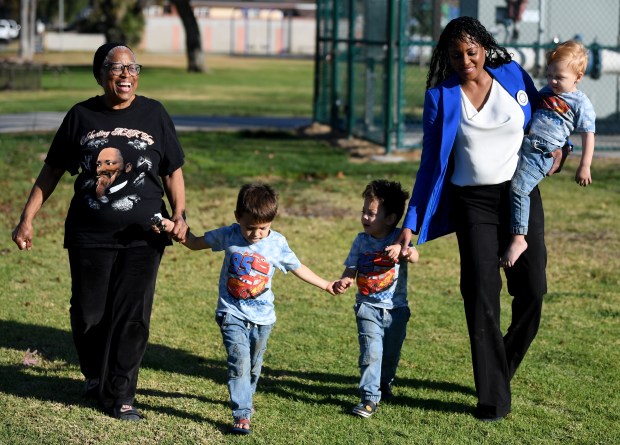
Sharifa Batts, the new president of the local chapter of the NAACP, and her mother Hattie Herring play with her grandchildren at Jackson Park in Long Beach on Thursday, Jan. 16, 2025. (Photo by Axel Koester, Contributing Photographer)
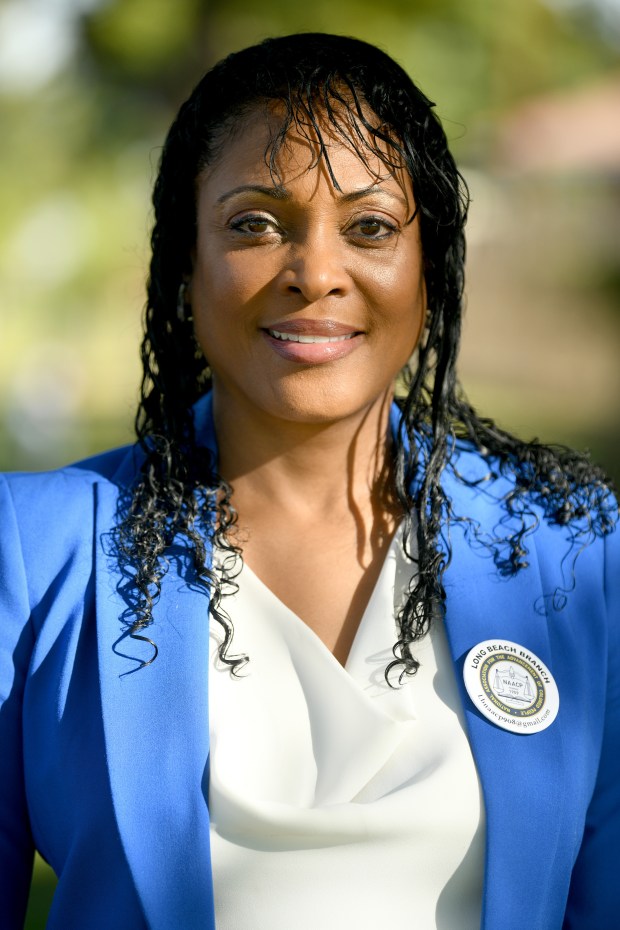
Sharifa Batts, the new president of the local chapter of the NAACP, plays with her grandchildren at Jackson Park in Long Beach on Thursday, Jan. 16, 2025. (Photo by Axel Koester, Contributing Photographer)
Show Caption
1 of 7
Long Beach City College student Priince Bass receives a scholarship from NAACP President Dr. Sharifa Batts at the chapter’s 85th anniversary celebration held Oct. 11, 2025, on the Queen Mary. (Photo courtesy of Dr. Sharifa Batts
In an emotional welcome, Batts recognized McBride, other NAACP leaders and members who “paved the way for progress in Long Beach and beyond.”
She said their sacrifices and determination “remind us that the struggle for justice and fairness is ongoing and that our collective work remains as vital today as it was in 1940.” That’s why, she said, the gala dinner was more than a celebration.
“This is a call to action,” she said as guests applauded. “Together, on this historic evening, we celebrate our past, embrace our presence and build our future.”
Batts also praised Naomi Rainey-Pierson, who served as branch president for 24 years before passing the torch to Batts.
“It truly is an honor to follow in the footsteps of Naomi Rainey-Pierson,” Batts said. “She is a true trailblazer whose leadership left an incredible legacy in our community. My goal is to build upon the strong foundation she established, honoring her work while bringing new energy, ideas and intergenerational connections to continue advancing equity and civil rights for all.”
Rainey-Pierson, reached at her home in Long Beach, said Batts had great ideas and would “bring the NAACP to another level.”
In an interview after the dinner, Batts said her strategic plan for the next few years aligns with the theme of “Bridging Generations for Justice.”
“I want to accomplish a stronger, more connected movement, one that bridges generations for justice and creates spaces where wisdom, experience and fresh perspectives come together,” she said. “Generational mentorship is key to that vision. We’re not just preserving the past, we’re preparing future leaders to continue the right for equity and inclusion.”
Batts said her plan is to create cross-generational mentorship opportunities that allow youths to learn from the wisdom and experience of older members while empowering elders with modern technology skills so they can thrive in today’s digital world.
How is she planning to attract younger members?
“By activating and reactivating the NAACP Chapters on the campuses at Long Beach City College and Cal State Long Beach is the start,” she said. “We are intentionally creating pathways for younger members to lead, not just participate. My goal is for the Long Beach Branch to feel like a home for emerging leaders, a place where they can learn from seasoned members while shaping the movement for equity and justice in their own voices.”
Batts recently attended a CSULB Black Consciousness Conference where she was a panelist and recruited 18 students to become members of the reactivated campus chapter. She addressed the young people with this recruiting message, “The NAACP needs you. There is a place for you on one of our committees, no matter whatever your skill or passion. Batts said the NAACP will address “systemic barriers in education, housing, economic opportunity, environmental justice and public safety, while ensuring representation and accountability in our local institutions.”
Other goals, she said, are to increase voter participation and protection, support economic justice and wealth building and promote health and environmental equity. “Professionally, with my job as the Head of Environment and Sustainability at Ports America, environmental justice is near and dear to my heart, she said.
Batts also said partnerships with other organizations are essential to advancing equity and justice. “Whether it’s working with faith-based groups, schools, businesses or grassroots organizations, our goal is to strengthen relationships that turn shared values into shared action,” she said.
Along those lines, Batts recently met with officers from the North Division of the Long Beach Police Department.
Batts said she learned an important lesson in race relations when she was in the seventh grade in Los Alamitos when a boy rode by on his bike and called her the “n” word. This was near Pine Middle School (now McAuliffe Middle School) where she was a student.
At first, she didn’t know what to do because her parents had always taught her to be careful in racial situations. But in this case she decided to take action. She ran after the boy, caught up with him, pulled him off his bike, slapped him and said, “Don’t you ever call me that name again!”
“He started crying and apologized, and we became friends,” she said. “I realized at an early age that I needed to stand up for myself in difficult situations. If I didn’t speak out for myself, who else would?”
That was just one of the lessons she learned at an early age. “I learned so much from my mother,” she said. “My mom taught me to learn as much as I could about different cultures and civil rights of all people.”
Sharifa, Swahili for distinguished, was born at the Long Beach Community Hospital in 1973 and grew up in the Wrigley area. Her parents were Bobby Cox and Hattie Herring, who was an advertising sales person at the Press-Telegram for many years.
She attended Lafayette Elementary until the third grade when she was bused to Madison Elementary. The family moved and she attended Pine Middle School and then Los Alamitos High where she became a track star, a cheerleader and the first female and first African American president of the Associated Student Body.
She attended Long Beach City College, majoring in political science, before earning a scholarship to San Diego State University. She also earned a master’s degree and a doctoral degree at Pepperdine University.
In track, she was a two-time conference and state champion at LBCC, a two-time conference and state champion at San Diego State University, an All-American in track and field and a qualifier for the Olympic trials in 1996.
After graduating from San Diego State, she began working for an automotive parts company and a trucking company which did business with the Port of Los Angeles. Eventually, she started working for Ports America, one of the largest stevedoring companies in the United States.
In 1995, she married Cameron Batts, a construction worker and casual longshoreman. They have two daughters, Sydney and Camiya, and seven grandchildren.
With a full time job in addition to her NAACP presidency, Batts said she finds time to relax and recharge her batteries by spending time with her husband and family.
“I have big shoes to fill in following Naomi, but I believe I am up to the challenge,” she told me.“I’m excited to be able to move on to the next chapter in my life and the life of the NAACP.”
An important chapter in her NAACP life continues today (Sunday, Nov. 16) with the 85th Anniversary of the Ernest McBride Family and NAACP Long Beach Branch Exhibits at the African American Cultural Center of Long Beach, 4321 Atlantic Ave. The exhibits will be on display until Dec. 31.