
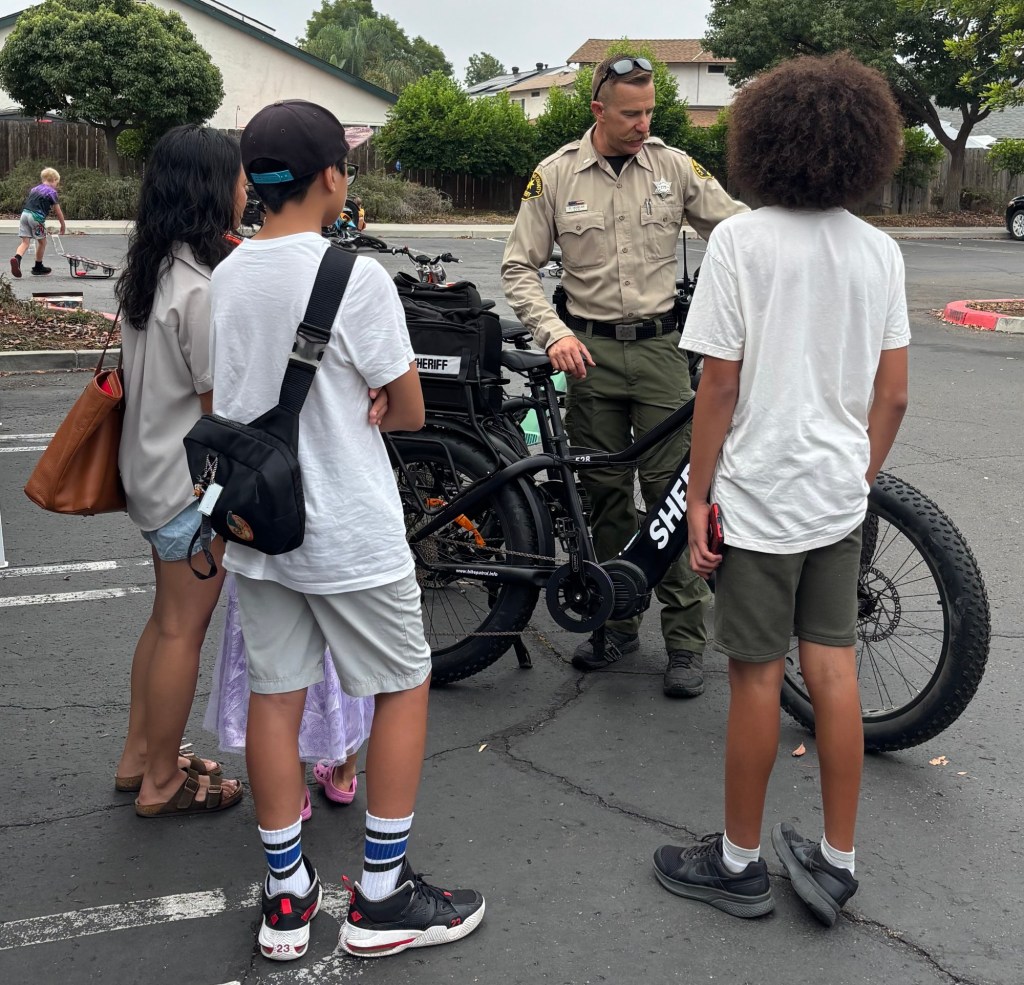
This is the fifth part of a series exploring electric bicycles, their local impact and the ongoing controversy that surrounds them.
Across San Diego County, California and indeed the country, there’s a drive to create a culture of responsibility and safety among e-bike riders.
But as each community faces its own challenges, it may need to come up with its own solutions.
Here’s a look at what is being done across the county and the state.
San Diego County
California Assembly Bill 2234, which went into effect in January, allows cities in San Diego County to prohibit e-bikes for children younger than 12 and for the county to do so in unincorporated areas. The opt-in pilot program was introduced by Assemblywoman Tasha Boerner (D-Encinitas), whose 77th District includes La Jolla. It will be in effect until 2029, when the state will evaluate whether to roll it out elsewhere.
The law applies to Class 1 and 2 e-bikes, which have a top speed of 20 mph. Class 3 e-bikes, which can reach speeds up to 28 mph, already have a statewide minimum age of 16.
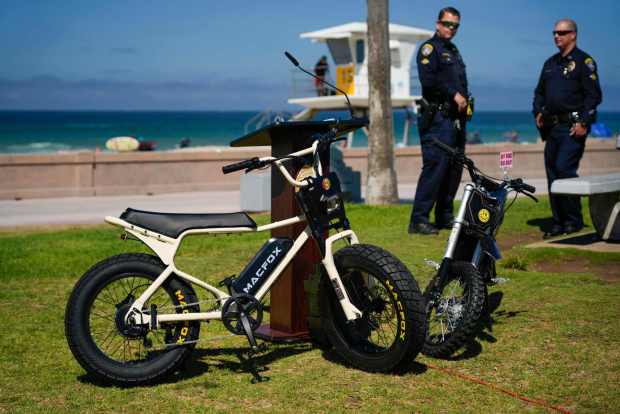 An e-bike is displayed next to an e-motorcycle as law enforcement agencies and health care professionals from across San Diego County held a news conference Sept. 8 on the need for safe ridership. (Alejandro Tamayo / The San Diego Union-Tribune)
As of last week, six cities in San Diego County either have adopted the AB 2234 age restriction or are in the process of doing so.
On Oct. 28, when San Marcos became the county’s fourth city to ban e-bikes for riders under 12 — joining Coronado, Chula Vista and Poway — there were three components to the City Council’s approval: the age prohibition, earmarking $77,000 from the 2025-26 budget to support its implementation, and adding an e-bike ordinance to the city’s municipal code.
“The purpose of this item is not to imply that e-bikes themselves are a problem,” City Manager Michelle Bender told the council. “Instead, we simply want to ensure that everybody stays safe, particularly our young riders.”
The city also plans to launch an informational campaign dubbed “Ride Right” in collaboration with the San Marcos Unified School District and the county Sheriff’s Office. The campaign will include after-school events, increased enforcement, new signage and safety training.
“We don’t want kids to feel like we don’t want them to have fun,” Mayor Rebecca Jones said. “We do want them to have fun. We do want them to get where they’re going. But we want to make sure they’re doing it in a safe manner.”
The Poway City Council approved new rules at its Oct. 21 meeting, including the ban on e-bike riders under 12.
The amended municipal code also establishes safety regulations for e-bike riders, among them that they must obey all traffic regulations applicable to vehicles; anyone younger than 18 must wear a properly fitted and fastened bicycle helmet; riders must not travel more than 28 mph on a public highway or over 10 mph on a sidewalk; no one under 18 may transport any passengers on an e-bike; and e-bikes are prohibited at playgrounds, parks and school grounds not designated as a bicycle path.
“Use of electric bicycles is an ever-growing public safety concern, especially among children,” according to a city staff report.
The rules take effect Thursday, Nov. 20, and warnings will be issued for the first 60 days. After that, fines can start at $25 and incrementally increase to $250 with multiple citations. The city also can seize any e-bike operated in violation of the ordinance.
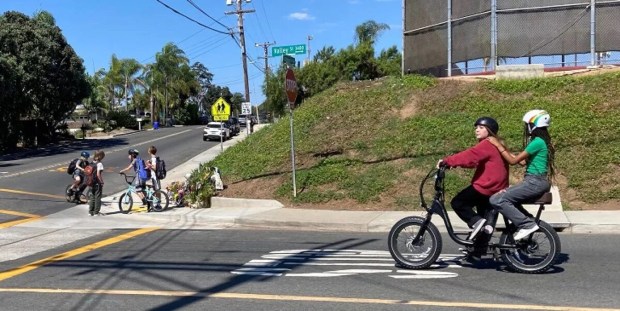 The Poway City Council took a final vote Oct. 21 on new regulations for the use of electric bicycles. The growing popularity of e-bikes, particularly among children, has resulted in safety concerns from residents and law enforcement. (File)
Coronado’s age restriction went into effect in January, Chula Vista’s in September.
On Sept. 16, members of Carlsbad’s Traffic Safety and Mobility Commission recommended that the City Council not only prohibit e-bikes for kids under 12 but consider taking the ban a step further, such as increasing the age limit to 16 or prohibiting passengers for all e-bike riders younger than 16. The higher age limit would require a separate action by the city other than just following AB 2234.
If approved by the council, the program would include 60 days of warnings. After that, violations would be punishable by a base fine of $25 with approximately $200 of additional fees.
Some residents suggested further measures such as licensing or registering e-bike riders, but state law does not give local agencies authority to do that.
The traffic commission proposed that city officials lobby elected state officials for new laws allowing more local control of e-bike issues.
On Nov. 12, the Santee City Council unanimously approved regulations banning e-bike use by riders under 12. The ordinance will require a second and final vote in December.
Councilwoman Lauren Koval said the city should inform Santee schools of the change and consider putting out informational fliers.
Other cities in San Diego County — such as Encinitas, Solana Beach and Del Mar — have passed ordinances that limit where e-bikes are allowed but don’t include age limits.
Newport Beach
In neighboring Orange County, Newport Beach’s City Council convened this month to explore updating the city’s bicycle regulations for the first time since 1997.
The proposed ordinance explicitly places e-bikes and other motorized devices alongside bicycles in the municipal code. The change would further define unsafe riding behaviors and require all riders younger than 18 to wear a helmet.
Police officers would be empowered to impound bicycles and e-bikes and offer a program with safety training in place of fines.
The proposed changes come via the city’s Bicycle Safety Working Group, which includes two City Council members, the mayor and city staff members. The group was formed in response to growing safety concerns surrounding e-bikes.
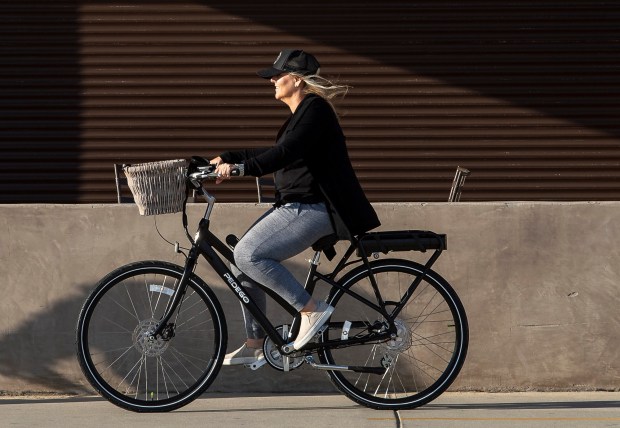 A woman rides an electric bike in Newport Beach. (Leonard Ortiz / The Orange County Register)
“For the three years I’ve been on the council, this is the No. 1 issue that people have brought up time and time again,” Councilwoman Robyn Grant said. “So it’s a welcome approach that we’re taking here … in starting some additional enforcement and ordinances that will be applied to this.”
The proposed ordinance is expected to return to the council for small adjustments and final approval.
This isn’t the first time this year that Newport Beach officials have intervened with e-bikes. In May, the council approved an ordinance to prohibit riding bicycles, e-bikes and more on the sand at city beaches.
Marin County
In Northern California, Marin County prides itself on being the birthplace of the mountain bike and an early adopter of bicycle culture. So when electric bikes started arriving on the scene in large numbers around 2018, they were a welcome addition.
“Marin is a well-resourced county. Folks have money, and when these e-bikes started coming out, there weren’t a lot of places that could afford a multithousand-dollar bike for a teenager,” said the county’s director of legislative affairs, Talia Smith. “So that combination is what led to Marin being an early adopter of bikes, particularly for young riders.”
But soon after, county officials and emergency first responders started seeing concerning data about accidents and 911 calls. At first, Smith said, the data did not differentiate between regular bikes and e-bikes for accidents involving 10- to 15-year-olds.
But in 2019 and 2020, she said, “we saw a twofold increase in 911 calls, and that was very concerning. So we worked with first responders to add a box to the form they have to fill out to note whether it was an e-bike.”
Data continued to be collected about e-bike accidents that necessitated a 911 call. In 2023, Smith said, the accident rate was slightly higher for the 10-15 age range on conventional bikes but five times higher for that same age group on e-bikes compared with other ages.
County officials partnered with area Assembly members to draft AB 1778 in December 2023. The bill established the Marin Electric Bicycle Safety Pilot Program that until January 2029 authorizes a local authority within the county to adopt an ordinance or a resolution to prohibit a person younger than 16 from operating Class 2 e-bikes, which have a throttle that allows the motor to power the bike without pedaling.
“We think for the youngest riders, it’s not age-appropriate to be on these bikes,” Smith said.
She said a cluster of seven cities and towns that are very close to one another needed to come together to make it happen.
“You could drive through all of them in 20 minutes,” Smith said. “So to have different rules in different towns was never going to work. It was all or nothing. We had to build consensus to get everyone to do this.”
Earlier this year, all seven communities opted into the program.
County officials also launched a public safety campaign including letters sent home with back-to-school packets and posters placed in local schools. Youths were involved in the design process for the posters, which often featured local landmarks or school mascots.
Other efforts were targeted at letting parents know that Class 2 e-bikes are illegal for anyone under 16, Smith said. “We wanted to be crystal clear, because parents are being asked to get the bike and it’s the parents that are buying them.”
As a result, she said, middle schools are seeing fewer and fewer e-bikes.
“There is no silver bullet and we need to do more, but we see that as a success,” Smith said.
CalBike
In October, the 30-year-old California Bicycle Coalition, also known as CalBike, formed the California Independent Electric Mobility Council, a coalition of 15 groups representing different elements of the e-bike issue, including cycling advocates, educators, public health officials and more.
The goal, said CalBike Executive Director Kendra Ramsey, is to “bring folks together with a variety of perspectives on e-bikes” to identify gaps in legislation and areas in need of solutions.
“We have seen a lot of well-intentioned but reactionary responses to concerns around e-bikes and e-motos [also known as e-motorcycles or e-dirt bikes],” Ramsey said. “We are not proposing legislation. It’s more about having this conversation and ideas around what the gaps are, strategies to fill those gaps, and educational ideas or resources that might be effective for the public information side. … Instead of having those conversations after legislation is drafted, we want to have them now.”
The intent is to have a report by May outlining such gaps and possible solutions to be submitted to state legislators.
State level
While some cities look to implement stricter e-bike policies, there is a statewide push to reduce greenhouse gases and encourage alternative forms of transportation. E-bikes are part of that.
One such initiative, the California E-Bike Incentive Project, was created to provide income-qualified residents with up to $2,000 to support the purchase of a new e-bike.
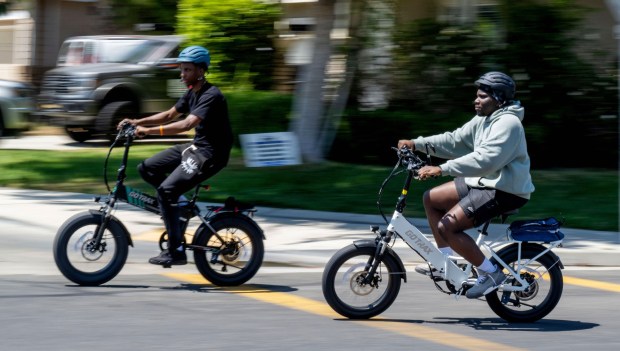 E-bike riders travel in Eastvale in Riverside County in 2024. (Terry Pierson / The Press-Enterprise)
But the program, which launched last December with a round of 1,500 vouchers and funding by the California Air Resources Board, dealt with setbacks and multiple investigations of Pedal Ahead, the San Diego nonprofit chosen to administer it.
Initial online signups were delayed by more than two years, and when it opened, the website shut tens of thousands of people out of the system and closed within minutes.
Follow-up enrollment in April faltered, with officials ending the session due to what they called a security threat. The Air Resources Board publicly apologized for the snafu and pledged to do better.
A week later, the state awarded 1,000 more vouchers worth up to $2,000 each — though that effort was managed by a new vendor.
Officials had begun investigating Pedal Ahead early last year on suspicion of failing to comply with terms of the grant it had been awarded two years earlier. At the same time, CARB was conducting its own review into Pedal Ahead’s management, and criminal investigators at the California Department of Justice were scrutinizing it.
The state attorney general’s office listed Pedal Ahead as delinquent and failing to comply with regulations governing nonprofit organizations. The nonprofit’s founder, Edward Clancy, was investigated on allegations of mixing his nonprofit and for-profit enterprises under a venture called Pedal Ahead Plus.
State officials removed Pedal Ahead as manager of the e-bike incentive program earlier this year.
Then this fall, the Air Resources Board closed out the program, blaming “budget constraints.” CARB moved $18 million previously earmarked for the California E-Bike Incentive Project to regional Clean Cars 4 All programs.
Next installment
The next article in this series will examine the future of e-bikes, from policy ideas to conversations that parents can have with their children before buying one.
— San Diego Union-Tribune and Community Press reporters Stacy Brandt, Phil Diehl, Jeff McDonald, Hannah Elsmore and Elizabeth Marie Himchak contributed to this report. ♦