
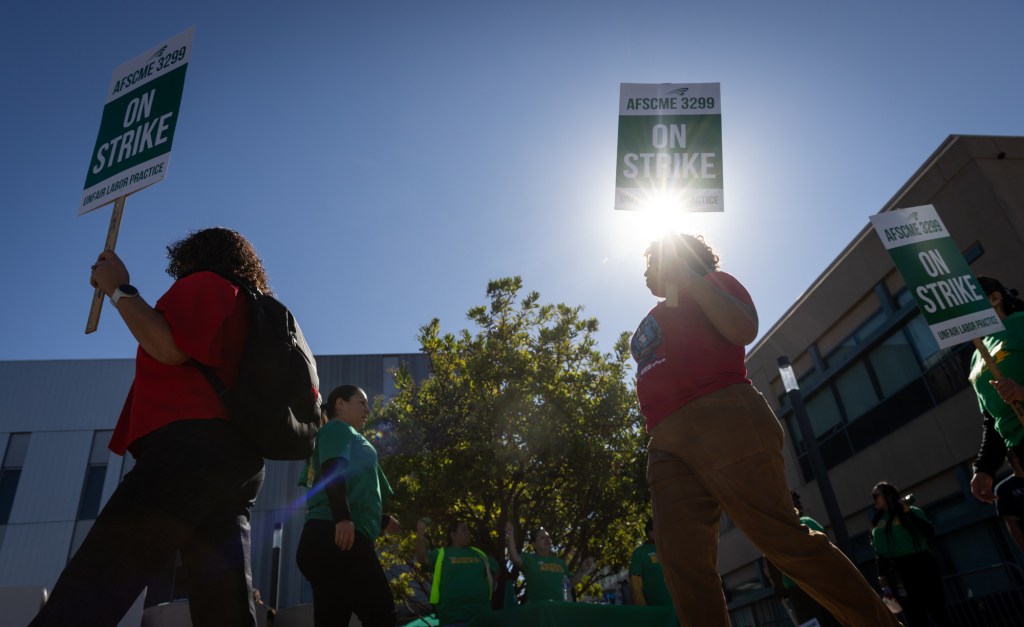
University of California workers — custodians, food service workers, patient care assistants, and hospital technicians — will stage a two-day strike on Monday, walking off their jobs to decry pay and benefits that they say have not kept pace with the rising costs of living in Southern California. And they will not be alone. UC members of the California Nurses Association, also in ongoing contract negotiations, announced Thursday that they will join their coworkers, striking in sympathy.
And that will not be the only health care strike that San Diego County patients will notice before November gives way to December.
Sharp HealthCare workers announced Friday that they intend to strike from Wednesday, Nov. 26, through 7 a.m. Saturday, Nov. 29. That work stoppage is said to involve more than 5,700 registered nurses and 127 other medical professionals at Sharp Chula Vista Medical Center, including pharmacists, occupational therapists, physical therapists, medical social workers, registered dieticians and speech-language pathologists.
Sharp Vice President Rita Essaian said in a statement Friday that the health system has plans in place that it believes “will ensure adequate staffing levels at all times” if a strike occurs.
While both employers are focusing on wages as the main item of disagreement leading to strikes, workers and the unions that represent them say they are also fed up with persistent understaffing that leaves them spread too thin. Similiar claims were made during a five-day strike of Kaiser Permanente workers.
The UC strike is said to involve about 65,000 members of the American Federation of State, County and Municipal Employees Local 3299, which staged a similar two-day strike in late November 2024 and again in February alongside the University Professional and Technical Employees Local 9119. UPTE workers, including physician assistants, optometrists, pharmacists, clinical social workers, staff research assistants and mental health clinicians, announced last week that they reached a tentative deal with UC after 17 months of bargaining, cancelling strike plans.
The AFSCME workers’ contract ended in August 2024, and workers have been laboring without a new agreement ever since. UC, declaring that negotiations had reached an “impasse,” implemented its last offer when negotiations reached the 16-month mark, increasing pay “to $25 an hour by July 1 or a 5% increase, whichever provides a greater benefit,” according to its website.
But these workers continue to insist that UC can do better.
A statement sent to the media Friday cites UC’s most recent financial statements that the union says “show the institution’s revenues and investment assets have nearly doubled over the past decade, with its unrestricted campus cash reserves increasing five-fold.”
But the university has called the coordinated strike an attempt to “pressure the University into accepting unreasonable wage and benefit demands that would put UC in a financially precarious position and jeopardize its mission of teaching, research and public service.”
It was not clear Friday just how onerous the two-day UC strike will be for patients. Generally, medical providers begin rescheduling non-emergency procedures in the days preceding and following a strike in order to reduce the number of temporary replacement workers that they must hire in order to remain open.