
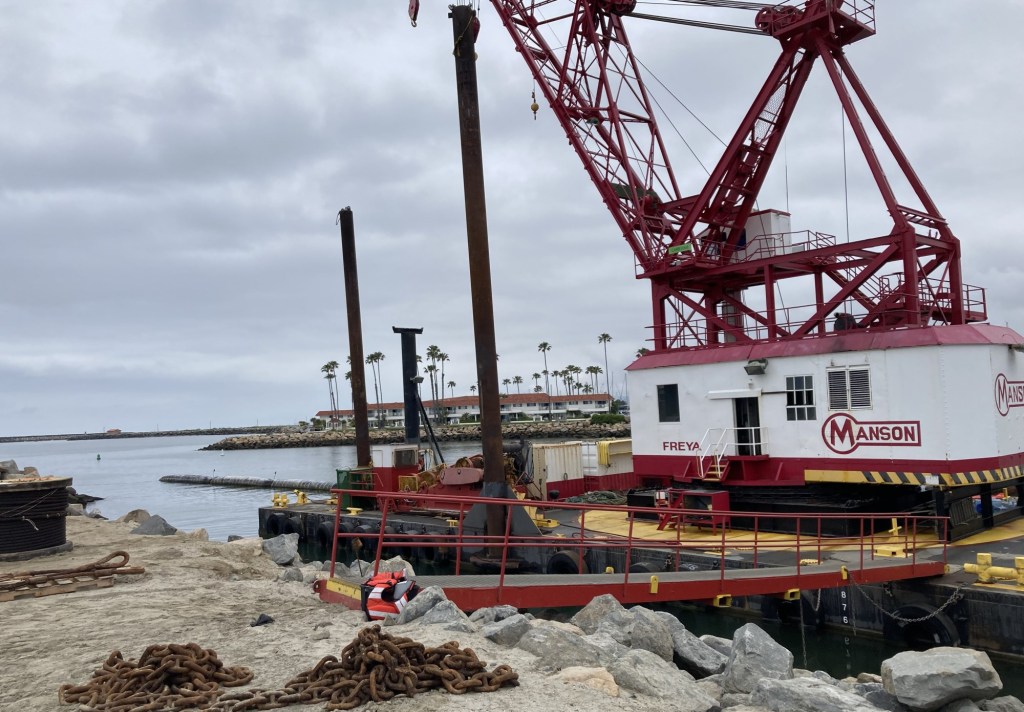
An emergency dredging is needed to clear a growing sandbar that’s a hazard for boats at the entrance to the Oceanside, Harbor Division Manager Joe Ravitch said last week.
At least two vessels have capsized in recent weeks in the surf created by what boaters call a shoal, Ravitch said. Both events required rescues by the Oceanside Fire Department’s lifeguards
Notices have been issued asking boaters not to use the entrance “unless they really need to” and to “always be cautious going in and out,” he said.
An “off-cycle dredge” is expected within the next month, based on availability of the dredge and its operator, Manson Construction, the company that regularly maintains the harbor channel, said Jayme Timberlake, Oceanside’s coastal zone administrator.
The city is working with the U.S. Army Corps of Engineers, which is responsible for maintenance of the harbor entrance and main channel, Timberlake said Wednesday. The cost, which has not been determined yet, will be paid by the Corps of Engineers.
The harbor’s marina has more than 900 boat slips of various lengths, nearly all rented, with a long waiting list for the more popular sizes. About 10% are occupied by live-aboard boaters. Oceanside has the only harbor between San Diego and Dana Point.
A 38-foot sailboat with two occupants encountered large breaking waves near the Oceanside Harbor entrance on Friday, Nov. 7, and was pushed into the surf in front of the nearby Harbor Beach, according to a Fire Department news release. Two lifeguards brought two people rescued from the boat safely to shore, and neither one was injured.
Five people were rescued Nov. 2 by lifeguards, with help from volunteers including a 12-year-old member of the city’s junior lifeguard program, after a boat capsized in heavy surf just outside the harbor, officials said. Three people were taken to a hospital and treated for minor injuries. The others were evaluated at the harbor and released.
Camp Pendleton, where the Marine Corps’ small harbor shares the Oceanside harbor entrance, issued a warning last week for all boaters to “use extra caution when entering or exiting the harbor.”
A fall dredging last was done in 2018 after the usual spring dredging was skipped because the Corps of Engineers had problems obtaining the necessary permits from local and regional agencies. Most years the dredging takes several weeks and is completed by the Memorial Day weekend, which is the unofficial start of the summer tourist season.
Tides, high surf and the ocean currents push sand into the harbor entrance, which was built for Camp Pendleton at the outset of World War II in 1942. Oceanside’s harbor was built in the 1960s. The federally authorized depth for the harbor channel is 20 feet, but without regular maintenance the channel can shrink to half that depth.
Oceanside also is talking with the Corps of Engineers about moving the annual harbor dredging from spring to the fall.
“This adjustment is expected to improve the effectiveness of sand placement, strengthen shoreline protection, create greater predictability for both dredging operations and community programming, and improve entrance channel conditions,” Timberlake said.
Sand from the harbor is piped onto nearby Oceanside beaches, mostly between the pier and the harbor. Beaches south of the pier are too far from the harbor to receive much of the sand and are badly eroded. The city has been working for several years on a separate sand project for that area.
Moving the annual dredging to the fall could benefit both the city and the Corps of Engineers, Timberlake said.
“Sediment transport in the fall and winter has greater potential to move sand southward, supporting beaches to the south that are most impacted by erosion, and improving coastal access,” she said in an email.
“A dedicated fall work window minimizes the array of potential delays that can be caused by Oceanside’s position at the end of the Corps of Engineers dredging cycle,” Timberlake said.
Placing sand on the beach in the fall is more efficient because there are fewer environmental restrictions such as those associated with grunion or nesting birds, she said. The wider late-summer beach conditions are better for placing the sand transport pipes, which means fewer interruptions for beach activities and programming such as the city’s junior lifeguard program.
Replenishing the beach before winter storms also will create a wider buffer to protect public infrastructure, recreational areas, and private property, she said.
“The current shoaling is partly due to northward sand transport,” Timberlake said.
The amount of sand on beaches fluctuates naturally with weather and wave patterns. California beaches are wider in the summer when less energetic waves push sand onshore, and narrower in winter from the erosion of powerful winter storms.
“When dredged sand is placed in spring, as it was in May 2025, south swells and prevailing littoral currents push it back into the harbor channel, San Luis Rey River mouth, and Harbor Beach,” she said.
Because of fewer northwest swells last winter, sand that could have moved south with the larger waves and currents instead accumulated along the coast, she said. That left the sand poised to move north into the channel when stronger south swells arrived.
“Collective studies indicate that fall would be a more efficient time of year for sand dredging for the beaches and for the efficiency of continual navigation through the channel,” Timberlake said.
Details of the possible shift from spring to fall will first be presented to the Harbor and Beaches Advisory Committee for a recommendation and then to the City Council early next year for a final decision, Ravitch said.