
An associate professor at Fresno State was called to help on the Palisades Fire in Southern California.
That experience, and working on other wildfires, became the inspiration for a new forensic academy.
Fresno State Anthropology Associate Professor Chelsey Juarez, Ph.D., was one of hundreds called in to help when the Palisades Fire erupted in January.
“He just said, ‘Things are looking pretty bad down here in the Palisades, and I need you to be ready to deploy.'” Juarez said.
She works as a forensic anthropologist for the California Office of Emergency Services.
She and a team of other anthropologists help with wildfires to identify human remains.
“What was happening is they were working with a canine, and if they got a hit and they came across something that they thought might be human remains, they took a photograph of it and sent it to the forensic anthropologist at the command center. The forensic anthropologist at the command center would look at the photograph and then say, ‘Okay, we need the forensic anthropologist in the field to go out and look and confirm.'” Juarez explained.
In addition, she ran “Just-In-Time” training on-site.
It’s essentially a crash course to pass on their knowledge to first responders and urban search and rescue teams.
“We brought several hundred individuals that were first responders, USAR from the United States and international to come through the tent to train them before going into the field, so they know what thermally altered human remains look like,” Juarez said.
Through that experience and previous fires, Juarez and her colleagues saw the need to train others to be better prepared to assist in future disasters.
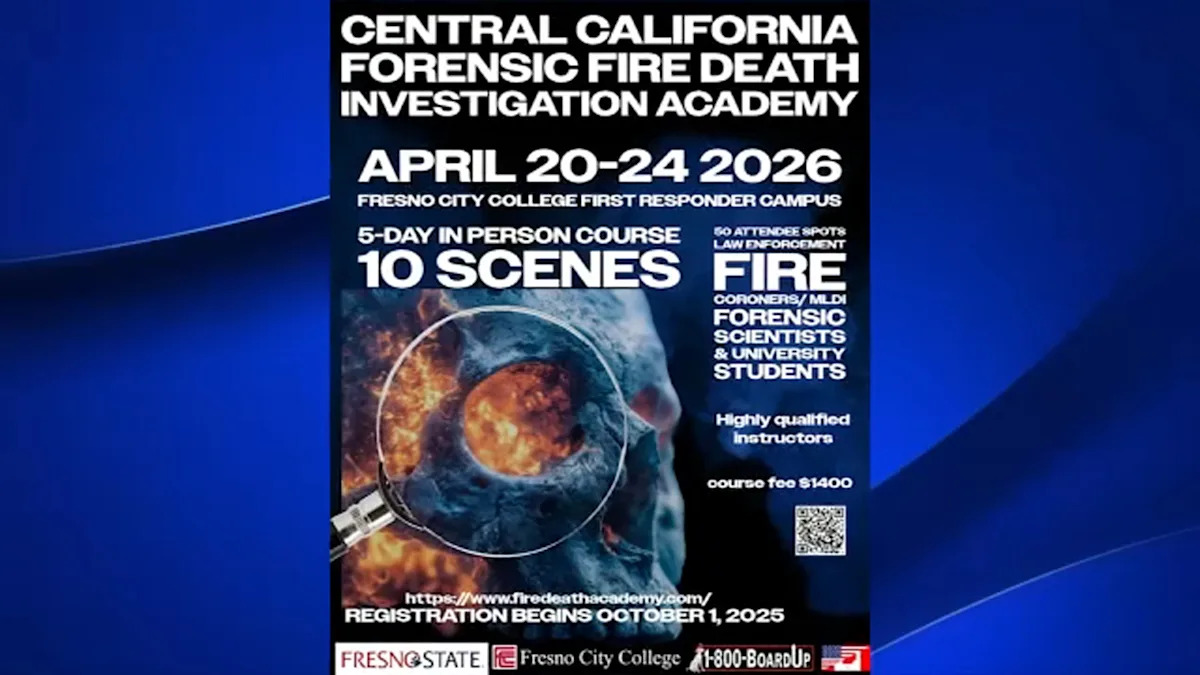
Now, they’re planning the Central California Forensic Fire Death Investigation Academy.
The five-day event is happening in April at the Fresno City College First Responders Campus.
Half the time will be lecture-focused. The other half will be hands-on training.
“We are contracted to receive 10 human remains, 10 bodies for the fire academy, and these individuals are individuals that have donated their bodies to science and have decided that they would like to participate in the fire academy,” Juarez said.
Juarez hopes this academy will also help advance fire research.
It will welcome 50 professional attendees and 10 student attendees.
The goal is to have participants from a variety of backgrounds and professions so they can also learn how to best work together.
“I want to provide something with my colleagues that is the absolute top-notch training anywhere in the country, and incredible research opportunities for scientists to come so that we can actually not only understand, but make changes,” Juarez said.
Applications for the academy opened in October and will close in December.
You can find more information about the academy and apply by clicking here.
For news updates, follow Jessica Harrington on Facebook, X and Instagram.