
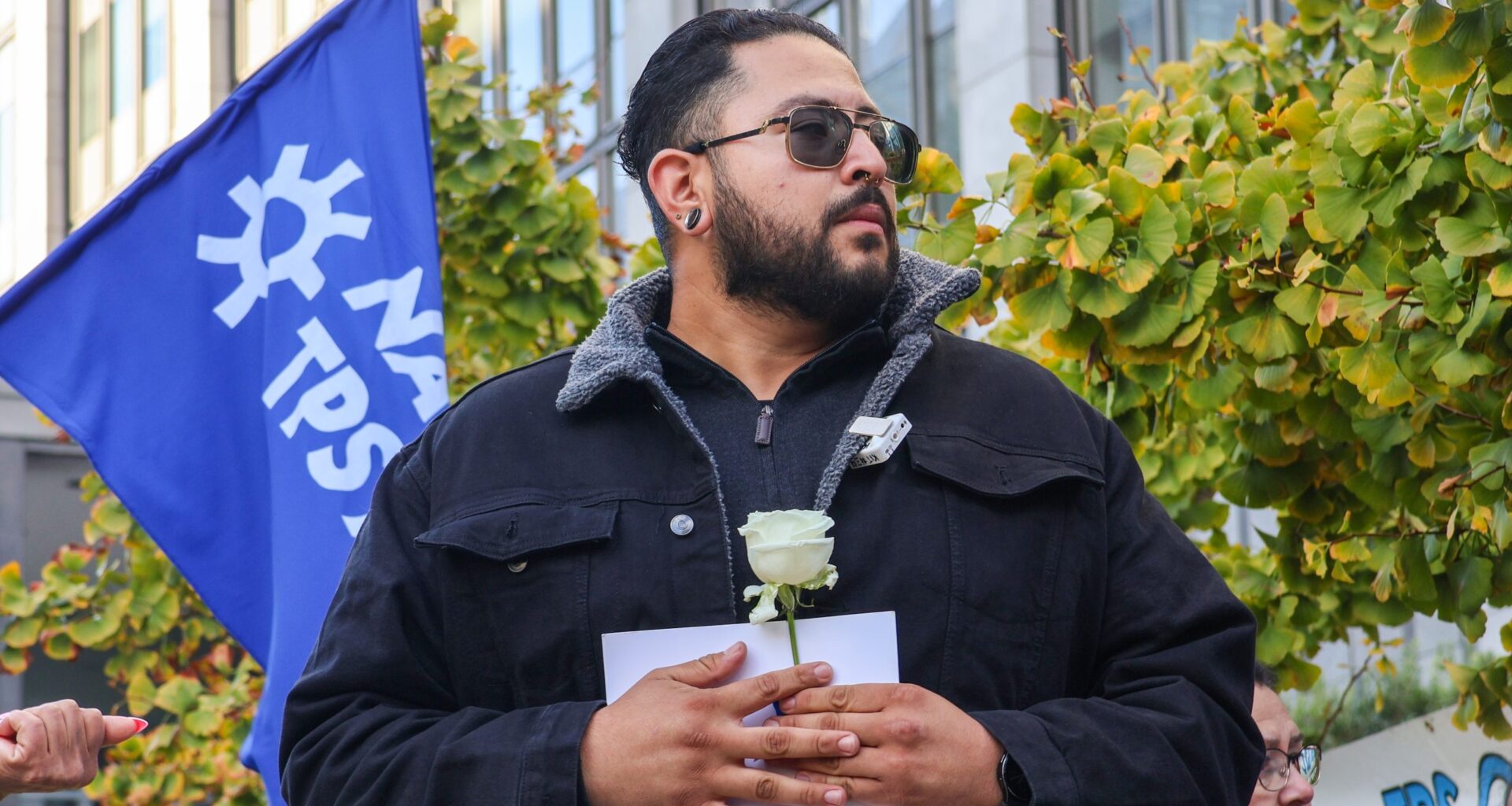
At 2 a.m. Tuesday morning, nursing student Jhony Silva folded clothes to quiet his anxiety. In a few hours, Silva’s attorneys would challenge the Department of Homeland Security’s July decision that terminated Temporary Protected Status for immigrants from Nepal, Honduras and Nicaragua who had fled to the U.S. to escape natural disasters.
Silva is among more than 60,000 people whose lives hang in the balance. Silva arrived in the United States from Honduras at the age of 12 after Hurricane Mitch devastated Central America in 1998. He remembers little of his home country and has made a life here, studying to become a registered nurse.
A recent lawsuit, filed by ACLU NorCal and partnering law firms challenged the Department of Homeland Security’s decision to terminate Temporary Protected Status and claim that DHS did so unlawfully. As it stands right now, those left without protected status will have to decide between uprooting their lives to face tenuous conditions in their home countries or remaining rooted in the U.S. where they could face severe legal consequences.
Inside Judge Trisha Thompson’s San Francisco courtroom – at the U.S. District Court for the Northern District of California – on Tuesday morning, an audience filled the wooden benches for the hearing: National TPS Alliance v. Noem. They sat shoulder-to-shoulder, many wearing TPS alliance pins from the advocacy organization National TPS Alliance. Others held white roses adorned with blue ribbons — the flower a symbol of peace and the color referencing the Nicaragua and Honduras flags. Silva made his way to an empty seat and sat down, nervously tapping his leg.
Thompson made the stakes clear; if the ACLU and its allies could make a strong case that San Francisco had jurisdiction, she would be able to make a summary judgment on whether or not TPS will be restored for people from Nicaragua, Honduras and Nepal. Thompson had pored over all of the submitted evidence, she told the attorneys for the ACLU and DHS. “I probably haven’t slept in three days due to the academic exercise you both gave me,” she said.
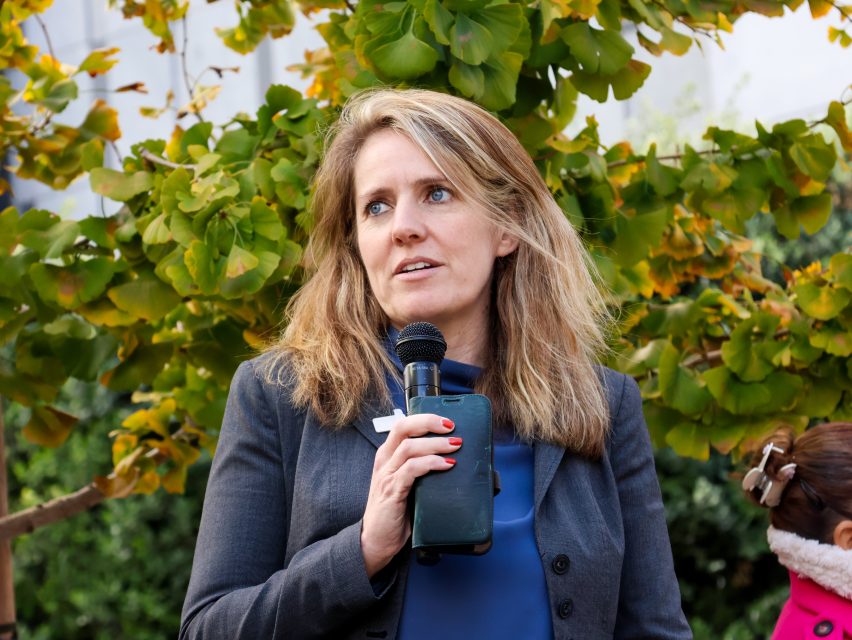 The ACLU NorCal attorney, Emi MacLean stands before a crowd outside of the U.S. District Court of Northern California in San Francisco. Photo by Sage Rios Mace.
Attorneys for both sides then took to the podium and began presenting their cases. The ACLU attorney, Emi MacLean challenged the termination of TPS on grounds that the government had failed to review the safety of the countries that TPS recipients risked being deported to before rescinding the status — a departure from decades of legal precedent.
“They made a decision based on stale information,” said the ACLU attorney. If the Secretary of Homeland Security had looked, MacLean’s co-council attorney Jessica Bansal said, they would have found that both Honduras and Nicaragua remained fundamentally unsafe.
Meanwhile, Bansal said, the government published numerous highly racialized and publicized statements, to justify the termination of TPS. One public statement referred to TPS holders as “criminals” and “Invaders.” Another highlighted statement said that allowing TPS holders to stay, “encourages a mass migration.”
For the next four hours, both the ACLU and DHS attorneys fought to answer Judge Thompson’s questions, as the audience gradually dwindled. At one point, the judge questioned the government attorney’s claim that discretion “solely” rests with the head of the Department of Homeland Security. “The statute says solely?” Thompson asked. The attorney admitted, “no it does not.”
Thompson ultimately denied the government’s motion to dismiss the case, but it will take longer to reach a final ruling.
MacLean’s attitude was hopeful as she exited the courtroom. “We were able to present powerful evidence that the secretary’s decision to terminate TPS was illegal, predetermined and not based on what the statute needs them to be based on,” she said. “We are hopeful that the court will recognize the illegality of these actions.”
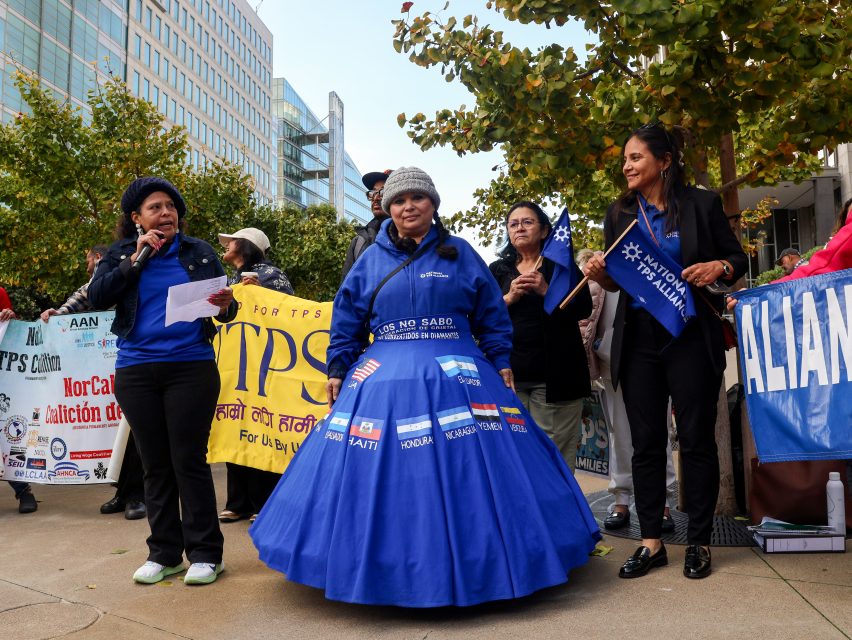 Women stand outside of the U.S. District Court of Northern California in San Francisco to protest the termination of TPS. Photo by Sage Rios Mace.
Outside the courthouse, supporters chanted, “El pueblo unido jamás será vencido,” (the people united will never be defeated) as Silva and his legal team emerged.
Silva said he was worried about how the threat of deportation was impacting his nine year-old child. “I couldn’t hide what is happening to my kid but I think he understands more than enough because he’s been anxious,” he told Mission Local.
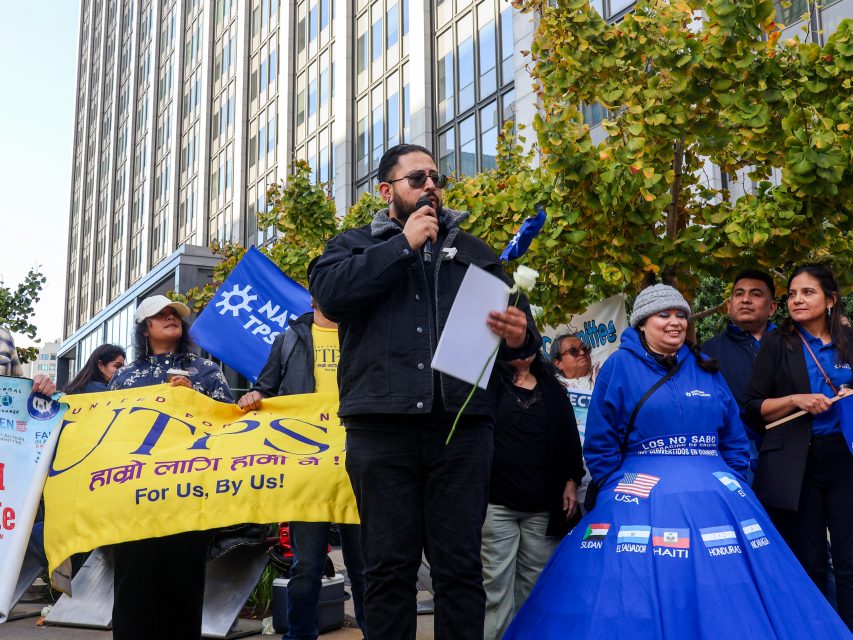 Jhony Silva stands before a crowd of organizers and community members gathered in solidarity against the termination of TPS. Photo by Sage Rios Mace.
In the background, music from a Los Angeles Central American band that had traveled to attend the hearing could still be heard, as well as chants from the crowd.
“It’s very powerful to be a part of this movement.” Silva said, as he stepped up to address the crowd. “I have faith that the judge will rule in our favor because we all deserve better.” He looked out at the crowd with tears in his eyes. “We shouldn’t be living like this.”