
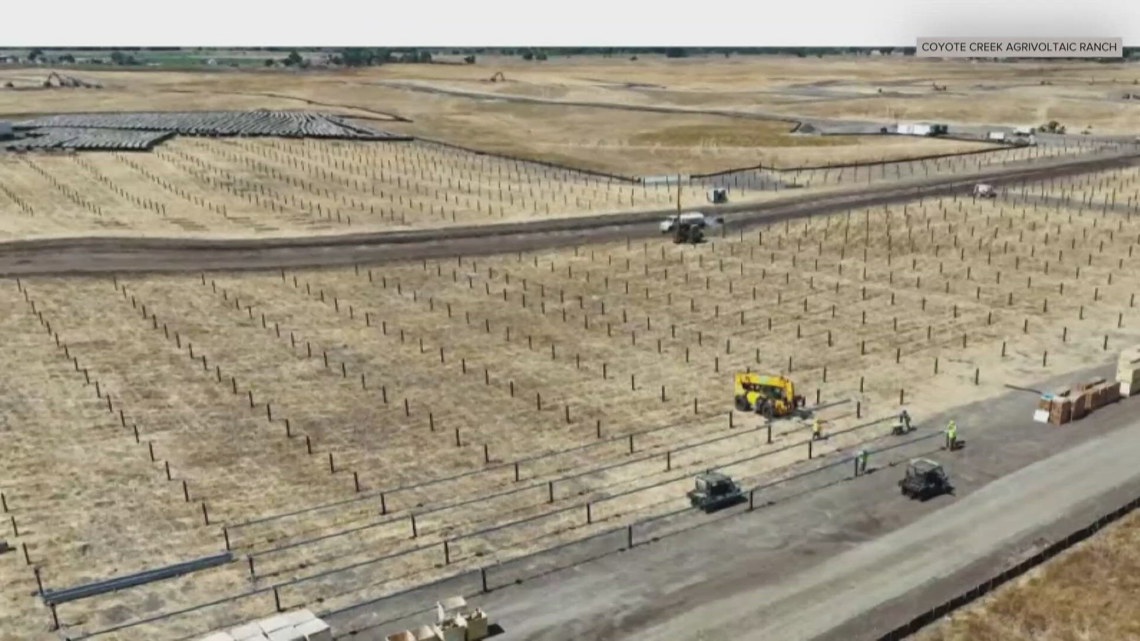
Supervisors framed the project as a mix of clean-energy development and continued agricultural use.
SACRAMENTO COUNTY, Calif — Sacramento County supervisors have approved one of the largest solar proposals in the the county, voting 5-0 after hours of testimony from more than 150 speakers.
The Coyote Creek Agrivoltaic Ranch would bring a 200-megawatt solar farm and a 100-megawatt battery system to roughly 2,700 acres east of Rancho Cordova, along Scott Road near White Rock Road. The solar array area is expected to take up 1,357 acres, also includes a 400 MWh centralized battery storage system, a new on-site substation and a 1.3-mile generation tie line connecting to the SMUD grid. It’s designed to operate for 35 years with a fully funded plan to restore the land after decommissioning.
Supervisors framed the project as a mix of clean-energy development and continued agricultural use. The developer, D.E. Shaw Renewable Investments, says sheep grazing remaining on land within the project’s fenced boundary and grazing is anticipated to continue outside of the fenced boundary under control of the landowner in the area of Barton Ranch.
“My decision to support is a business decision,” Supervisor Rodriguez said.
“We are running out of time. We have to take bold action now,” Supervisor Patrick Kennedy said.
“I am not going to be the one to kick the can down the road and set us back for another five years,” Supervisor Pat Hume said.
Supporters told the board the project would protect open space, increase tax revenue and help shift the region toward carbon-free power.
“This project is a forward looking investing that delivers clean energy, preserves open space and enhances the long term value of this county asset,” said one speaker in support.
Another said, “A vote for Coyote Creek is a vote for responsible development that provides an economic development for all.”
Opponents argued the project was placed in the wrong area, too close to Prairie City State Vehicle Recreation Area, vernal pools, oak woodlands and tribal cultural landscapes.
One speaker warned it would cause “irreparable harm and desecration of cultural resources, including villages sites, burials and habitat for our plants and animals.”
Others leaned on poetry to make their case, including a Dr. Seuss reference: “I am the Lorax I stand with trees, I speak for the trees because they have no tongues.”
Developers said they reduced tree impacts by 30 percent during the environmental review. They added conservation commitments that include at least 1,150 acres of oak woodland, riparian habitat and wildlife corridors, saying that protection covers about 13,000 oak trees, nearly four times the number slated for removal. They also said the project would permanently affect less than one-hundredth of an acre of vernal pools.
But some supervisors noted frustration that SMUD, which is expected to buy the electricity, did not attend the meeting.
“It is bit uncomfortable being asked to make a big decision and they are nowhere to be seen or heard from,” said Supervisor Phil Serena.
SMUD released this statement to ABC10:
“SMUD is not the developer of the Coyote Creek project. It is being developed by a third-party, D.E. Shaw Renewable Investments (DESRI). SMUD’s role is limited in scope as a power purchaser. The developer is responsible for project development, including site selection, environmental reviews and regulatory compliance, as well as the County of Sacramento’s approval process.
While SMUD does not have direct oversight of project development, the project has undergone extensive environmental review as part of the regulatory process.”
County officials said the developer still needs additional permits from other agencies before construction can begin.
Supporters said that once the project is running, it will contribute to SMUD’s 2030 zero-carbon plan.
WATCH MORE ON ABC10 | Workshop on the future of Sacramento Avenue
ABC10: Watch, Download, Read