
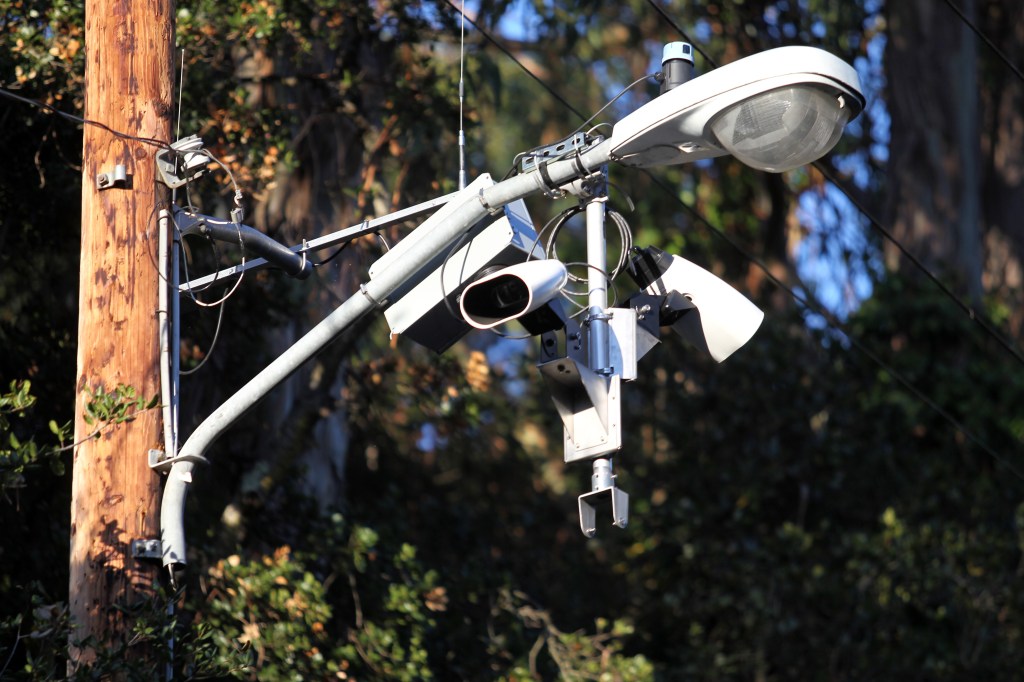
OAKLAND — For years, the city has grappled with balancing public safety with residents’ privacy concerns — namely over law enforcement’s use of surveillance cameras that track license plate data on cars driving through the city’s major thoroughfares.
On Tuesday, the city’s leaders voted down a $2 million contract with Flock Safety, the company that operates Oakland’s existing camera systems, after hundreds rallied against the threat of immigration authorities and other federal law enforcement spying on residents, bypassing the city’s sanctuary policies.
The issue has grown so contentious that two members of the local Privacy Advisory Commission resigned last week — and one subsequently filed a lawsuit against the Oakland Police Department.
The Oakland City Council had seemed prepared to ignore the commission’s advice and buy an upgraded set of Flock’s cameras for roughly $2 million. But in a 2-2 vote following a tense, dramatic meeting, a committee of council members failed to advance the contract to a final decision.
Police leaders had sought for the city to operate the cameras itself, arguing the added surveillance could fill in the gaps as OPD’s officer staffing levels decline. A recent poll indicated the city’s residents are broadly supportive of law enforcement surveillance.
But hundreds of public speakers Tuesday rallied against Flock, even after Councilmember Charlene Wang proposed amendments that would have imposed financial penalties on the company if it allowed other U.S. law enforcement agencies access to Oakland’s camera data.
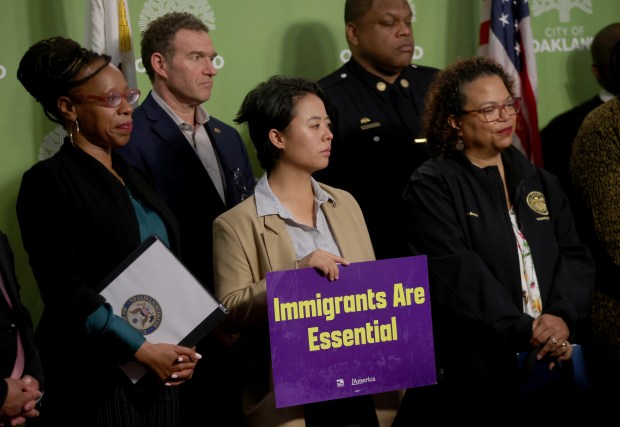 Oakland city Councilmember Charlene Wang, center, listens during a press conference at City Hall in Oakland, Calif., on Thursday, Oct. 23, 2025. To the left is 12th District Congresswoman Lateefah Simon and to the right is 18th District Assemblymember Maria Bonta. (Jane Tyska/Bay Area News Group)
Flock already has nearly 300 cameras installed across the city, but since last year those had been operated by the California Highway Patrol, on the orders of Gov. Gavin Newsom. The city’s contract would have upgraded the existing camera systems, which are installed along East Bay state highways and Oakland’s local surface streets.
The city established a policy for license-plate readers in 2022, later enhancing restrictions so that OPD could retain camera footage for just 30 days.
But an intense crackdown on immigration by the Trump administration has ratcheted up privacy concerns in Oakland, where crime has declined the past two years following a spike during the COVID-19 pandemic.
“I have no idea how we, as a sanctuary city, support any association with Donald Trump, (or) Peter Thiel, or any of his conservative billionaire cronies who are working to reshape this country in the image of something that looks nothing like the people who came here to speak today,” Councilmember Carroll Fife said at Tuesday’s meeting.
Thiel, a prominent Trump ally, was an early venture backer of Flock Safety, whose representatives on Tuesday distanced themselves from controversies over its license plate reader data being accessed by U.S. Immigration and Customs Enforcement.
Brian Hofer, a leading local privacy advocate who stepped down last month from the city commission, filed a lawsuit Monday accusing the Oakland police of routinely sharing camera data with federal law enforcement since last August.
It is the second lawsuit Hofer has filed in recent years alleging the city violated SB 34, a law that restricts how data captured by license-plate reader technology can be used.
“Flock is a shady vendor – this is not a good corporate partner,” Hofer said in a recent interview. “The commission pushed for alternatives, but the city moved forward.”
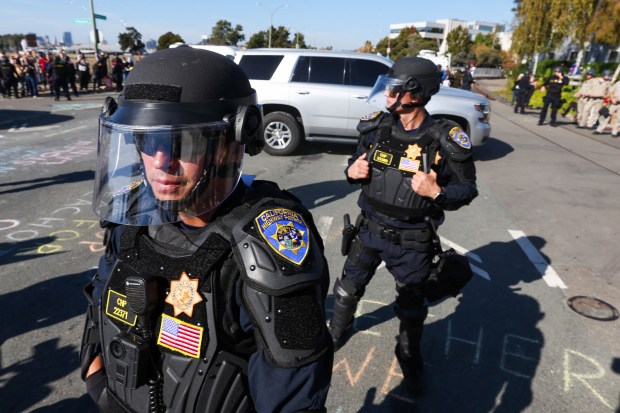 California Highway Patrol officers in riot gear clear the road during a protest as federal vehicles leave the U.S. Coast Guard Island in Oakland, Calif., on Thursday, Oct. 23, 2025. Earlier today, dozens of federal agents, including personnel from U.S. Customs and Border Protection (CBP) and Immigration and Customs Enforcement (ICE), entered the island. (Ray Chavez/Bay Area News Group)
Flock’s camera systems use artificial intelligence to scan all its footage, identifying license plate data to cross-reference with law enforcement databases. As a result, all kinds of identifying information becomes available — even for people who are not suspected of a crime. The company says it does not use facial-recognition technology.
Criticism of Flock has mounted across the country, including in other Bay Area cities. A coalition led by the ACLU and Electronic Frontier Foundation filed suit Tuesday against the city of San Jose over what it described as “millions of warrantless searches of automated license plate reader data.”
Speakers in Oakland were enraged Tuesday that the council would even propose the contract amid Trump’s unprecedented approach to immigration enforcement, including his short-lived deployment last month of federal agents to the East Bay.
“Considering this proposal tells me you are not connected to the immigrant community in this city,” Oakland resident Zerena Diaz said. “Folks are not even leaving their house to eat, to get groceries. Kids are not going to school. How do you think having Flock all over the city will impact them?”
Broadly, however, Oakland residents have pushed for additional law enforcement measures, even as crime numbers decline.
Two-thirds of residents surveyed in a recent poll said they would support “automated surveillance cameras operated by the city of Oakland in neighborhoods and commercial corridors.”
Abu Baker, an Oakland resident, offered a rare show of support for Flock among Tuesday’s public speakers, noting there wasn’t enough available camera footage to catch a suspect after Baker’s son was killed three years ago in the front yard of the family’s home.
“We have no closure,” Baker said, “and Flock technology could have been useful to catch that person. Who knows who they’ve gone on to hurt since then?”
Wang and Ken Houston, the two council members who unsuccessfully voted to advance the contract, indicated they wanted to see the full council discuss all the details before rejecting the deal outright. Fife and Councilmember Rowena Brown voted against the resolution.
It was not immediately clear what becomes of the nearly 300 Flock cameras that are already installed across the city that had mostly been operated by the CHP.
But residents on Tuesday celebrated defeating — for now — Oakland’s splashy purchase of a new camera system that they described as part of a “global surveillance network.”
“If we make dragnet surveillance the norm,” said one speaker, who provided only the first name Rebecca, “it’s going to be really hard to take it back.”
Shomik Mukherjee is a reporter covering Oakland. Call or text him at 510-905-5495 or email him at shomik@bayareanewsgroup.com.