
A society founded by Benjamin Franklin had met outside its home base in Philadelphia only once since it began in 1743. That is, until last week.
The American Philosophical Society held its semiannual meeting Nov. 13-15 in La Jolla, marking only the second time in its history and the first time in 20 years it had met outside its usual spot.
The event was in partnership with La Jolla’s Scripps Research and featured a bevy of local scientists, professors and public figures.
The first and third days of the meeting, as well as Day 2’s morning session, were held at the Estancia La Jolla Hotel & Spa. The afternoon session on Day 2 was at Scripps Research’s Hazen Auditorium.
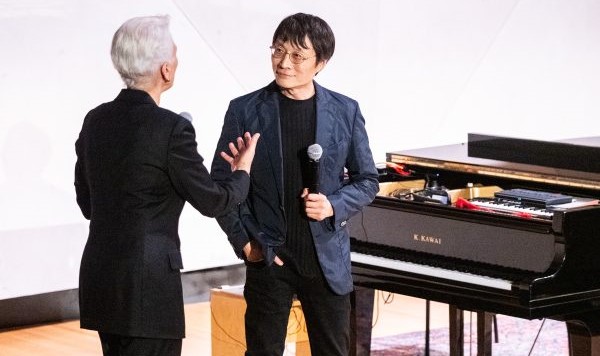
The second day concluded with a concert led by composer Lei Liang, a professor of music at UC San Diego.
Among the presentations were:
• “A Conversation with Irwin Jacobs on Science, Technology and the Future,” hosted by the La Jolla philanthropist and chairman emeritus of the Salk Institute for Biological Studies
• “Super Agers: An Evidence-Based Approach to Longevity,” presented by Dr. Eric Topol, director and founder of the Scripps Research Translational Institute
• “What Still Needs to be Done to Conquer Cancer,” by Salk Institute professor and cancer biology pioneer Tony Hunter
• “Invisible Currents: How Polluted Rivers and Oceans Change our Air Quality,” by Kimberly Prather, an atmospheric chemistry researcher and a professor at the Scripps Institution of Oceanography and UC San Diego’s Department of Chemistry and Biochemistry
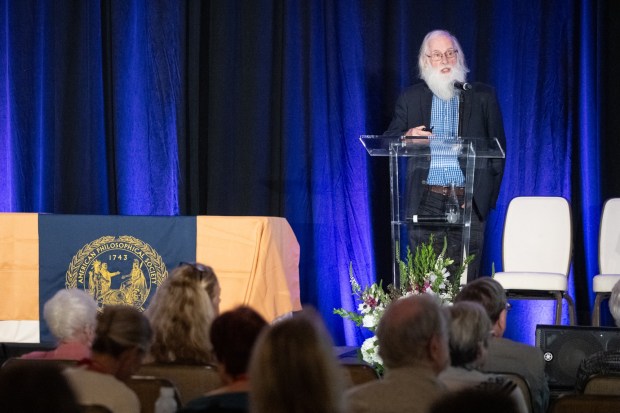 Tony Hunter, who began working at the Salk Institute for Biological Studies in 1975, speaks at the American Philosophical Society’s meeting in La Jolla about what can be done to conquer cancer. (J.T. MacMillan)
The event also shed light on the state of science funding and how leaders can respond to what they described as “new realities” for universities and science institutions. Several university and college presidents — Alan Garber of Harvard, Michael Crow of Arizona State and G. Gabrielle Starr of Pomona College — spoke at a panel discussion Nov. 14.
The American Philosophical Society was formed as a means to disseminate ideas.
“Franklin’s idea was that at the time, [in] colonial America, there were all these colonies and they needed an institution that would bring the leading minds together to share what they were learning in their home communities with each other, with the idea that if more knowledge was shared, the better humankind would be,” said Chief Executive Patrick Spero.
Centuries later, APS is still pursuing its mission of “promoting useful knowledge” by electing scholars, scientists and professionals as members and meeting with them in semiannual gatherings; providing grants, fellowships, lectures, publications and more; and offering a research library of historic manuscripts and collections.
Choosing La Jolla as the site of November’s member meeting was a product both of connections between APS and Scripps Research and the community’s focus on science, Spero said.
“California is the single largest state for our members,” he said. “We have a little over 100 members here in California. … La Jolla, being this incredible center for science and innovation, actually [has] a large contingent of members.”
“The APS is all about research and scholarship,” Spero continued. “We fund a lot of research. And to be in a place like Scripps really represents who the APS is.”
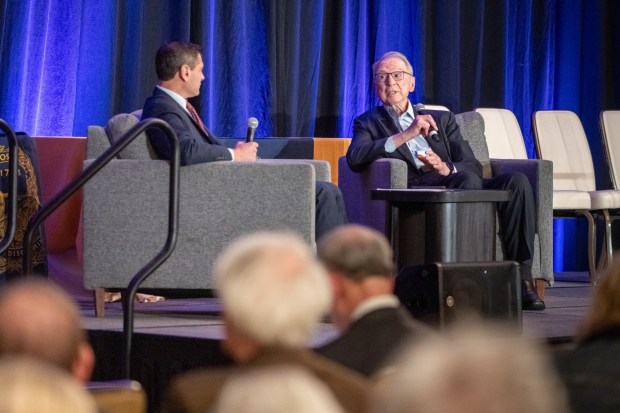 Irwin Jacobs hosts a conversation about science, technology and the future on Day 1 of the American Philosophical Society’s semiannual meeting Nov. 13 in La Jolla. (J.T. MacMillan)
Spero called the meeting a great success and said it might have opened the door to more events on this side of the country.
“It was such a good time that the society has made it a priority to have more meetings on the West Coast because of the experience we had in La Jolla,” he said. “We wanted to do this for a long time. We finally were able to, and now we’re committed to do it more frequently.” ♦