
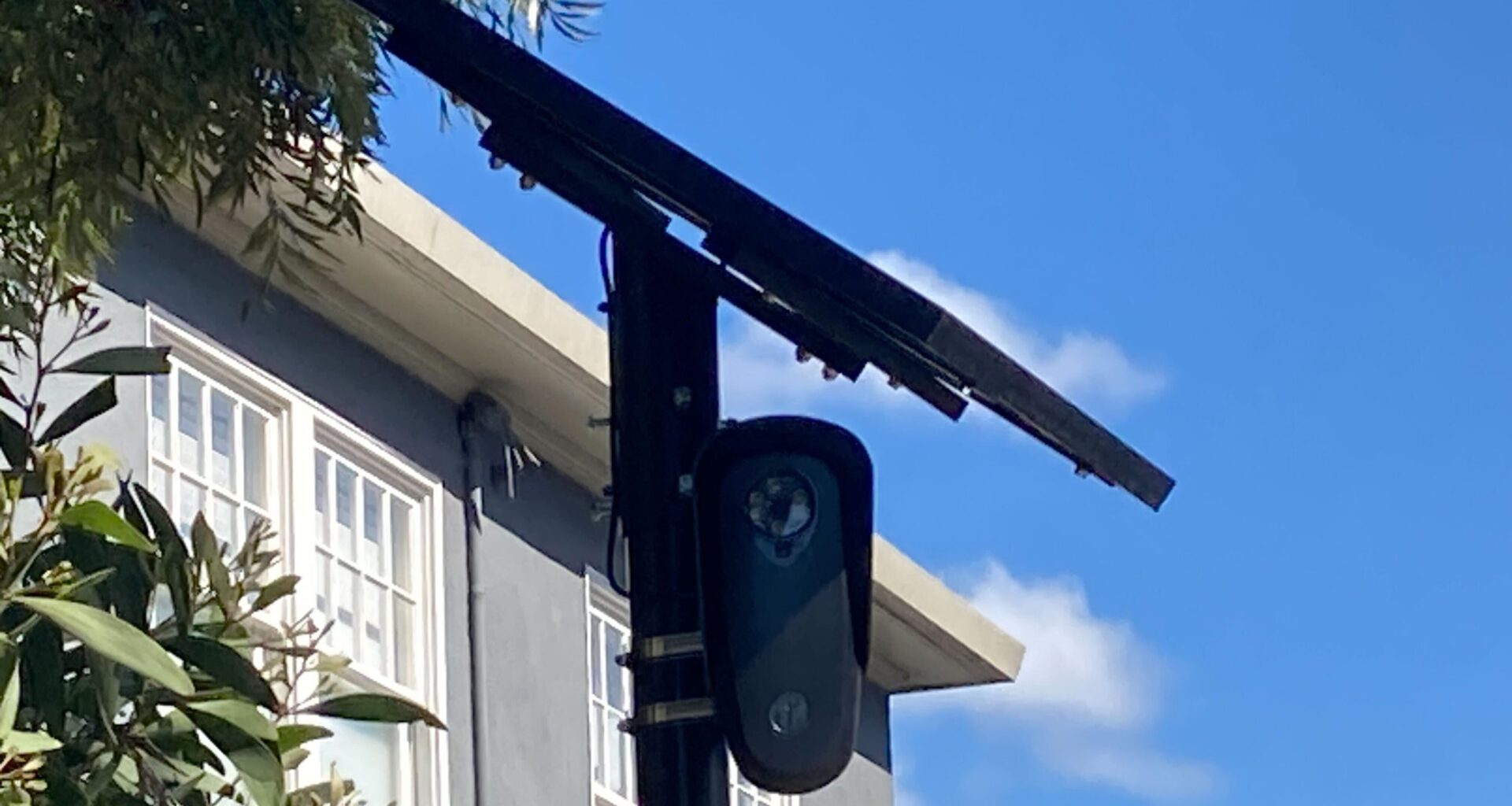
The Oakland Police Department’s push to sign a new deal with a Georgia-based company to operate surveillance cameras on local roads flopped on Tuesday after the City Council’s Public Safety Committee refused to move it forward.
Councilmembers Carroll Fife and Rowena Brown voted against a police plan to approve a $2.25 million contract with Flock Safety.
Under the deal, Flock would maintain a network of 290 automated license plate reader cameras that monitor vehicles on Oakland’s roads. The department also wanted councilmembers to approve a policy that would allow police to incorporate private cameras into Flock’s system.
Councilmembers Charlene Wang and Ken Houston voted in favor, resulting in a tie. Wang tried unsuccessfully to broker a compromise by suggesting an amendment that would impose a $200,000 penalty for any incident where Flock causes the unauthorized sharing of data.
The department’s proposal has faced strong headwinds from the public for months. Oakland’s Privacy Advisory Commission, a volunteer board that weighs the pros and cons of new technologies and advises the council and OPD, refused to endorse the police department’s plan, citing concerns about Flock, which has shared access to data with federal law enforcement agencies, potentially making it available for immigration enforcement and investigating people seeking abortion services. California state law prohibits police departments from sharing license plate reader data with the feds.
A new lawsuit also challenges Oakland’s ability to deploy license plate readers
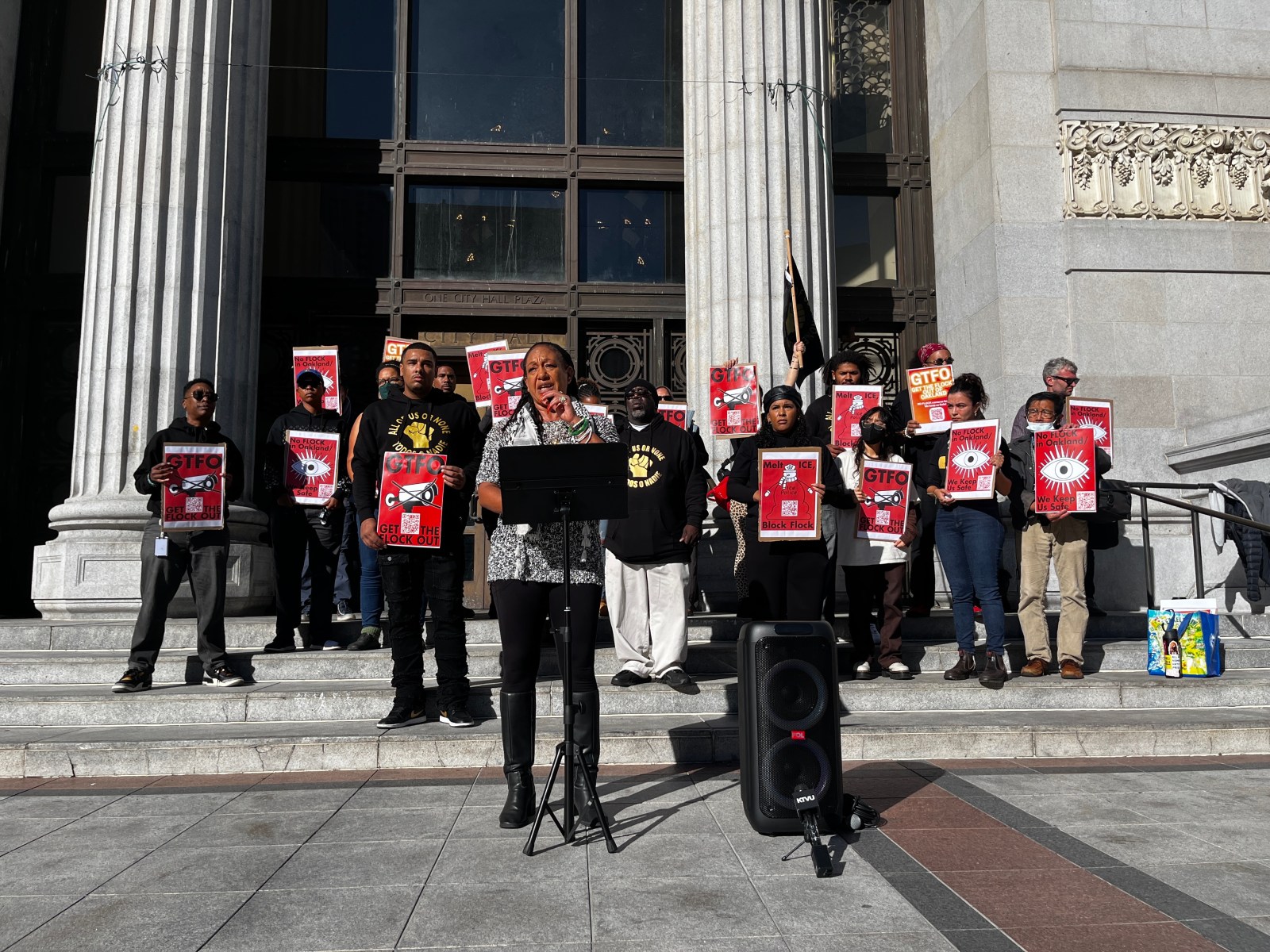 Cat Brooks, Executive Director of the Anti-Police Terror Project, speaking in front of City Hall on Nov. 18, 2025. Brooks was one of dozens of people who urged councilmembers to reject a contract with Flock Safety. Credit: Eli Wolfe / The Oaklandside.
Shortly before Tuesday’s meeting, a former member of the Privacy Advisory Commission sued the department for allegedly breaking state and local law by repeatedly sharing its ALPR data with federal authorities. And while some business owners and residents strongly support OPD’s plan, they were outnumbered at City Hall by people protesting against the contract.
“What I would like to see is a complete rejection of Flock,” Fife said, prompting raucous cheers from most of the roughly 100 people packed into the chambers.
OPD has the option to bring the proposal back to council for scheduling, but it will still need to be passed out of the public safety committee before it receives an up-down vote by the full City Council.
A police department spokesperson told The Oaklandside that OPD “is disappointed by last night’s vote. The camera system is an essential tool for ensuring safety in our community. We will consider the community’s concerns before presenting the item again.”
Over the course of Tuesday evening, dozens of public commenters told the committee that they didn’t believe Flock was a trustworthy company.
Several pointed to alleged security issues with Flock’s cameras and the political leanings of the company’s investors. Some appeared to reference a video that was recently posted online by Benn Jordan, a YouTuber with over 900,000 subscribers. In the video, Jordan explored technical vulnerabilities and other issues with Flock products. He also brought up Oakland and disclosed that he has been informally “consulting” with some councilmembers and shared his research with them. It’s unclear with whom he spoke.
Many of the speakers at Tuesday’s meeting said they were afraid that Flock would share Oakland data with federal immigration agencies. Lisa Hoffman, co-executive director of East Bay Sanctuary Covenant, an organization that provides legal services to immigrants, said she believes the contract will put Oakland immigrant residents in “grave danger.”
“Flock has violated contracts with other sanctuary cities by sharing data with the federal government for immigration enforcement and lying about it,” Hoffman said, adding that cities have terminated their contracts because of this. “Why would Oakland choose to spend $2.25 million building the very surveillance infrastructure that will be weaponized against our immigrant neighbors?”
Federal agents accessing license plate reader data is driving some cities to rethink their Flock contracts
Flock cameras have been posted on utility poles around Oakland since 2024, and the Oakland City Council – including Fife – approved an agreement to procure the cameras in 2023 with little fanfare.
But attitudes toward Flock shifted earlier this year after media outlets reported that ICE had obtained access to data from Flock systems through local police departments in other states. Over the summer, the San Francisco Standard reported that SFPD had accessed Oakland’s ALPR system and turned over data to federal law enforcement agencies.
OPD officials have repeatedly asserted that, as a sanctuary city, Oakland doesn’t share data with U.S. Immigration and Customs Enforcement. A state law, SB34, also prohibits local police from sharing ALPR data with law enforcement agencies outside of California. Representatives from Flock have also argued that the company does not own the data collected by its cameras and that agencies decide with whom to share their information.
Some cities in other states ended their contracts with Flock after the company disclosed that it had briefly partnered with the U.S. Customs and Border Patrol and provided the agency with access to ALPR data. In October, Oregon Senator Ron Wyden wrote in a letter to Flock’s CEO stating his belief that “abuses of your products are not only likely but inevitable” and encouraged local Oregon communities to remove the company’s cameras.
The backlash against Flock and ALPR cameras has been building in the Bay Area. On Wednesday, the ACLU, the Electronic Frontier Foundation, and other groups filed a lawsuit against San Jose over the use of warrantless searches of the city’s ALPR data, the East Bay Times reported. The plaintiffs claim this practice is unconstitutional and allows law enforcement—including federal agencies—to continuously monitor the movements of San Jose residents and visitors.
In Berkeley, a police watchdog organization recently reported that an audit of external law enforcement searches of the city’s ALPR data turned up a case where someone used the search terms “ICE” and “CBP.”
Some Oaklanders still support the department’s surveillance proposal
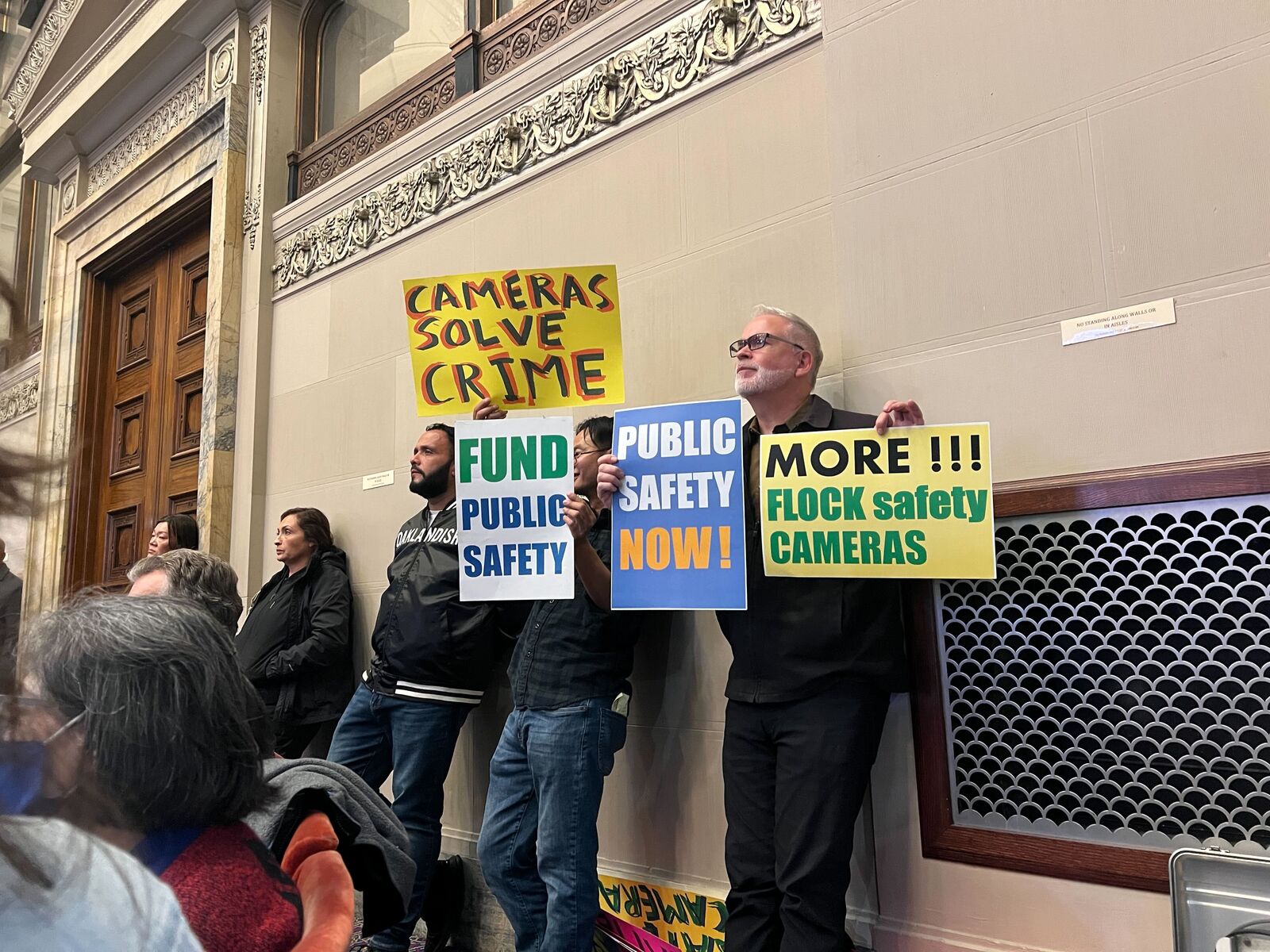 Flock Safety supporters Tuan Ngo and Edward Escobar hold up signs reading, “Cameras solve crime” and “More Flock safety cameras” at the City Council’s Public Safety Committee meeting at Oakland City Hall on Tuesday, Nov. 18, 2025. Credit: Roselyn Romero / The Oaklandside.
Wang, who spent much of the meeting Tuesday night trying to maintain order in the rowdy chamber, quizzed OPD about some of the issues raised by critics.
During the meeting, OPD Acting Lieutenant Gabriel Urquiza credited Flock cameras for helping drive down violent crime since 2024, in concert with the revamped anti-gun violence program Ceasefire. According to a recent report shared with the privacy commission, OPD logged 240 “enforcement actions” in Flock between August 2024 and February 2025. Of these, OPD was able to generate 112 leads, 55 of which were cleared by arrests.
Urquiza also stressed several safeguards, including a provision in the city’s proposed contract to terminate the deal with Flock in the event that the federal government were to take over Oakland or the police department.
A contingent of residents supports OPD’s proposal, which they say will help the understaffed department clear more crimes. They’ve also touted a recent poll by the Oakland Chamber of Commerce that they say shows strong support for OPD to use surveillance technology, including integrating privately owned cameras into the Flock system.
Several business improvement districts that have existing surveillance networks are eager to incorporate their cameras with OPD in the hopes that it will help reduce burglaries. Kanitha Matoury, a downtown business owner who ran for city council last year, told councilmembers she had to leave the meeting early because her store had been broken into.
Abu Baker, a third-generation Oakland resident, told the committee that his son was killed three years ago in the front yard of his home. He said OPD secured video footage from a neighbor, but there wasn’t enough evidence to track down the shooter.
“Flock technology could have been useful to help catch that person,” Baker said. “Who knows who they’ve gone on to hurt since then.”
“*” indicates required fields