
Multifamily landlords across the country face challenges as rents soften, but in Southern California, there are extra hurdles, namely rent caps.
This month, the Los Angeles City Council voted to put a cap on rent increases for the majority of the multifamily rental units in the city, and the city of Burbank is drafting an ordinance to implement its own version of a rent cap.

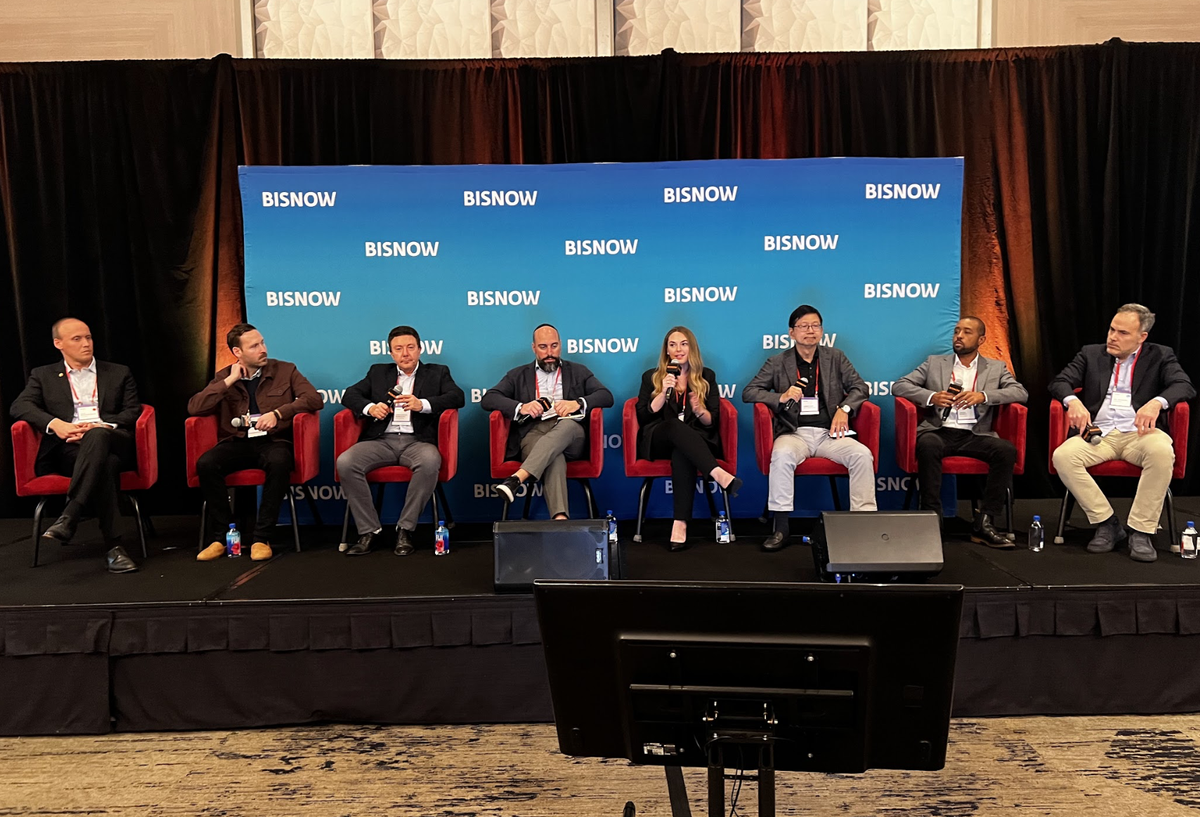
Bisnow/Samantha D’Angelo
CIM Group’s Alex Kolodziejczyk, Assemblage Works’ Conor Wood, Stack Modular’s Konstantin Daskalov, SL Equity’s Samuel Landman, Arc Capital Partners’ Gina Pfingston, Lam + Tea Engineering’s Jerry Lam, Marx|Okubo’s Jason Morris and RMG Housing’s Mo Zahrawi.
The ever-shifting rules have complicated some multifamily owners’ plans, even midexecution.
Over the last 10 years, Champion Real Estate purchased a lot of Class-C properties with the intention of upgrading them to high Class-B rentals, Champion Real Estate CEO Parker Champion told attendees at Bisnow’s Multifamily Annual Conference.
“That’s been very difficult given the restrictions that cities have put on us with rent control,” Champion said.
Rent control has dogged multifamily landlords with new tenacity since the pandemic. Some property owners hoped that the efforts of landlords in New York would bring the matter to the Supreme Court, but others weren’t waiting for relief and were instead getting creative.
Champion said the challenges posed by rent regulations were partly why his company has pivoted to student housing.
“We can count on those students moving out every year,” offering the opportunity to raise rents, Champion told the room at the Hilton Los Angeles/Universal City on Nov. 12 and 13.
Predictability is coveted but elusive, multifamily owners said, pointing to rising costs for everything from insurance to utilities and the difficulty in anticipating just how much those line items would increase. Measure ULA, the real estate transfer tax on almost all transactions above $5M, was another source of headaches for multifamily owners.
“We used to buy existing multifamily buildings and get them to pencil by just marking rents to market,” LWK Partners partner Austin Nissly said. “That business plan really does not work anymore, because of higher costs, inflation.”
Now, to get deals to make financial sense, Nissly said his company has to take a different tack.
“We need to be able to increase the density by at least 40% to make a deal pencil in this market,” Nissly said.
With all the restrictions and hurdles apartment owners said they faced trying to replicate business plans that used to work but don’t anymore, many are looking for a path of least resistance, especially if that path can help them avoid Measure ULA.
Some owners are looking to work within the parameters of LA real estate and the challenges posed by increasing regulations around rent-stabilized units. One option is the property tax welfare exemption, which exempts properties that provide affordable housing from paying property taxes.
By partnering with a reputable nonprofit partner, apartment buyers agree to preserve or create new affordability in the income-restricted sense. By having that nonprofit partner, the buyer avoids paying the Measure ULA transfer tax and has an ace up its sleeve to present to the seller.
It’s a strategy Langdon Park Capital has used to buy apartments in and out of Los Angeles proper, including an August transaction in Azusa for an 84-unit apartment complex.
“We split some of that exemption, [or] that exemption can go all to the seller. It kind of depends,” Langdon Park Capital CEO Malcolm Johnson said. “It does allow you to win a deal at a potentially lower purchase price than others, where the transfer tax would be a big burden.”