
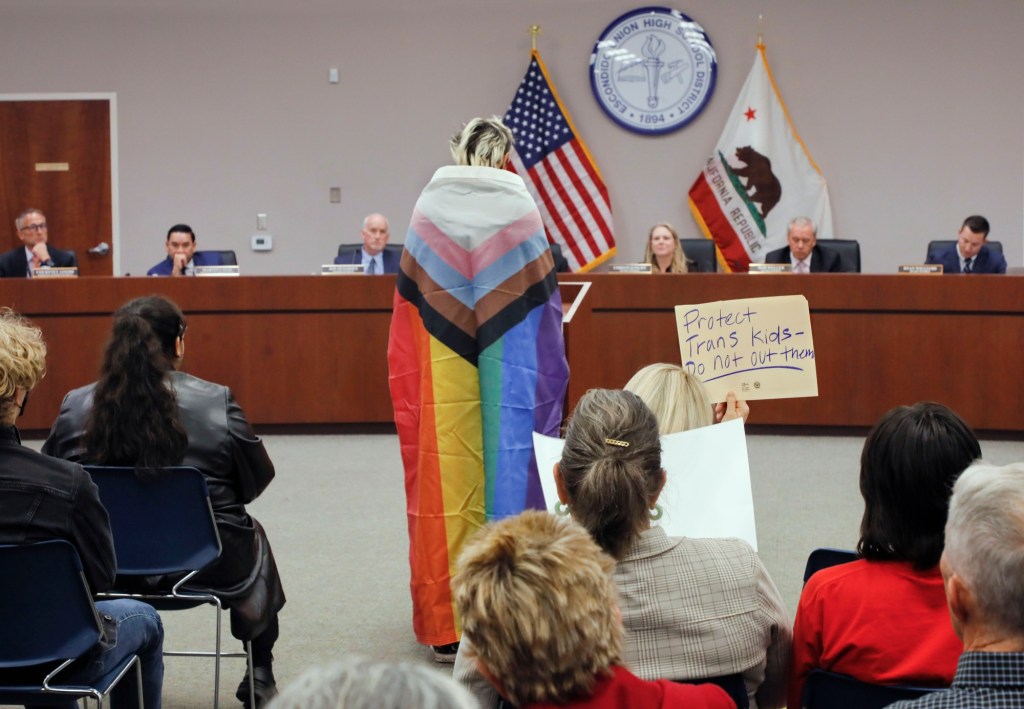
A San Diego federal judge debated with attorneys for hours during a hearing this week as he prepares to decide soon whether schools should be allowed to not tell parents about possible changes in their child’s gender without the student’s consent.
The hearing Monday was the latest development in a federal lawsuit filed in 2023 by two Escondido middle school teachers who said their district’s policy barring school staff from informing parents about possible gender changes violated their religious free exercise rights.
“We 100% support our LGBTQ students, but we don’t do it by cutting out their family. It puts teachers in an impossible situation,” said Elizabeth Mirabelli, one of the teachers, after the hearing.
The case has evolved beyond Escondido to focus more generally on the state’s position on the issue, since Escondido had modeled its policy on guidance from the state education department. The state has held that notifying parents or others about possible changes with their child’s gender without the student’s consent could compromise the student’s safety and infringe on the student’s privacy rights.
The lawsuit names as defendants state Superintendent Tony Thurmond, Attorney General Rob Bonta and the members of the State Board of Education, in addition to the Escondido district’s school board members and administrators.
In addition to ruling on the plaintiffs’ motion for summary judgment, Judge Roger Benitez is also expected to decide whether to sanction the state defendants, who the plaintiffs say misled the court on what they’ve been telling districts about parental disclosure.
The state had previously argued the case is moot because early this year it withdrew its published guidance telling schools not to tell parents or others about possible changes to a student’s gender identity without the student’s consent. That guidance was the basis of the plaintiffs’ case against the state.
But the plaintiffs later revealed that the state’s current training materials for educators included links to third-party websites that, like the state’s withdrawn guidance, advised non-disclosure.
Lawyers for the state defendants said they had mistakenly overlooked the third-party links when reviewing the training materials, calling it an honest error that did not warrant sanctions.
Privacy vs. parents
The case has grown in recent weeks.
Last month, Benitez certified the case as a class-action lawsuit to include parents and school staff who oppose their schools’ non-disclosure policies or have requested a religious exemption or opt-out from them. And the listed plaintiffs now include six additional anonymous teachers and parents.
The plaintiffs said after the hearing that they expect Benitez to rule in their favor on summary judgment, similar to how he had ruled two years ago in issuing a preliminary injunction.
That may not be the end of it. Benitez hinted Monday that he thinks his ruling may be appealed to the U.S. Court of Appeals for the Ninth Circuit.
Benitez said he thinks that not telling parents about potential gender changes denies them the chance to seek care or treatment for their children. He said gender incongruity “could result in a lifetime of pain and suffering, and possibly happiness for the child or the parents,” and that if schools don’t tell parents, parents can’t get their child help or affirmation.
“What’s really important is the fact that the parents are being denied the ability to seek — whether it’s a medical, psychological or social — treatment of their children, if the children are perhaps showing the slightest indication that they have a gender incongruity issue,” Benitez said.
He also said children’s privacy rights do not trump their parent’s right to care for them.
“So the state, with a straight face, is saying that a kindergartener who says that he or she wants to transition has a right to privacy that supersedes … the parents’ 14th Amendment, long-standing — long, long, long, long-standing — right to the care, custody and control of their children,” Benitez said.
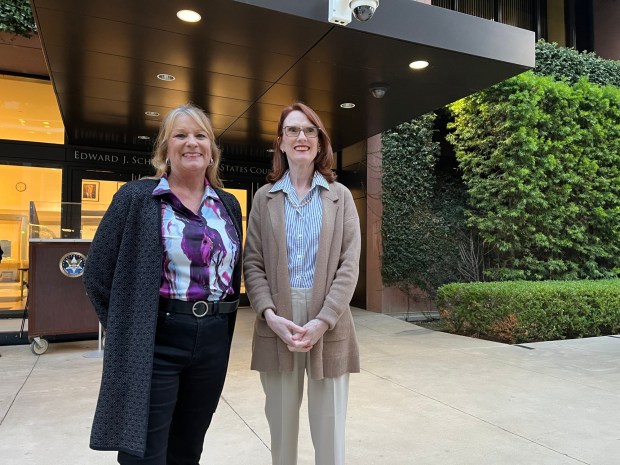 Lori Ann West, left, and Elizabeth Mirabelli, right, are two former Escondido Union School District teachers who sued the district and the state over policies that prohibited them from notifying parents of possible changes with their child’s gender. (Kristen Taketa / The San Diego Union-Tribune)
Paul Jonna, attorney for the plaintiffs, asked Benitez to declare that parents have a substantive due-process right to be informed if their child begins to identify as a different gender. Jonna also wants Benitez to bar schools from adopting policies requiring staff to keep such information from parents.
Jonna suggested schools should be required to seek parental consent before granting a student’s request to be called by different pronouns or names.
‘A compelling interest’
The California Department of Education used to tell schools on its website that parents and others must not be told about possible changes with their child’s gender at school without the student’s consent.
“Schools must consult with a transgender student to determine who can or will be informed of the student’s transgender status, if anyone, including the student’s family,” the education department’s former guidance stated.
But the department backtracked on that position this year, after the Escondido teachers’ lawsuit and after the passage of a related new state law.
In January, the state department replaced its old guidance with guidance about AB 1955, a law passed last year that prohibits schools from requiring staff to disclose anything to parents about a student’s sexual orientation, gender identity or gender expression without the student’s consent. The law does not bar schools from disclosing that information but rather bars them from requiring its disclosure.
Even though the directive to prevent disclosure is now gone from the state department’s website, attorneys representing state defendants argued Monday that changes to students’ gender status should be kept private unless the student consents.
The attorneys noted that appeals courts have ruled that parents don’t have a right to dictate school policies.
In a 2020 decision, for example, the Ninth Circuit ruled against parents who argued that letting a transgender boy use the boys’ bathroom violated students’ and parents’ constitutional rights. It said that parents’ due-process right to direct the care of their children does not include a fundamental right to direct the ways a public school educates their child, including its policies or curriculum.
Defendants’ attorneys also disagreed with the plaintiffs’ claim that not informing parents of changes to their children’s gender would violate free exercise rights.
Students who may be transgender should be allowed to come out to their parents on their own, and such news should come from the child, not the school, said Jennifer Bunshoft, an attorney with Bonta’s office who is representing the state defendants.
And attorneys said the state has an interest in preventing parents from, for instance, denying the use of a student’s requested pronouns at school, because schools are supposed to be inclusive environments.
“If a parent’s unilateral insistence that a teacher not recognize their child’s name and pronouns is objectively shown to students in that environment, that sends a message in that environment that transgender students are wrong, that they are not to be respected — and that is something the state has a compelling interest and indeed can stop the parents,” said Kevin Lee Quade, an attorney from Bonta’s office.
But Benitez interrupted him: “The message would be that, ‘No, young one, you have a lot of growing up. Your frontal cortex has not yet developed … You should listen to your parents.’ … What about that?”
It’s unclear when Benitez will issue a ruling on either motion.