
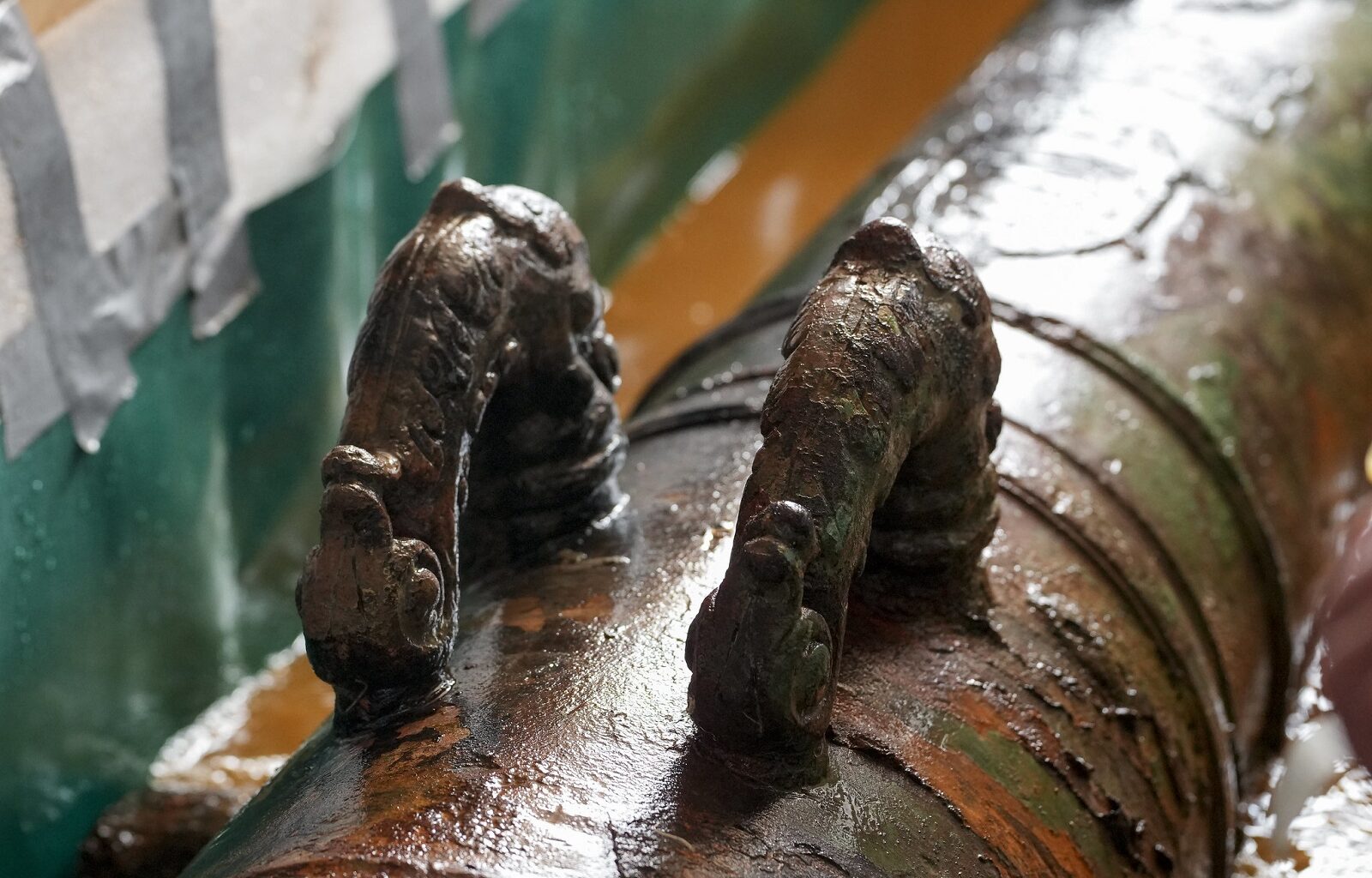
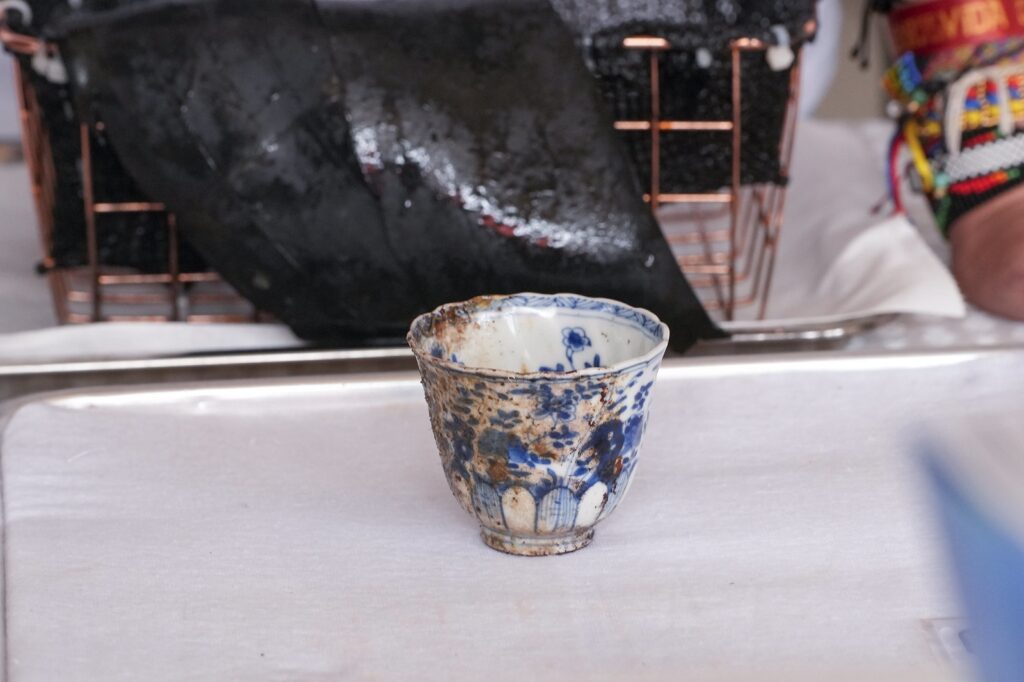
Colombia presented the first five pieces recovered from the San Jose galleon, which sank more than 300 years ago off the coast of Cartagena de Indias. Credit: Andrea Puentes / Presidency of Colombia.
A little more than three centuries after the sinking of the San Jose galleon off the coast of Cartagena de Indias, Colombia has announced the recovery of five archaeological objects submerged in the depths of the Caribbean.
This achievement was made in the second phase of the country’s scientific research project on underwater historical heritage, which President Gustavo Petro himself inaugurated this week. It is the most ambitious scientific and technological effort the country has undertaken to study its submerged cultural heritage.
The galleon was a Spanish ship that transported valuable objects, reportedly sunk on the night of June 8, 1708, after being struck by a cannonball from the invading British fleet commanded by Charles Wagner.
Three hundred and seventeen years later, the Colombian government officially presented the first five archaeological objects recovered from the Protected Archaeological Area of the San José Galleon, as part of the second phase of the project “Toward the Heart of the San José Galleon.”
Colombia recovers first artifacts from the San Jose galleon after three centuries
The extracted artifacts are not simple relics. They include a bronze cannon, a porcelain cup, three cob coins, as well as ceramic fragments and associated sediments.
These pieces were recovered using advanced underwater robotics technology deployed by the National Navy under strict protocols designed to safeguard both the heritage value and the integrity of the archaeological site.
Once brought to the surface, the objects were taken to a specialized laboratory at the Caribbean Center for Oceanographic and Hydrographic Research, where experts are working on their stabilization to adapt them to terrestrial conditions.
This effort is part of phase two of the national project called “Toward the Heart of the San Jose Galleon,” an alliance among the Ministry of Cultures, the Colombian Institute of Anthropology and History (ICANH), the Navy and the Maritime Directorate (DIMAR). In contrast with the initial stage, which was completely non-intrusive, there is now explicit permission for the studied collection of objects, always for research purposes.
ICANH highlights the importance of this project not only for understanding the shipwreck, but for deepening knowledge of the historical context of the eighteenth century. Thanks to prior surveying, it was confirmed that the archaeological context of the galleon remains intact, without human alterations, which reinforces the scientific legitimacy of the site. In addition, the area has been declared a Protected Archaeological Zone by the State, with a management plan aimed at preserving this legacy for at least a decade.
ICANH director Alhena Caicedo noted that these pieces will allow Colombians, through concrete objects, to connect with the history of the galleon, generating a sense of identity and belonging. For her part, the minister of Cultures stated that this development reflects the strengthening of Colombia’s technological and scientific capacity to protect its submerged cultural heritage.
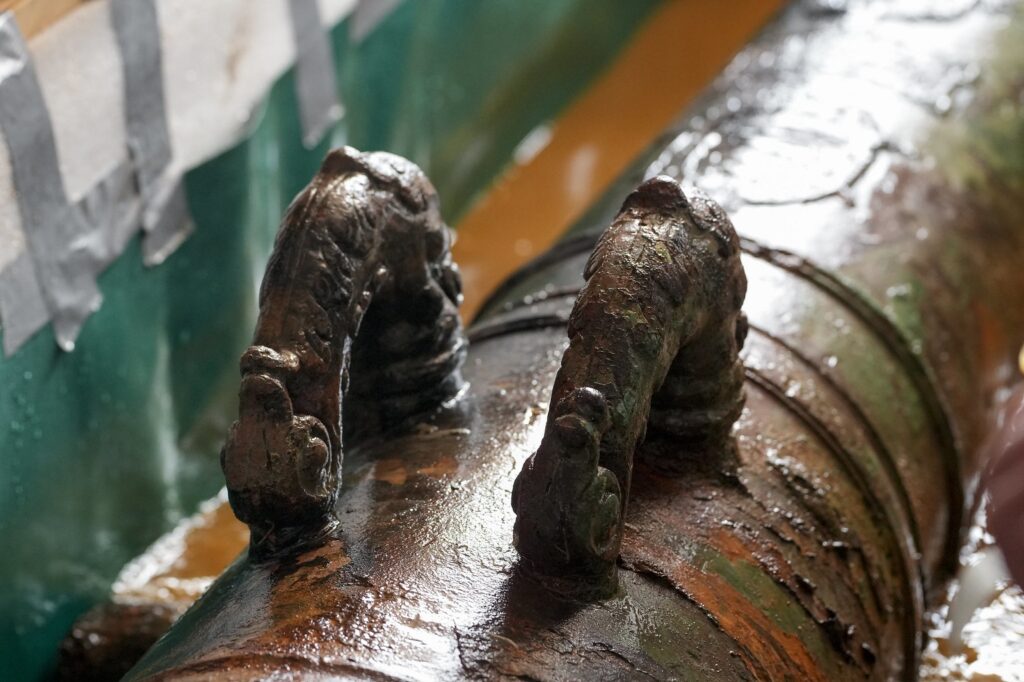
Among the five pieces recovered from the seabed is a cannon with an inscription revealing that it was manufactured in Seville, Spain. Credit: Andrea Puentes / Presidency of Colombia.
Technology and depth: a window into the past
The San Jose lies about 600 meters deep, an environment challenging even for sophisticated missions. The Navy has used unmanned underwater vehicles, such as Lynx robots, to explore the seabed with minimal impact. In previous expeditions, these tools made it possible to identify clusters of objects, confirm the integrity of the wreck, and map out the most promising areas for scientific recovery.
The interdisciplinary work includes archaeology, oceanography, conservation, and materials analysis. Archaeometric studies of the recovered pieces are expected to reveal details about their origin, their manufacture, their dating, and the role of the San José in eighteenth-century overseas trade.
Although the State’s approach is scientific, the project is not free of tensions. There is an underlying backdrop of legal and historical claims. On one hand, private firms have attempted to claim parts of the treasure; on the other, legal disputes have arisen, especially regarding the sovereignty of the galleon.
Nevertheless, both ICANH and the Colombian Government hold a clear position: the San José is cultural heritage, not simply an economic bounty. This perspective seeks to change the narrative: beyond the gold and gems, it is about preserving historical memory, contextualizing life on board, understanding colonial trade flows, and honoring the tragedy of that shipwreck that defined an era.
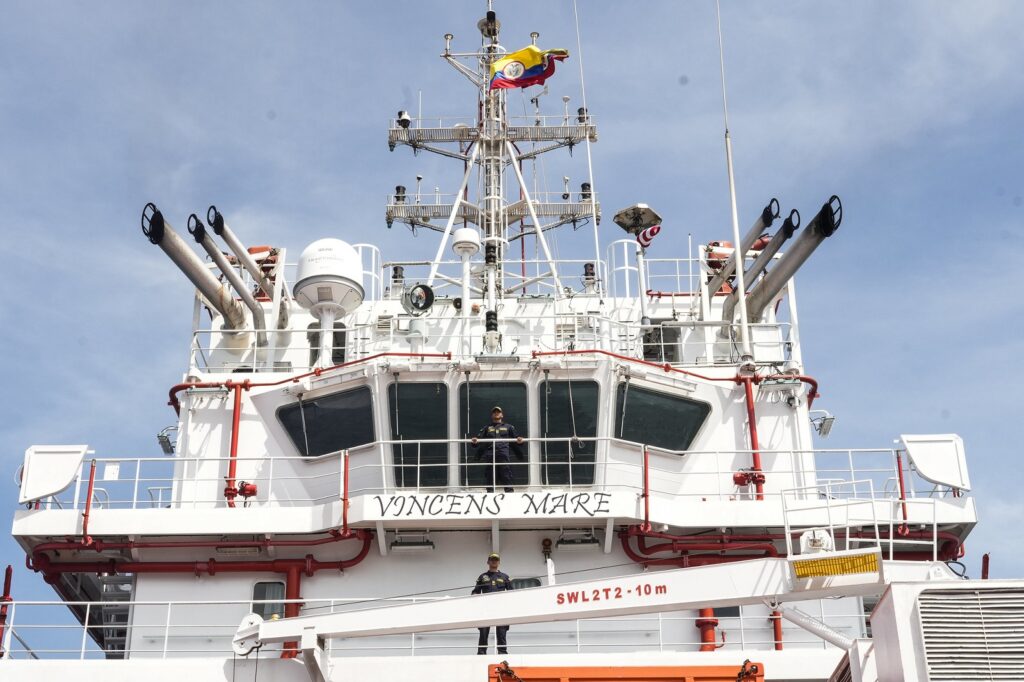
This week, the second phase of exploration began, during which the first five objects were recovered from the sunken galleon. Credit: Andrea Puentes / Presidency of Colombia.
Building Colombia’s memory by understanding its past
The recovery of these five pieces is only the beginning of a process that combines science, ethics, and education. With this mission, Colombia not only reaffirms its ability to carry out complex underwater operations, but also establishes a model for the responsible conservation of cultural heritage.
Moreover, by opening the door to public outreach, the State offers citizens a profound material testimony: the objects emerge from the shadows of the past to prompt questions about colonial trade, maritime violence, the routes of the Spanish Empire, and the symbolic value of heritage.
With both a scientific and social lens, the project “Toward the Heart of the San José Galleon” could become a benchmark for future similar missions aimed at preserving heritage without falling into commercial exploitation. The stated goal of this mission, according to its leaders, points in that direction: the reconstruction of collective narratives around a legacy that for centuries lay hidden beneath the waves.
This discovery promises not only to enrich the imaginary museum of national memory, but also to strengthen a homegrown scientific infrastructure capable of protecting, studying, and showcasing the secrets that lie in the depths of the Caribbean.
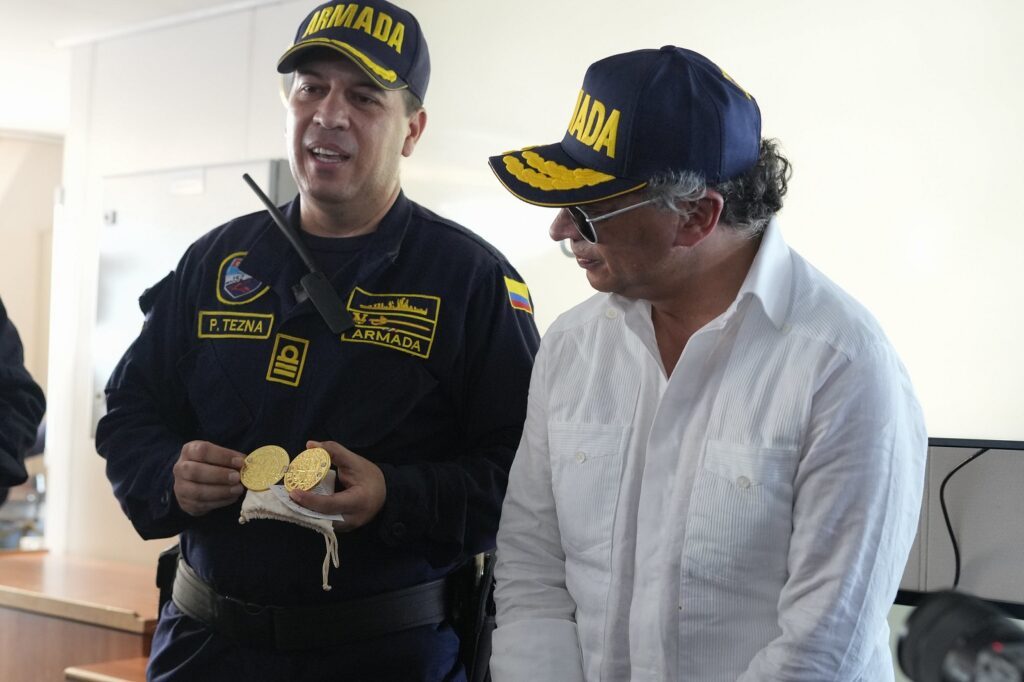
President Gustavo Petro was present during the rescue operation of the first five pieces of the San José galleon, which sank in 1708. Credit: Andrea Puentes / Presidency of Colombia.