
Renewable energy, water conservation, and a zero-waste commitment are among the methods Long Beach State has used to advance its sustainability efforts.
The university has strived for an eco-friendly campus for decades, making progress toward a 2030 goal of carbon neutrality for operational emissions and a 2040 goal for commute-related emissions.
However, buildings and construction projects have been identified as among the largest sources of greenhouse gas emissions by the UN Environment Programme. This means the Future U Project could put CSULB’s sustainability goals and accomplishments at risk.
To combat this, Beach Building Services has set standards to ensure the University Student Union renovation remains within the scope of its sustainability efforts.
Last May, the university received a STARS Silver Rating for its sustainability efforts. The STARS organization seeks to recognize and foster sustainability efforts in educational institutions, awarding them performance-based seals.
The seals are based on a range of criteria under campus operations, including, but not limited to, waste and water management, groundskeeping and energy usage.
CSULB improved by 17% from 2021’s score of 53.82 points, and by 19% from 2017’s 45.39 points.
To maintain these standards, Lisa Salgado, Capital Projects Program manager at Beach Building Services, said in an email exchange with the Current that the university is using many strategies to remain sustainable, including a low-carbon design.
“Nearly 90% of the existing building structure is being reused—an approach that avoids thousands of tons of embodied carbon typically associated with demolition and new construction,” Salgado said.
Additionally, a rooftop solar panel array on the new USU will seek to offset energy consumption as a part of their climate-responsive site design and energy stewardship, Salgado said.
CSULB is also following sustainable construction practices by monitoring disposed waste during construction.
“At least 75% of construction and demolition waste will be recycled or salvaged, diverting materials from landfills,” Salgado said.
This regulation also aligns with the Design Standards Manual developed by Beach Building Services.
The sustainability section of the manual requires contractors to submit a sustainable waste-management plan for university approval.
Salgado said these plans have already been submitted in accordance with the Design Standards Manual and will continue to be updated throughout the construction process.
In addition to university standards, CSULB must also follow the U.S. Green Building Council’s Silver Level building standard, as mandated by the CSU policy.
The LEED standard, or Leadership in Energy and Environmental Design, sets regulations for buildings to be considered “green.” These regulations consider energy performance, water efficiency, sustainable site development and materials selection.
According to the U.S. Green Building Council, to receive LEED certification, a building must earn points by meeting sustainability goals and criteria.
The number of points determines the type of certification awarded. CSULB currently has 10 LEED-certified buildings.
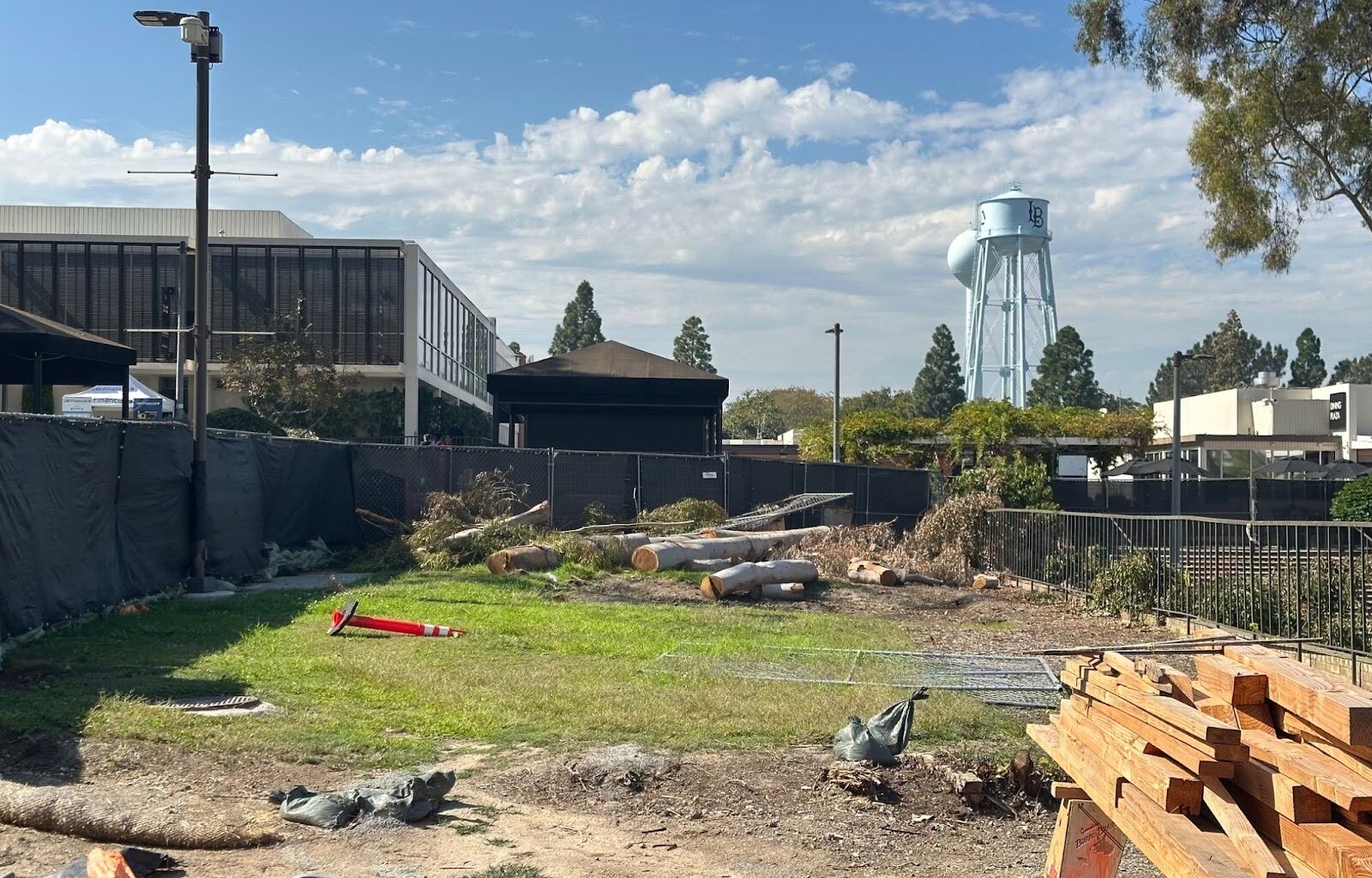
In regards to sustainable landscaping, the university’s urban forest has not been forgotten in the construction process.
Trees, especially mature trees, reduce carbon emissions and enhance water filtration. This makes them crucial to campus sustainability. The last recorded number of trees on campus was nearly 7,000.
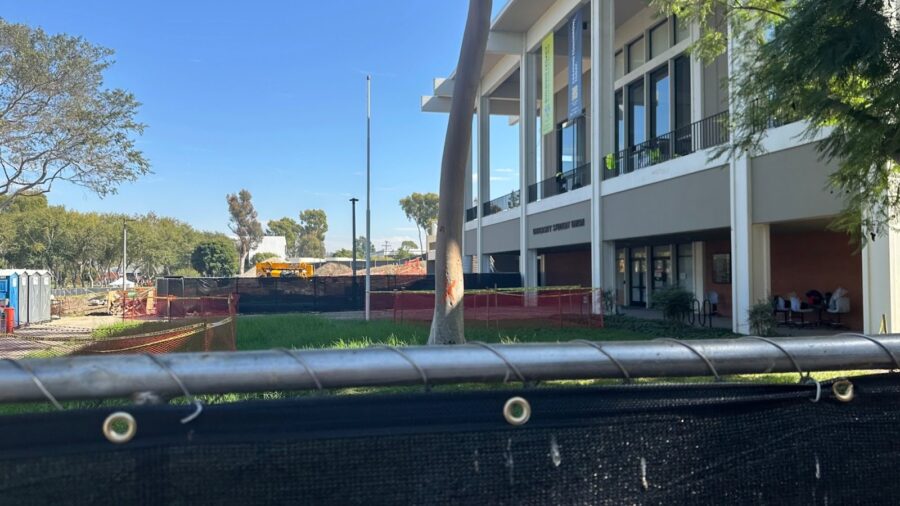
A tree marked for removal on the border of the University Student Union construction site on Oct. 21. Trees are removed on campus because of decay or if they pose a threat to people or infrastructure. Josh Gentle | Long Beach Current
Salgado said that while preserving existing trees near the USU is important, the university must remove trees that have been assessed as safety hazards.
Trees identified as a safety hazard are too sick to save or pose risks to people or property.
Several trees have already been removed during the renovation of the Friendship Walk Stairs. To offset the loss, Salgado said two trees will be planted for every tree cut down. This is in accordance with CSULB’s Climate Action and Adaptation Plan.
It is unclear how many trees have been cut during construction and how many will be planted, as the data is preliminary and will not be available until the design process for the Future U Project is completed, Salgado said.
As for the existing trees that will remain, the university requires an arborist to monitor the treatment of trees during construction.
The Current attempted to contact the arborist involved in USU construction, but was unable to secure an interview due to contractual agreements with the school.
The CSULB Master Plan Environmental Impact Report seeks to “advance the CSULB mission, vision, and values by guiding the physical development of the campus.” It outlines specifications and controls for contractors who are involved in construction to protect these biological resources.
While there have been extensive standards set in place by the university to combat the negative impacts of a large construction project such as the Future U, it is uncertain how it will impact the overall sustainability score for CSULB until the project is complete.
The current STARS silver rating is valid through June 5. 2027. The university is hoping for a gold rating next review period and is developing a roadmap to achieve that goal, sustainability manager Holli Fajack said in a campus press release.