
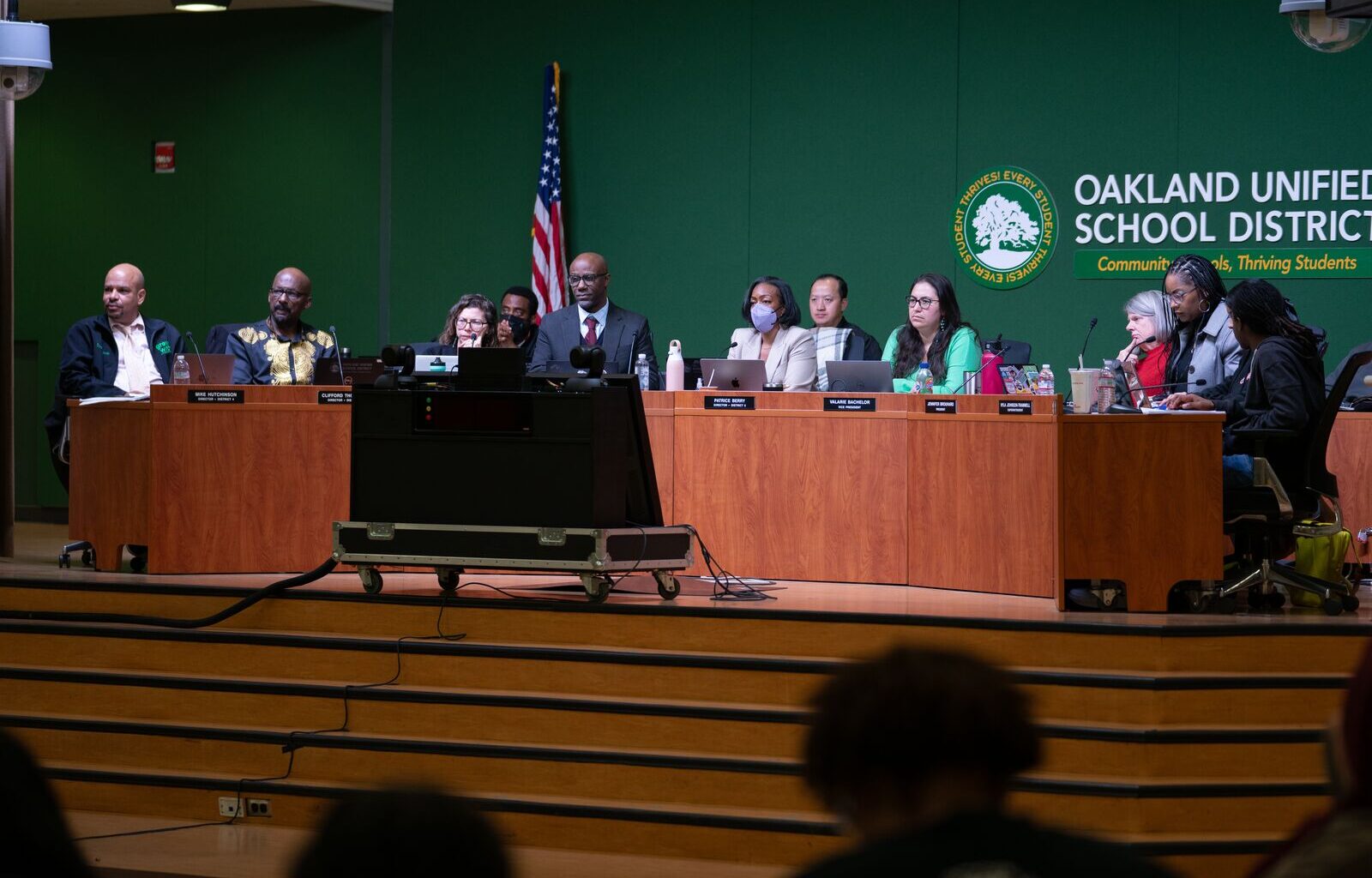
The Oakland Unified School District board has a tough road ahead to find consensus on how to trim $100 million from the budget for the 2026-2027 school year.
On Wednesday, the board and the public got their first look at two budget scenarios, each of which falls far short of the target amount needed to balance next year’s budget, roughly 20% of the general fund. The proposals mostly look to layoffs and restructuring at the central office. The first package would see reductions of about 54 positions at district headquarters, resulting in about $22 million in savings. The second package, which protects some key staff positions, would eliminate 48 positions, saving about $17 million.
Throughout the evening, district leaders and community members emphasized that the process would be painful.
“We are absolutely in a place where we have to do less with less,” said Dan Bellino, the district’s chief of staff who joined OUSD over the summer. “We can’t continue to keep doing the same work with less. These are not necessarily recommendations, but proposals to get to a balanced budget. We know these aren’t things that any of us actually want. But this is where we’re at.”
The board has until Dec. 10 to vote on a package of budget cuts.
“There’s no way to cut $100 million, roughly 20% of our unrestricted general fund, without significant pain,” said Denise Saddler, OUSD’s interim superintendent. “Our financial situation is genuinely urgent — we will fall back into state receivership, likely within two years, if we don’t make some changes. If we lose local control, the state will make decisions for us, and our community voice disappears.”
Saddler urged the board to work together, not to point fingers or lay blame, and to collaborate with the community on how to move forward.
She mentioned the Immigration and Customs Enforcement sighting earlier in the day in West Oakland near Hoover Elementary, where soon after an alert went out, hundreds of community members mobilized to patrol the school, act as escorts for students and families, and form picket lines.
“In a moment, everybody came together in service of our students and families,” she said.
‘The clock is ticking’
In October, the board, in a split vote, directed district staff to prepare two budget cut options that rely on restructuring the central office, which is home to departments such as academics, enrollment, finance, human resources, facilities, and labor. The resolution, introduced by Jennifer Brouhard and Valarie Bachelor, the board’s president and vice president, instructs staff not to consider school closures or mergers as a cost-saving measure, and to keep the cuts away from school sites. Those restrictions don’t leave much from which to cull $100 million.
The majority of OUSD’s unrestricted revenue comes from the state, through the Local Control Funding Formula. In OUSD, 60% of those dollars go directly to school sites — funding that the board does not want to touch.
Alameda County Superintendent Alysse Castro is keeping a close eye on the board’s decisions. The district left state receivership in July, after 22 years spent paying back a $100 million state loan. District leaders and community members warned that another takeover is looming if the board doesn’t come up with a sound plan.
“The clock is ticking,” said Mike Hutchinson, the director for District 4. “People want to call what’s going on now austerity measures … I guarantee you, if we take a loan from the state, they’re going to enforce every austerity measure because they’re not going to let us take 20 years to pay it back.”
OUSD’s chief academic officer, Sondra Aguilera, reminded the board that there will likely be reductions in federal funding, though that remains uncertain.
“We’re hearing that there will likely be a termination of Titles II through IV, and a reduction of 15% in Title I,” Aguilera said, referencing federal funds that support low-income students, immigrant students, and English learners. “So we need to be mindful of this when we’re thinking about services.”
While the school board majority has put school closures off the table, some community members pushed the board to consider them.
“You’re under immense political pressure, and this is a really tough decision, but we need to take a really hard look at our school footprint and think about whether the sites we’re operating are truly delivering for our students and whether this is the right way to do it,” said Emily Wasserman, the parent of a preschooler and a transitional kindergartener. “We need to have a conversation about restructuring, and we need to think about how we can do that in a way that is equitable and student oriented and serves our students.”
At the end of the evening the board approved a new amendment, introduced by Brouhard and Bachelor, that directs staff to put together additional plans that could produce deeper budget cuts: a plan to curb contracts and consultant spending, a plan to improve attendance, and a third budget scenario that has no restrictions, unlike the previous two. The amendment asks district staff to include state grants and leftover funds from local tax measures in plans to balance the budget. These options will be presented at the Dec. 3 and Dec. 10 school board meetings.
Director Hutchinson voted against the amendment and Patrice Berry, the director for District 5, was absent. Bachelor, who represents District 6, urged her colleagues and community members not to give into pessimism about the district’s financial situation.
“I want our community to really think about not buying into the doom loop, that we are doomed as a district, that we must go into receivership, that we cannot handle our own business,” she said. “We must persevere over that, and we must work together.”
“*” indicates required fields