
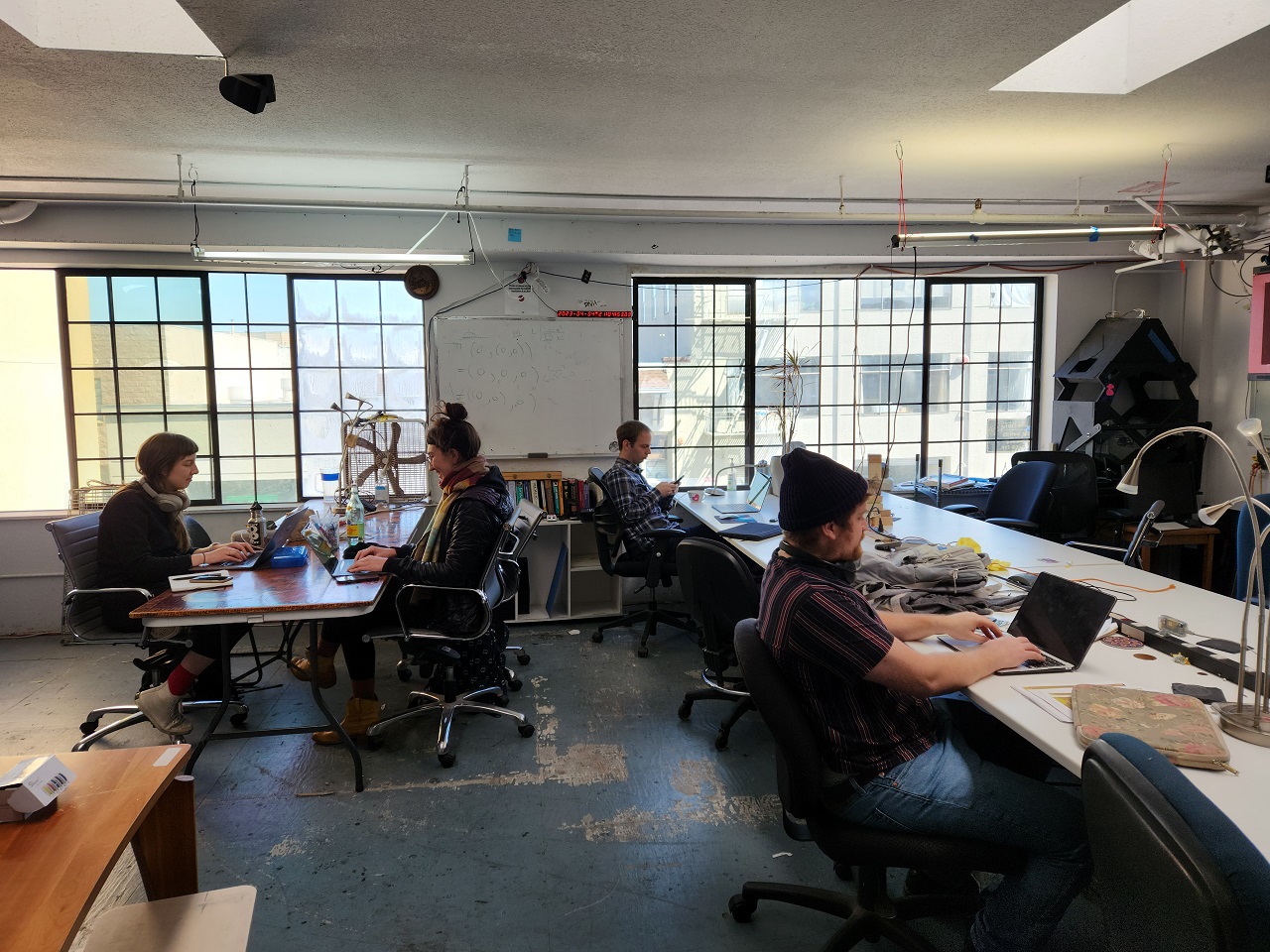
Anyone who walks through the gates of Noisebridge, a nondescript Mission District warehouse plastered with graffiti reading “Hack the Planet,” is “already a member,” says software engineer by day turned volunteer “hacker” by night Elan Hourticolon-Retzler. Unlike many of the other makerspaces that have sprung up around the city, there is no membership fee.
But that motto, which the self-described anarchist collective of tech-enthused coders, crafters, and science-fiction writers behind Noisebridge have lived by for nearly 20 years, is understandably difficult in one of the most expensive real estate markets in the country.
Like many non-profits, Noisebridge has experienced financial strain before. As recently as two years ago, when Mission Local toured the space, volunteers voiced concerns that they would need to raise a substantial amount of funding to keep the space free.
But in the five years that Retzler has volunteered there, this is the worst shape Noisebridge’s finances have ever been in, he says.
The hackerspace has funds to cover the next three months of expenses — about $12,000 a month. But if it doesn’t raise enough money by February, it may be forced to close its doors — or make some serious changes — like finally, after two decades, requiring a membership fee.
“One of our cornerstone goals has always been to never turn someone away for a lack of funds,” said Retzler. “We’re trying to be as open as possible and keep it going for as long as we can …. But we’re struggling to keep the lights on.”
Much of the recent hardship stems from a 2020 move from its former Mission Street spot to a new space on Capp Street. “We were all crammed on one floor,” said Retzler. The new spot, at 272 Capp St., is a big improvement — with two floors, there’s much more room for more organized, and increasingly ambitious projects.
But when it moved, Noisebridge discovered that the space hadn’t been properly permitted since 1995.
Many permits, a lot of time, and nearly $60,000 later, the group now has an upgraded electrical system, an ADA-compliant entryway, a wall to protect the rest of the space from dust produced by the building’s woodshop — and a $6,000 per month deficit.
That’s due to a steep decline in recurring donations Retzler attributes to recent tech layoffs and the popular woodshop being closed while the building was renovated.
Charging fees would help with those ongoing costs, but it would be a big adjustment. Retzler estimates that nearly 80 percent of Noisebridge’s members use the space for free. “Our goal is to be the neighborhood community-garage-classroom for people to learn new skills,” Retzler said. Everyone from students to recently laid-off tech workers flock to the space to learn wood-working skills, or use Noisebridge’s behemoth of a laser cutter.
Noisebridge is modeled after European hackerspaces like Metalab in Vienna or Berlin’s c-base: early-aughts era neon-light shrouded dens that conjure up images of cyberpunks hunched over very large computers. But it has also often been referred to as “the last free space” for tech-inclined creatives in San Francisco. Other makerspaces, like HumanMade, require a pay-per-use fee.
A poster taped to the door alerts members of Noisebridge’s impending financial crisis. Next to a QR code linking to Noisebridge’s donation page, (whatever you can!) was scrawled next to a statement urging a donation of $160 per month.
The poster, which states that Noisebridge will close by the end of the month if it doesn’t raise $50,000 by December, is a bit dramatic, says Retzler. But, putting up a dramatic sign without asking anyone else first is to be commended as an example of Noisebridge’s “do-ocratic” attitude — which the group defines as “doing excellent stuff” without needing the permission of other members.
For now, do-ocracy has led to a panoply of plans to save Noisebridge — a silent auction, plans to raise funds by using the space for classes, a fundraising drive (which has so far raised over $13,600), and hosting events in the space.
Noisebridge typically operates “fairly on the cusp of going out of business,” Retzler said. But this, said Retzler, is a whole new bug that is proving tough to crack. “Despite what we thought was reasonable financial planning,” said Retzler. “We got stuck in a place that is not quite so stable anymore.”