
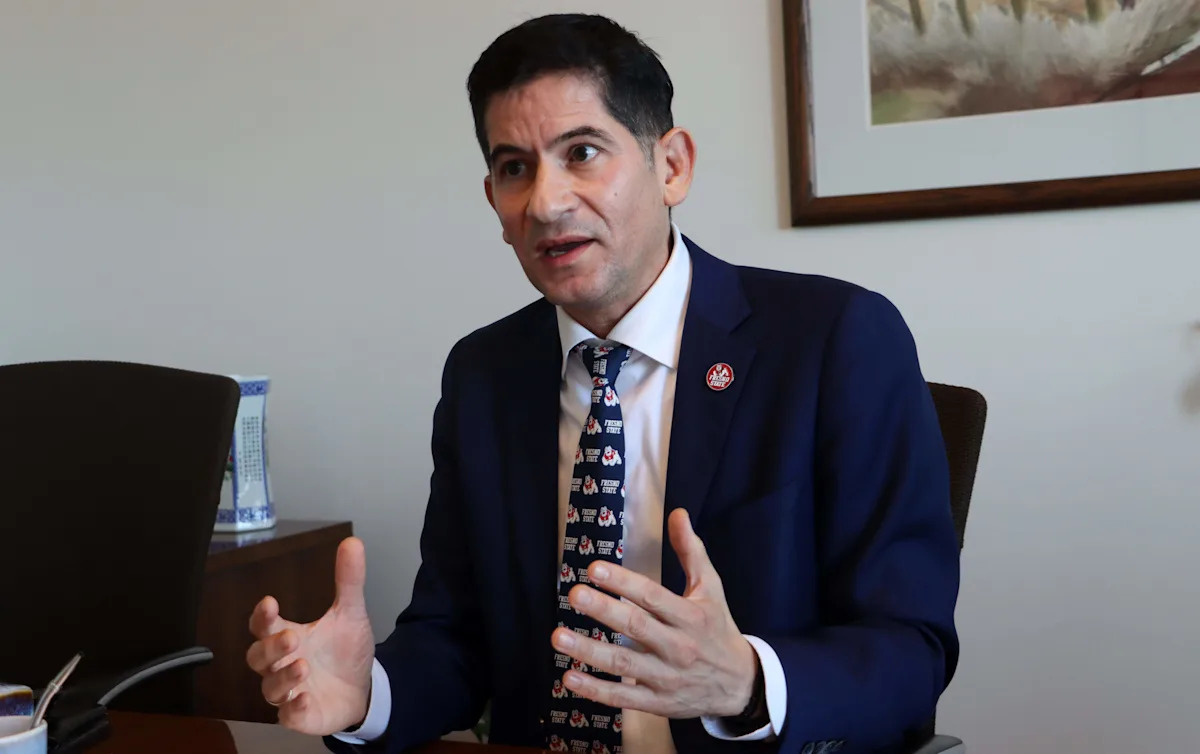
Fresno State president Saúl Jiménez-Sandoval is in line to receive a 10% increase in base pay to $523,617 after the California State University board of trustees approved an executive compensation plan that includes market-based pay, increased housing allowances, performances bonuses and deferred compensation.
The goal of the changes is to strengthen the CSU’s ability to recruit and retain high-level administrators – five campuses at this time have interim or acting presidents, according to its website.
But the increases come at a time the CSU is dealing with severe state budget cuts, resulting in layoffs on some campuses and cuts to academic programs and services. The pay increase plan was ripped by officials with the faculty and employees unions.
“CSU management has the money to increase executive compensation that would add to their future pension, but tell their staff we are not worthy of that,” California State University Employees Union president Catherine Hutchinson said, in a statement from the union. “For a place that loves to promote how diverse, inclusive and equitable they are, they sure know how to exclude the backbone of the system.”
Under the plan, Jiménez-Sandoval will have the fifth-highest base salary in the CSU system behind Cal Poly president Jeffrey Armstrong ($611,203), Cal State Northridge president Erika Beck ($563,012), San Diego State president Adela de la Torre ($559,805) and San Jose State president Cynthia Teniente-Matson ($546,066).
The CSU’s executive compensation plan also eliminated a board policy that allowed for only a 10% increase over the incumbent’s salary when a new president is appointed. That policy impacted the Fresno State president when he was appointed in January 2021.
Jiménez-Sandoval received the same salary as his predecessor, Joseph I. Castro, which the board at that time had determined lagged behind the market median by more than 26%. Jiménez-Sandoval received a 10% pay increase in May 2024 following his first triennial performance review in accordance with board of trustees policy, and a 16.1% equity pay increase in July 2024, which brought his base salary to $476,015.
With this latest increase, the salary of the Fresno State president will have increased by 50.3% since he was appointed.
Fresno State under Jiménez-Sandoval has seen its enrollment rebound after three down years . In the Fall 2025 semester, 24,992 students were enrolled at the university, fueled in part by first-time freshmen through the Bulldog Bound program and junior college transfers. Since hitting a high of 25,341 in the Fall 2020 semester, enrollment dipped in consecutive years to 24,946, 23,929 and 23,832, according to university records.
Fresno state faces a number of budget and other challenges, including deferred maintenance on campus buildings and infrastructure and an underfunded athletics department about to take a step-up from the Mountain West into a rebuilding and more competitive Pac-12 Conference.
The new compensation plan moves the CSU to a more market-driven approach, and provided base pay raises for 13 of its campus presidents. The performance bonuses for presidents of up to 15% of a base salary would not come from state funding, tuition or student fees, but the salary increases likely stretch further already tight state funding and tuition revenues.
The CSU last November merged one of its campuses, Cal Maritime, with Cal Poly due to financial issues and a declining enrollment. A number of campuses also have had layoffs, including Dominguez Hills and Channel Islands, and Sonoma State in January made broad-based cuts to faculty and staff and cut its athletics department, which competed at the NCAA Division II level.
“CSU executives are already taking home compensation packages that average half a million dollars a year, not including housing and car allowances,” California Faculty Association president Margarita Berta-Avila said, in a statement. “Meanwhile, the average faculty member earns roughly $71,000, and many make even less. In many parts of California, that isn’t enough to make ends meet, and many of our lecturers and other staff are making even less. The CSU board of trustees need to support funding for programs, infrastructure and faculty pay, not enriching themselves and the campus executives.”