
We had a family dinner the other evening at Perry’s on the Embarcadero. There were 10 of us, all with long connections to San Francisco. We hadn’t been together for a while so there was a lot of talk and catching up. Though our family has been in San Francisco for 170 years, we have moved around. It’s the old story – San Franciscans leaving San Francisco behind. Only two of us still live in the city.
San Francisco still looked the same to them: BART trains, streetcars in front of the Ferry Building, the silvery Bay Bridge lit at night. But they wondered about some things: the huge statue of the naked woman at the foot of Market Street, the herds of driverless cars. They don’t have 50-foot-tall women or robocars in the suburbs, or even in San Diego, where my daughter Lynn lives with her husband, Ken Murray.
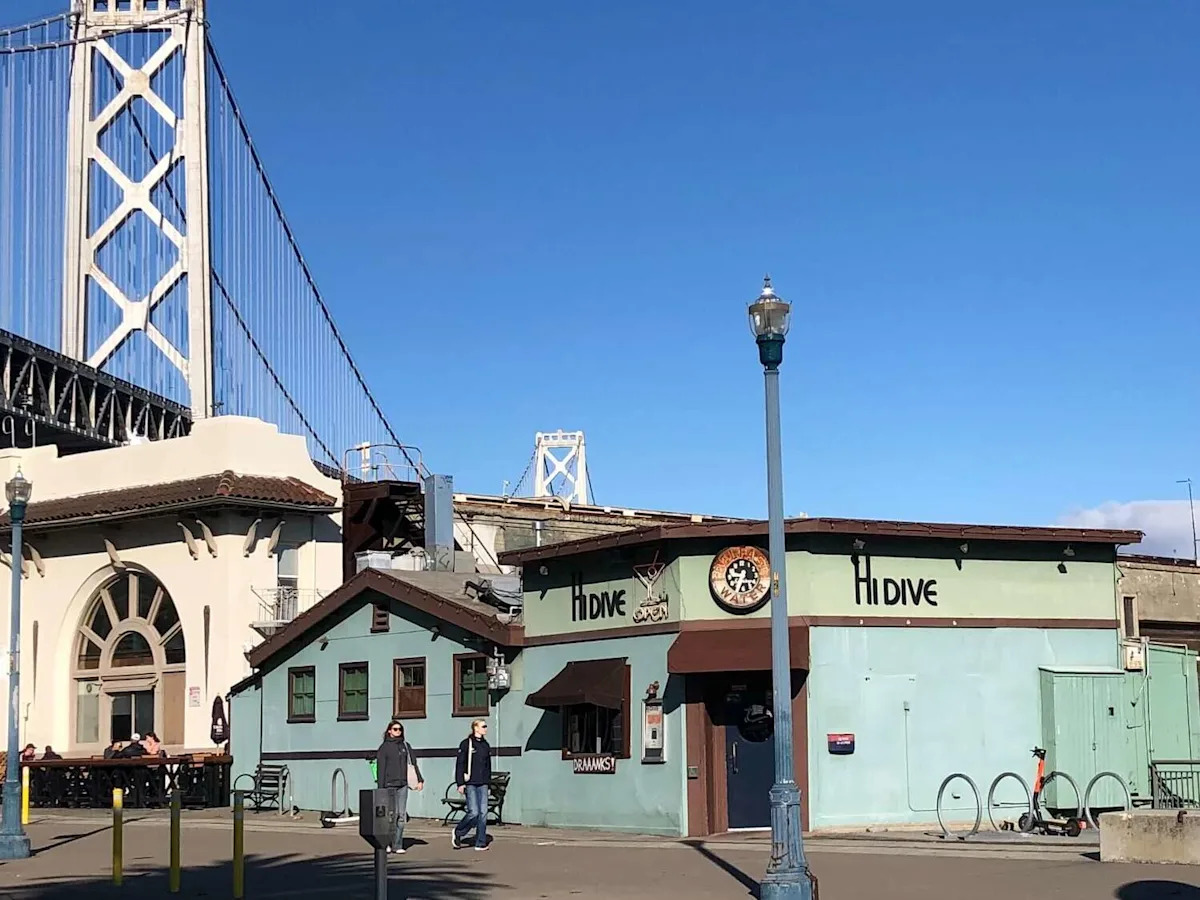
Dinner was over early, but the night was still young. Let’s go for a drink, Ken said. He suggested a place he’d found on the internet – the Hi Dive, a bar on the waterfront at Pier 28, only a 10-minute walk away.
One of the women, a fourth-generation San Franciscan who knows the city, shot me a glance. She didn’t say a word, but I could read that glance easily: you want to walk on the southern waterfront at night? Are you crazy? “Don’t worry,” I said aloud. “It will be all right. The city’s changed.”
It’s changed all right – but slowly, day by day. It’s like watching a glacier moving, a river of ice flowing without you noticing how it’s different.
We walked along the waterfront, the city on one side, the black bay waters on the other. I walked with the youngest of the women, my granddaughter, Sarah Lopez, telling her stories about shanghaied sailors, and fireboats, and tough old sailors and longshoremen, desperate dive bars, robbers in the shadows, waiting for drunks they knew had wads of cash. The waterfront was full of life and so tough, I said, that even tough guys stayed away at night. I worked down there myself when I was younger, unloading mail trucks, so I knew.
She listened politely, but I could tell she didn’t believe a word. The place looked as safe as San Diego.
As it turned out, the Hi Dive wasn’t the waterfront joint I remembered, but a neighborhood bar full of young people on a rainy Saturday night.
The Hi Dive is a landmark in its way, just under the San Francisco end of the Bay Bridge, next to the better known Red’s Java House. During baseball season, both places are full of fans walking to the ballpark. “It’s jumping then,” a longtime fan said.
In the offseason, it’s quieter. There are a lot of regulars, said Christal Davies, who is a waitress and sometime bartender. “People from around the neighborhood, and businesspeople for happy hour, office parties at the holidays.”
The Hi Dive serves drinks, of course, but also food – simple stuff, uncomplicated, burgers, chili, chicken wings, fish tacos. “We do bar food done right,” Davies said.
No extra charge for the view of San Francisco Bay, the lights of the Bay Bridge, the East Bay glittering on the other side. On a nice day, patrons can sit outside on the edge of the bay.
That part of the waterfront has a long history. Pier 28, the nearest ship dock to the Hi Dive, was built in 1912 and ’13 for Matson Navigation Co. freighters; later it accommodated ships from the American-Hawaiian Steamship Co., which had a fleet of two dozen freighters. Home port: San Francisco.
Chronicle file photos show as many as eight cargo ships tied up on this section of the waterfront in the 1940s. Not anymore. These days there is not a single active seagoing cargo ship on the Embarcadero.
Back in the day there was a small lunch counter at Pier 28½, and in 1935, a bar and restaurant called the Boondocks opened. It was a shot and a beer kind of place, popular with maritime workers; a bit raunchy in its day, famous for lingerie shows Friday afternoons.
The Boondocks and the working port faded away, then Pacific Bell Park opened in 2000 and changed everything. New management opened the Hi Dive in 2004.
Now regulars include people such as Michael Morris, who lives in the neighborhood. Morris and his husband, Scott Davidson, are at the Hi Dive at least once a week, drawn by the food and the friendly atmosphere.
Morris, an architect by trade, remembers coming to San Francisco a few years ago from New York. He liked the city, he said, but wondered whether it was the place for him. Those were days not so long ago when young people could come to San Francisco and try to figure the place out; if it worked, they’d stay. Morris had a timetable and six days before his deadline to go back East, and he got a job.
“So I stayed,” he said. I asked him about the past and how he’d seen San Francisco change, even in the past few years. Of all the places in San Francisco that have changed, I said, I thought the waterfront has changed the most. “That’s one of the things I like,” he said. “This is a city that constantly reinvents itself.”
This article originally published at This stretch of S.F.’s Embarcadero once entertained rowdy maritime workers. Things are different now.