
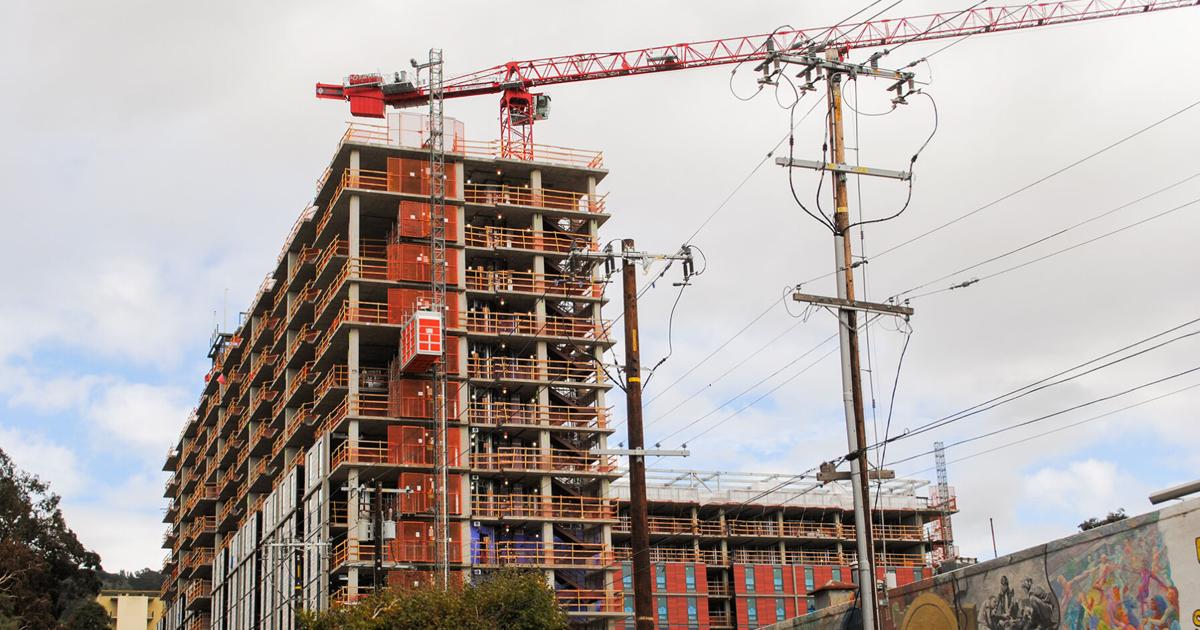
While construction of student housing on the former site of Berkeley’s People’s Park is well underway, UC Berkeley still lacks a developer or concrete public plan for its supportive arm, which was advertised to park advocates and residents as a key part of the plans.More than two years after a state appellate court ruling impeded progress on the development and the initial developer dropped out, a campus official suggested a change of plans.
Despite UC Berkeley’s claim that the permanent supportive housing development will contain approximately 100 apartments, campus Director of Local Government and Community Relations Ruben Lizardo said in a meeting last week he “assumes” the project will consist of 50 units of affordable housing and 50 units of permanent supportive housing instead.
Permanent supportive housing combines affordable housing, which ensures low-income households don’t spend more than 30% of their annual income on housing costs, with services for individuals and families who have histories of houselessness.
Communities that utilize this approach have a more than 90% success rate in avoiding a return to houselessness, according to Jamboree Housing Corporation, an affordable housing developer based in California.
Currently, UC Berkeley’s webpage for the People’s Park supportive housing advertises that the housing “will include approximately 100 apartments” and makes no mention of affordable housing.
An anonymous source familiar with the matter alleged a similar change in plans months before Lizardo’s statement at last week’s City / UC / Student Relations Committee special meeting.
“The university is backtracking on their commitment to 100% permanent supportive units and decreasing their total promised permanent supportive housing units,” the source alleged.
Campus spokesperson Kyle Gibson stated in an email that Lizardo was not speaking on campus’s behalf at the meeting and that the developer of the supportive housing will be the one making specific commitments regarding the unit count, which they will be able to do “only after they are officially onboard and their development process is underway.”
Although campus has not been able to find a developer for years, Gibson stated that campus is close to finalizing an agreement with a “soon-to-be-named” developer for the supportive housing.
According to campus spokesperson Dan Mogulof, the “supportive housing” will only be developed after construction for the student housing at People’s Park has been completed. This is because the land reserved for the supportive housing is currently “being used to support construction activities for the student housing project,” according to Mogulof.
“The university is not developing the supportive housing — we have made the commitment to provide land for the facility,” Gibson said. “It is the responsibility of the supportive housing developer to obtain funding, develop and construct the building, and to operate it.”
Last year, after a state appellate court ruling blocked campus from building both the student and the supportive housing on People’s Park, the developer for the supportive housing, Resources for Community Development, or RCD, pulled out of the project.
The lawsuit heard by the court was brought against campus and RCD by advocates who said the housing at People’s Park would introduce noise problems to the area, among other arguments. The ruling stated that the California Environmental Quality Act, or CEQA, required public agencies to submit an environmental impact review for proposed projects, and that the one submitted for the People’s Park project was inadequate.
The ruling has since been overturned by the California Supreme Court, which based its June 6 decision AB 1307, a law that limits the scope of CEQA.
“Requiring developers to consider who will inhabit the housing, and assess how noisy those residents might be, is inappropriate as a type of potential environmental risk requiring study under CEQA and opens a new pathway for costly and time-consuming lawsuits designed to delay and block housing development,” according to a statement by RCD.
Alice Conry and Paarth Mishra contributed to this report.